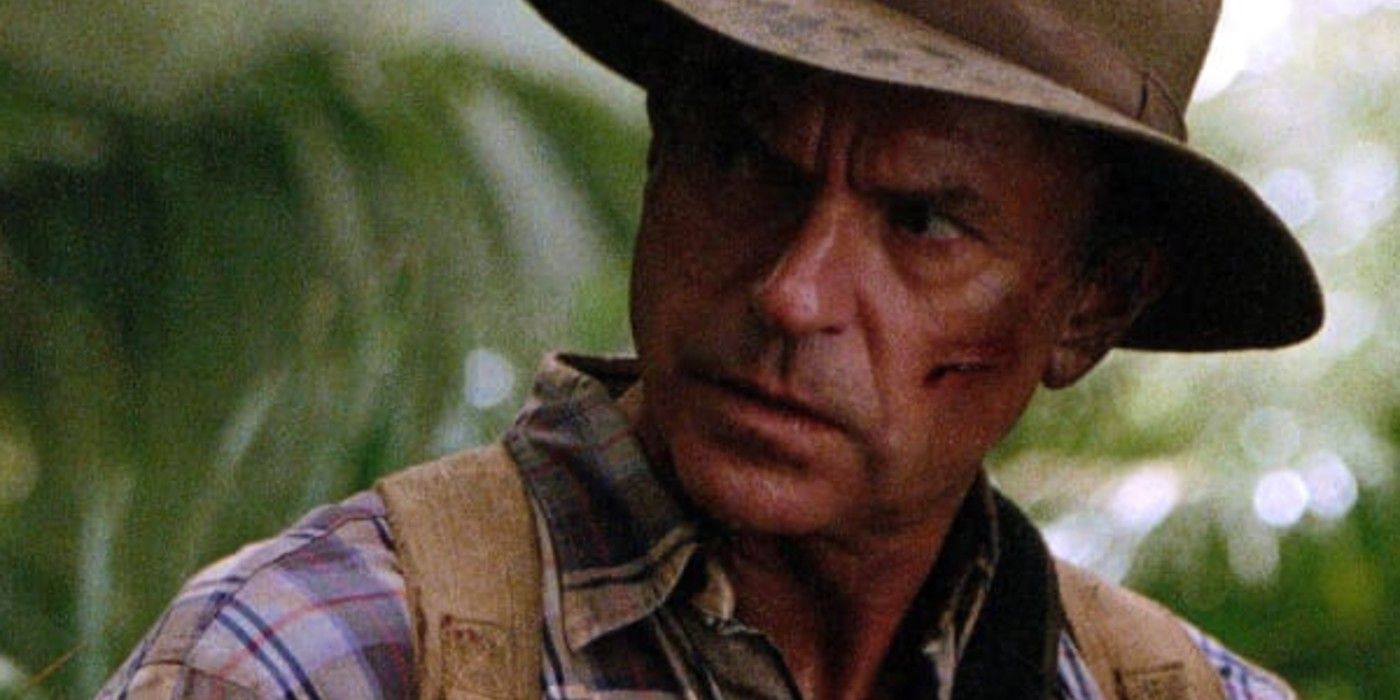
Dr. Alan Grant looks tired. Honestly, can you blame him? By the time we catch up with him in Jurassic Park 3, the guy has been through the ringer. He’s no longer the wide-eyed paleontologist we met in 1993, gasping at a Brachiosaurus. He’s cynical. He’s broke. And frankly, he’s a little bit over the whole "dinosaurs are majestic" thing.
Most people watch Alan Grant in Jurassic Park 3 and see a grumpy man who was tricked into a sequel. They see the "talking raptor" dream and cringe. But if you look closer, there’s a lot more going on with Grant’s psyche than just a simple rescue mission plot. He’s a man whose entire life’s work was rendered obsolete by a petri dish, and that changes a person.
The "Moot Field" Problem: Why Alan Grant Came Back
Let’s be real for a second. Why would Alan Grant, a man who barely survived Isla Nublar, ever get on a plane toward Isla Sorna? The movie tells us it’s for the money. Paul and Amanda Kirby—the ultimate "divorced energy" couple—promise to fund his research at Fort Peck Lake.
But there’s a deeper, sadder layer here.
In the world of Jurassic Park 3, traditional paleontology is dying. Grant mentions it during his lecture: people aren't interested in fossils anymore. Why look at dusty bones when you can see the real thing on the news? He’s a "relic," as some fans put it. He didn't just go for the check; he went because his field was starving. He was desperate to keep the "real" science alive in a world obsessed with InGen’s "theme park monsters."
It’s a classic conflict of the old guard vs. the new world. He hates the Isla Sorna dinosaurs. He doesn't even call them dinosaurs; he calls them "genetically engineered theme park monsters." That distinction is huge. It shows he hasn't lost his love for the actual animals that lived millions of years ago, but he has zero respect for the clones chasing him through the jungle.
The Billy Brennan Betrayal and the Raptor Eggs
The relationship between Grant and his protégé, Billy Brennan, is actually the emotional heart of the movie, even if it gets overshadowed by the Spinosaurus. Billy represents the "new" generation—enthusiastic, a bit reckless, and willing to take shortcuts.
When Billy steals those Velociraptor eggs, he isn't trying to be a villain. He’s trying to save their dig site. He thinks he’s being pragmatic. But for Grant, it’s the ultimate betrayal.
"Some of the worst things imaginable have been done with the best intentions."
That line from Grant hits hard. It’s not just about the danger the eggs put them in; it’s about the ethics. Grant spent his life trying to understand these creatures with respect. Billy treated them like a payday. The moment Grant tells Billy he’s "no better than the people who built this place," you see the bridge burn. It takes Billy’s "sacrifice" with the Pteranodons later for Grant to even consider forgiving him.
Let’s Talk About That Talking Raptor
We have to address it. The "Alan!" scene.
You know the one. Grant is on the plane, he falls asleep, and a raptor in a suit (okay, not a suit, but it might as well have been) speaks his name. It’s been a meme for decades. It’s often cited as the moment the franchise "jumped the shark."
But narratively? It actually makes sense.
Earlier in the film, Grant is trying to get Ellie’s parrot, Jack, to say his name. He’s obsessed with raptor vocalization and their intelligence. He’s literally just spent weeks theorizing that raptors could communicate better than primates. His nightmare is just his subconscious mash-up of his research and his trauma. It’s weird, yeah. But it’s not "supernatural." It’s a man with PTSD dreaming about the thing that haunts his career and his sleep.
The Raptor Resonating Chamber
This is where Alan Grant in Jurassic Park 3 actually shows his growth as a scientist. In the first movie, he’s a spectator. In the third, he’s an active participant in "dinosaur culture."
- He uses the 3D-printed resonating chamber (the "raptor flute") to communicate.
- He understands the social hierarchy of the pack.
- He realizes they aren't just killing for fun; they want their "babies" back.
When he returns the eggs at the end, he’s not just surviving. He’s negotiating. It’s a level of understanding he didn't have in the first film. He stopped seeing them as monsters and started seeing them as a tribe.
Was the Ellie Sattler Breakup a Mistake?
A lot of fans were gutted to find out Alan and Ellie weren't together anymore. Ellie is married to "Mark the State Department guy" and has kids.
It feels like a slap in the face to the ending of the first movie where Alan looks at the kids and then at Ellie, implying he's ready for a family. But honestly? It feels more human this way. Life is messy. Some people are just married to their work. Grant is a man of the dirt and the fossils. Ellie moved on; Alan stayed in the past.
Their phone call during the Spinosaurus attack is one of the best moments in the film. It shows that despite the breakup, there is a deep, unbreakable trust there. She’s the only person he calls when the world is ending. And she’s the one who sends in the Marines. That’s a different kind of love, and it’s arguably more interesting than a standard "happily ever after."
Survival Lessons from Dr. Grant
If you ever find yourself on an island of prehistoric clones, you could do worse than following Grant’s lead. His survival isn't about being an action hero. He’s not Owen Grady riding a motorcycle with raptors. He’s a guy who uses his brain.
- Don't trust the "experts" with the checkbooks. If someone offers to fund your research for a "flyover," they are lying. Every time.
- Understand the motivation. The raptors didn't want to eat them; they wanted the eggs. Knowing why an animal is attacking is more important than having a gun.
- Respect the power of communication. The "raptor flute" saved his life. Sometimes, "speaking the language" is better than running.
- Check your 6. Or in the case of the Spinosaurus, check the satellite phone's ringtone in the literal pile of dung.
Why JP3 Grant Still Matters
Jurassic Park 3 is often the "forgotten" sequel, but Alan Grant’s presence grounds it. He brings a weary, blue-collar academic energy that we haven't really seen since. He’s not a superhero. He’s a guy who just wants to dig in the dirt but keeps getting pulled into the chaos of human greed.
He ends the movie looking out the window of a helicopter, watching the Pteranodons fly away. He’s not smiling. He’s just observing. He knows that no matter how many fences we build or how many times we "rescue" people, the world has changed. The "dinosaurs" are back, and he’s just the guy who knew them when they were bones.
If you’re looking to dive deeper into the lore, I’d suggest re-watching the first fifteen minutes of JP3 specifically. Pay attention to his lecture. It sets up his entire motivation for the rest of the film—and his eventual return in Jurassic World: Dominion. He never stopped being that guy in the jeans and sneakers, and that’s why we love him.
Next time you watch, skip the memes and look at the man. He’s the most realistic character in a franchise full of monsters.
Actionable Insight: If you're a fan of the character's evolution, compare his "six-foot turkey" speech from the first film to his "smarter than primates" lecture in the third. It shows the transition from a man who uses fear to teach, to a man who uses science to respect the unknown.