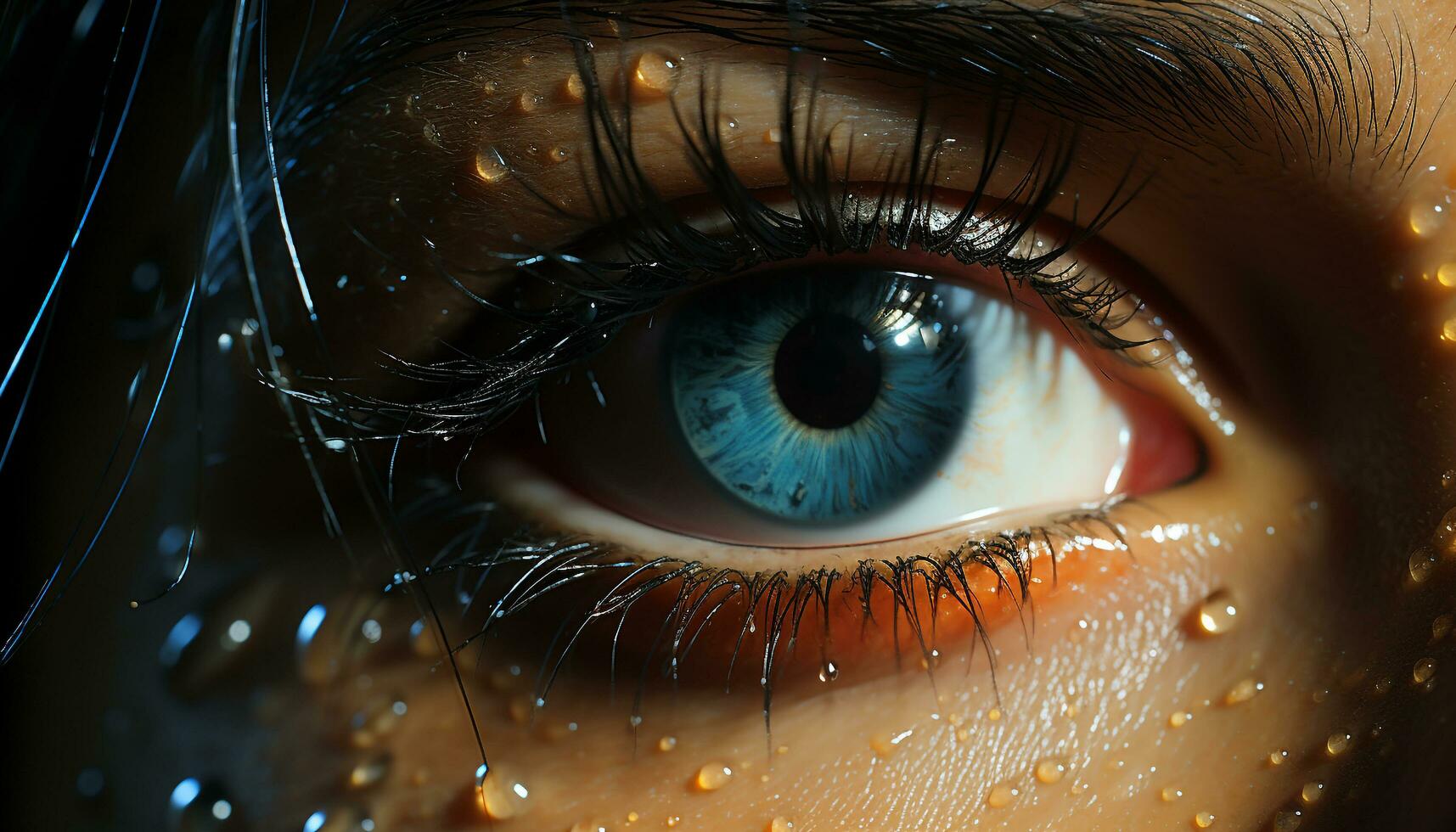
You’ve seen them. Those hyper-detailed, almost alien-looking shots of a human iris that look more like a nebula or a topographical map of a distant planet than a part of the human face. It’s wild. We spend our lives looking into people's eyes, yet we rarely actually see them. Most of us just notice the color—blue, brown, green—and move on. But when you get into the world of high-end macro photography, you start to realize that beautiful images of eyes are actually snapshots of the most complex tissue in the human body.
Macro photography has basically blown the doors off our understanding of facial aesthetics.
Honesty time: most "eye photos" on social media are heavily filtered. You’re looking at smoothed-out textures and boosted saturations that don't exist in nature. Real beautiful images of eyes are gritty. They show the "crypts of Fuchs," those tiny pits in the iris, and the contraction furrows that look like ripples in a pond. If you look at the work of photographers like Suren Manvelyan, you see that the eye isn't a flat disc. It's a landscape. It has mountains, valleys, and craters. It’s honestly a bit intimidating when you first see it up close.
The Science Behind the "Beautiful"
Why do we find certain eyes so much more striking than others? It isn't just luck. There’s a lot of biology at play. The limbal ring—that dark circle around the iris—is a massive factor. Research, including studies cited in Evolutionary Psychology, suggests that humans perceive a thick, dark limbal ring as a sign of youth and health. It creates a high-contrast border that makes the white of the sclera pop. When you’re looking for truly beautiful images of eyes, you’re often subconsciously looking for that specific contrast.
Then there’s the iris itself. It’s made of two layers: the stroma and the iris pigment epithelium. Blue eyes aren't actually blue. There’s no blue pigment in the human eye. It’s all physics. It’s called Tyndall scattering. It’s the same reason the sky looks blue. Light hits the stroma, bounces around, and the shorter blue wavelengths get scattered back at you. So, when you see a stunning photo of a blue eye, you're literally looking at a light show, not a paint job.
Capturing the Shot: It’s Harder Than It Looks
If you’ve ever tried to take a photo of your own eye with a smartphone, you know the struggle. It usually ends up being a blurry, watery mess.
To get those crisp, professional-grade beautiful images of eyes, photographers use dedicated macro lenses—think 100mm or even the specialized Canon MP-E 65mm which can magnify things up to five times their life size. Lighting is the real enemy here. The eye is a wet, curved mirror. It reflects everything. If you use a standard flash, you just get a big white blob in the middle of the pupil. Pros use ring lights or very specific off-camera softboxes to create "catchlights" that give the eye depth without obscuring the iris pattern.
And don’t even get me started on the "eye shake." Your eyes are constantly making tiny, involuntary movements called microsaccades. To get a sharp shot at 5x magnification, the subject has to be incredibly still, and the shutter speed has to be lightning-fast. It's a technical nightmare that results in something beautiful.
Common Misconceptions About Eye Color and Rarity
People love to argue about what the rarest eye color is. For a long time, everyone said green. Nowadays, many experts point to "red" or "violet" eyes, usually associated with forms of albinism, as the true outliers. But rarity doesn't always mean beauty.
What makes for truly beautiful images of eyes is often the presence of heterochromia or "sectoral" patterns. This is where one part of the iris is a completely different color than the rest. It’s a genetic fluke, but in photography, it’s gold. It breaks the symmetry. It gives the viewer something to investigate.
I’ve seen photos of "central heterochromia" where the center of the eye is gold and the outer edge is deep green. It looks like a sunflower. That kind of natural complexity is why we can’t stop looking at these images. We are hard-wired to look for patterns, and the iris is the ultimate pattern.
The Ethics of Editing
We have to talk about Photoshop. In the quest for beautiful images of eyes, many creators go too far. They remove every single red vein in the sclera. They make the pupil a perfect, ink-black circle.
The problem? It starts to look like CGI.
True beauty in eye photography comes from the imperfections. The tiny "freckles" on the iris (called Nevi) are actually quite common and add a layer of personality to the shot. When you scrub all of that away, you lose the "human" element. A high-quality image should show the texture of the moisture on the surface. It should show the slight irregularity of the pupil. If it looks too perfect, your brain instinctively flags it as fake.
How to Appreciate (and Take) Better Eye Photos
If you want to start capturing or even just curating better images, you need to look for three things:
First, the catchlight. Look at the reflection in the pupil. Is it a messy blob or a crisp shape? A good catchlight gives the eye "life." Without it, the eye looks "dead" or flat, like a doll's eye.
Second, the depth of field. In the best beautiful images of eyes, the iris fibers are sharp, but the eyelashes might softly blur out. This creates a sense of three-dimensionality.
Third, the color transitions. Look at where the brown meets the green or where the blue fades into gray. Nature rarely uses solid colors.
If you're a hobbyist, don't buy a $2,000 macro lens yet. Try a "reverse ring" for your existing camera or a clip-on macro lens for your phone. Use natural, indirect sunlight—like standing near a window—instead of your phone's harsh LED flash. You'll be surprised at what's hiding in your own reflection.
Why This Matters for 2026 and Beyond
As AI-generated imagery becomes the norm, the value of real, raw, beautiful images of eyes is actually going up. We are craving authenticity. We want to see the "biological fingerprint" that makes an individual unique. No two irises are the same—not even in identical twins.
Next time you see a close-up photo of an eye, don't just scroll past. Look at the architecture of the iris. Look at the way the light catches the moisture. It's a reminder that there's a whole universe of detail in the person sitting right across from you.
To take your appreciation further, start by observing eyes in different lighting conditions. Notice how the "color" changes from a fluorescent-lit office to a golden hour sunset. If you're interested in the technical side, look into the works of ophthalmic photographers—the people who take pictures of eyes for medical reasons. Their work isn't always meant to be "art," but the level of detail they capture is staggering and often more beautiful than anything you'll find on a stock photo site. Focus on the raw texture, avoid the over-saturated filters, and you'll find that the most striking images are the ones that stay true to the messy, complex reality of human biology.