Making a burger isn't exactly rocket science, but somehow we still manage to mess it up. We buy the "lean" beef because it feels healthier. We press the patty down with a spatula like we're trying to win a wrestling match. We treat the meat like a blank canvas for every spice in the pantry. Honestly? It's too much.
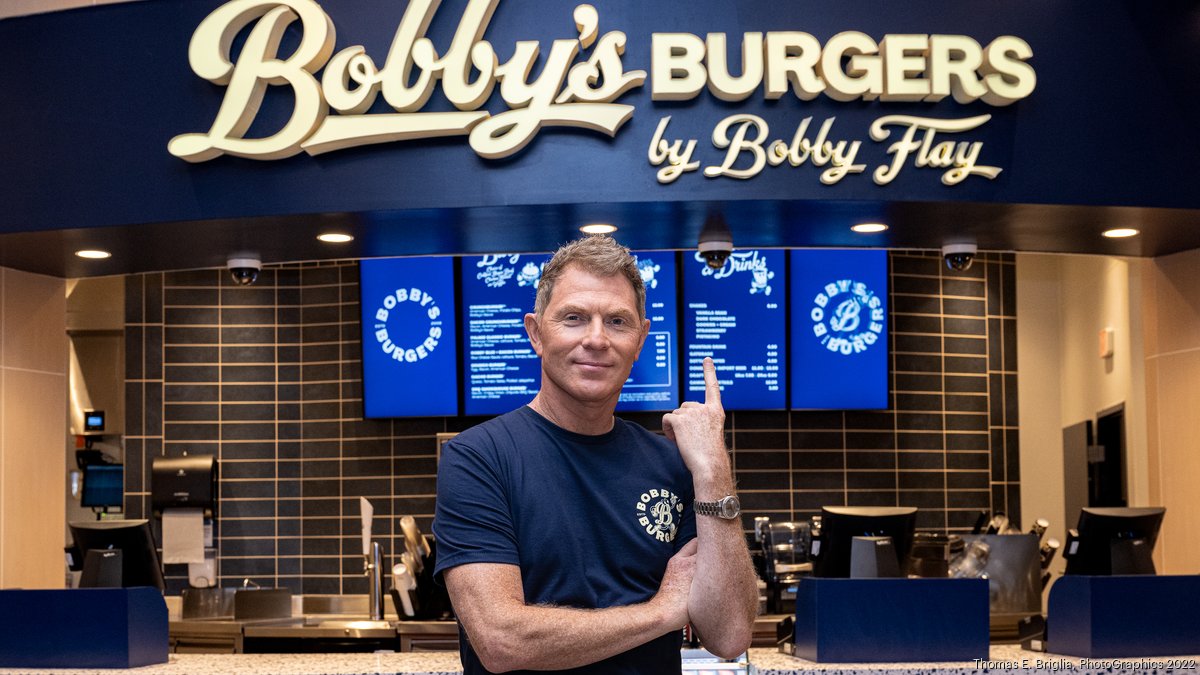
If you want to understand Bobby Flay’s best burger, you have to stop trying so hard. Bobby Flay has built an entire empire, Bobby’s Burgers, on a philosophy that basically boils down to one word: "Crunchify." But before we get to the potato chips—and yes, there are actual potato chips involved—we have to talk about the physics of the beef itself.
The 80/20 Rule Isn't a Suggestion
Let’s be real for a second. If you’re buying 90/10 ground sirloin for your burgers, you’re making a mistake. You're making meatloaf on a bun. Bobby Flay is very vocal about the fact that a truly great burger starts with an 80/20 ratio. That’s 80% lean meat and 20% fat.
Why? Because fat is where the flavor lives. It’s also what keeps the burger from turning into a dry, sad hockey puck the moment it hits the heat. He typically reaches for ground chuck. It has the right texture—coarse enough to have a "crumb" but fatty enough to stay juicy.
Most people over-handle the meat. They squeeze it, roll it into a ball, and pack it tight. Don't do that. You want to form the patties loosely. When you bite into Bobby Flay’s best burger, you should be able to see the individual grains of beef. If the patty is too dense, the heat can't penetrate properly, and the texture becomes rubbery.
The Thumbprint Trick
This is the one thing everyone forgets. As the meat cooks, the proteins tighten up and the burger starts to bulge in the middle. It turns into a "football" shape. Bobby’s fix is stupidly simple: use your thumb to make a deep depression, or a "well," in the center of the raw patty. As the burger cooks and expands, that well fills in, leaving you with a perfectly flat surface instead of a mound. It's a game-changer for stacking toppings.
Cast Iron vs. The Grill
Here is a hot take that might upset your backyard barbecue plans. Bobby Flay often prefers a cast-iron skillet or a flat-top griddle over an open-flame grill.
Why? Because of the "crust."
When you cook a burger on a flat surface, the meat cooks in its own rendered fat. This creates a gorgeous, salty, brown sear across the entire surface of the patty—not just where the grill marks are. This is called the Maillard reaction. It’s chemistry, but it tastes like heaven. He uses a high-smoke-point oil, like canola, and gets that pan screaming hot.
He also only flips the burger once. Seriously. Stop flipping it. Let it sit for three or four minutes, get that crust, flip it, and then don't touch it again until it's time for the cheese.
The Secret Ingredient is Actually... Water?
If you’ve ever watched Bobby Flay in a kitchen, you’ve seen him use a stainless steel bowl and a squeeze bottle of water. This is his "melt" technique.
He puts two slices of American cheese (he’s a purist about American cheese because of how it melts) on the patty. Then, he squirts a little water onto the hot pan and covers the burger with the bowl. The water turns to steam instantly, trapped under the bowl, and melts the cheese in about 30 seconds so it’s draped over the meat like a blanket. It’s the difference between a "cheeseburger" and a burger where the cheese is a fundamental part of the structural integrity.
What is a Crunchburger?
You can’t talk about Bobby Flay’s best burger without mentioning the "Crunchburger." This is his signature move. It’s basically a classic cheeseburger—usually with double cheese and a spicy horseradish mustard—topped with a massive handful of plain, salty potato chips.
It sounds like something a hungover college student would invent. Maybe it is. But the texture works. The softness of the brioche bun, the juiciness of the 80/20 beef, and the sharp, shattering crunch of the chips create a contrast that most burgers are missing.
He doesn't use fancy, kettle-cooked chips either. Just standard, thin potato chips. They need to be fragile enough to crush slightly when you take a bite, but sturdy enough to hold their salt.
The Topping Hierarchy
Bobby keeps it surprisingly simple. He usually goes with:
- Romaine lettuce: For the crunch (leaf lettuce is too wimpy).
- Beefsteak tomato: Thick-cut and seasoned with salt.
- Red onion: Thinly sliced.
- Horseradish Mustard: A mix of Dijon, prepared horseradish, and mayo.
He’s gone on record saying that if you put too many things on a burger, you can’t taste the beef. And if you can’t taste the beef, what are we even doing here?
How to Do This at Home Right Now
If you want to replicate this tonight, here is the roadmap. Don't skip steps.
- Get the right meat. Go to the butcher counter and ask for 80/20 ground chuck. Don't buy the pre-packaged stuff if you can help it.
- Season aggressively. Only use salt and pepper. No garlic powder, no onion flakes, no Worcestershire sauce in the meat. Just heavy salt and pepper on the outside of the patty right before it hits the pan.
- Heat your pan. Use cast iron. If you don't have one, get one.
- Don't touch it. Flip once. Use the water-and-bowl trick for the cheese.
- Toast the bun. A dry bun is a crime. Use a little butter and get it golden brown.
- The Crunch. Put the chips on last, right before the top bun goes on. If they sit there too long, they'll get soggy from the steam.
Bobby Flay’s approach isn't about being a "chef." It’s about respecting the basics. It’s about understanding that a burger is a sandwich, and a sandwich is only as good as its weakest layer. Keep the meat fatty, the pan hot, and the toppings crunchy.
Start by grabbing a cast iron skillet and a bag of plain chips. Once you have that sear down, you'll never go back to the "lean" patties again.