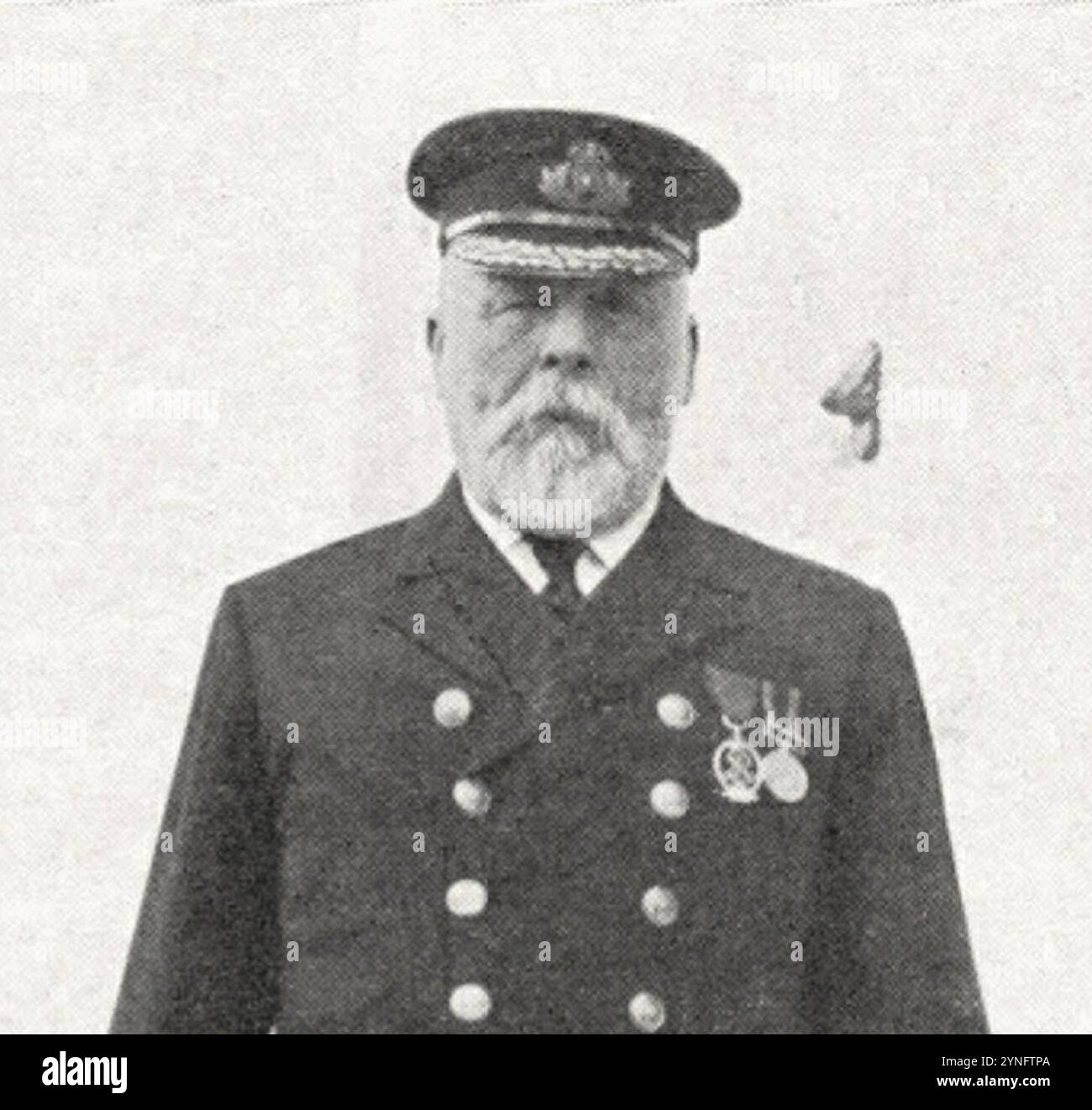
He was the "Millionaire’s Captain." That wasn’t just a catchy nickname some tabloid dreamed up. For the wealthy elite of the Edwardian era, if you weren’t sailing with Edward John Smith, you weren't really traveling. He was the safe pair of hands. The silver-haired, charismatic face of the White Star Line who had spent decades crossing the Atlantic without a single major catastrophe to his name. Until, of course, the one that defined him.
History has a weird way of flattening people into caricatures. To some, Captain Edward J Smith is the stoic hero who stood on the bridge as the water rose. To others, he’s the negligent mariner who ignored ice warnings because of corporate pressure. The truth is messier. It's buried under 12,000 feet of water and a century of myth-making.
Smith wasn't some rookie. He had 40 years of experience. He was the highest-paid sea captain in the world, earning about £1,250 a year—a massive sum in 1912. People loved him. He had this "safe" aura.
The Man Behind the White Beard
Born in Hanley, Stoke-on-Trent, Smith didn't come from maritime royalty. His father was a potter. He left school at 13 to operate a steam hammer at a forge. It’s a classic "bootstraps" story that we often forget when looking at his later, polished image. He eventually joined the White Star Line in 1880 as the Fourth Officer of the SS Celtic.
He climbed the ladder fast. By 1887, he had his first command.
He was a big guy, physically imposing but known for a quiet, gentle voice. This helped him navigate the egos of the Gilded Age's ultra-wealthy. If you were John Jacob Astor or Benjamin Guggenheim, you wanted to sit at Smith’s table. He was a social asset as much as a navigator.
Did He Actually Ignore the Ice Warnings?
This is the big one. The question that keeps Titanic buffs up at night.
On April 14, 1912, the Titanic received multiple wireless messages about ice. We know this for a fact. At 1:40 PM, a message from the Baltic reported "icebergs and large quantities of field ice." Smith showed this message to J. Bruce Ismay, the managing director of the White Star Line. Ismay allegedly put it in his pocket.
Was he reckless?
Honestly, by 1912 standards, not really. It sounds insane today, but the standard operating procedure back then was to maintain speed until you actually saw the ice. They believed that on a clear night, the lookouts would see the "ice blink" or the white foam at the base of a berg in time to turn. Smith wasn't being a maverick; he was doing what every other captain on the North Atlantic route was doing.
He did alter the ship's course slightly to the south, aiming for a "safer" track. But he didn't slow down. The Titanic was doing about 22 knots.
Then the night turned dead calm.
A flat sea is a nightmare for spotting ice. Without waves breaking against the base of an iceberg, there’s no white water to see. The air was freezing, the stars were out, and the ocean was a mirror. By the time Fleet and Lee saw the "black mass" from the crow's nest, the physics of a 46,000-ton ship were already working against them.
The Chaos of the Final Hours
When the iceberg struck at 11:40 PM, Smith was in his cabin. He felt the vibration. He was on the bridge almost instantly.
Thomas Andrews, the ship's designer, broke the news to him: the ship was "a mathematical certainty" to sink. Smith knew the math on the lifeboats. He knew there weren't enough. He knew roughly 1,500 people were going to die under his watch.
Some accounts from survivors describe Smith as being in a "state of shock" or "paralysis" during the evacuation. It’s a controversial take. Others saw him on the deck, megaphone in hand, directing the lowering of boats.
"Be British," he reportedly told the crew.
But there was a breakdown in communication. The boats were leaving half-empty. The Titanic had a capacity for 1,178 people in its boats, yet only 705 survived. That gap—those 473 lost seats—is a heavy burden on the man in charge. Smith didn't issue a general alarm immediately. He didn't use the public address systems (which were primitive but existed in some forms). He seemed to favor a quiet, orderly evacuation to avoid a "mad rush," but that silence might have cost lives by making the danger seem less urgent to the passengers.
How Did Captain Smith Die?
We don't actually know.
The most popular image—the one James Cameron used in the 1997 movie—shows him retreating to the wheelhouse and waiting for the windows to implode. It’s poetic. It’s dramatic. It might even be true.
But there are other accounts.
- The Heroic Rescue: Some survivors claimed they saw him in the water, holding a baby up to a lifeboat before slipping away.
- The Suicide Theory: One or two accounts suggested he shot himself, though this is widely dismissed by historians like Tim Maltin and others who have studied the testimony extensively.
- The Wave: Most likely, he was swept off the bridge by the "bridge wave" when the ship took its final plunge.
His body was never recovered.
The Legend vs. The Reality
Smith was supposed to retire after this voyage. This was his "retirement cruise." That adds a layer of irony that almost feels too scripted for real life.
There's a statue of him in Lichfield, England. The inscription says he died "leaving to his countrymen a memory of a quiescent spirit, a boyish heart, and a desire to live and die as a gentleman."
It’s easy to judge him with 20/20 hindsight. We have GPS, radar, and satellite imaging now. We forget that in 1912, the Titanic was the pinnacle of technology. Smith believed the ship was essentially its own lifeboat. He wasn't a villain. He was a man who stayed within the comfort zone of his era's arrogance.
He was a victim of a system that prioritized luxury and schedule over the cold, hard realities of the North Atlantic.
Why Edward J. Smith Still Matters in 2026
We still talk about him because he represents the ultimate responsibility. The captain goes down with the ship. It’s one of the few ancient codes we still respect. In an era of corporate finger-pointing and "passing the buck," there is something hauntingly dignified about a man who stays at his post when he knows the end is coming.
But we should also see him as a warning.
He was the expert. He was the "master." And he was wrong. He let his past successes—decades of safe crossings—blind him to the specific risks of that April night. It's a classic case of "normalcy bias."
Understanding the Legacy
If you're looking to dive deeper into the history of Captain Edward J. Smith, don't just watch the movies. Look at the British and American Inquiry transcripts.
- Read the Testimony: The Senate Inquiry led by William Alden Smith (no relation) is eye-opening. You can see the struggle to define where Smith’s responsibility ended and the White Star Line’s began.
- Visit the Memorials: If you're ever in Southampton, the Titanic Engineers' Memorial and the Captain Smith statue in Lichfield provide a somber look at how he was mourned.
- Evaluate the "Speed" Myth: Research the "Blue Riband." While many believe Smith was trying to break a speed record, the Titanic actually wasn't fast enough to beat the Mauretania. He was likely just trying to arrive on Tuesday night instead of Wednesday morning to impress the press.
The story of the Titanic is a story of human error, and Edward J. Smith is the human at the center of it. He was a man of his time—brave, professional, and tragically overconfident.
He didn't survive to defend his choices, which means he belongs to history now. And history is rarely as black and white as a captain’s uniform.
To truly understand the maritime culture Smith lived in, look into the "Safety of Life at Sea" (SOLAS) conventions that were created directly because of his ship's failure. Every time you step on a cruise ship and see enough lifeboats for everyone, you're seeing the legacy of Smith's greatest mistake.
Study the transition from sail to steam. Smith lived through that entire evolution. He saw the world change from wood and canvas to 50,000 tons of steel. That context matters. It explains why a man might feel invincible in the face of nature.
Stop looking for a hero or a villain. Look for the man.