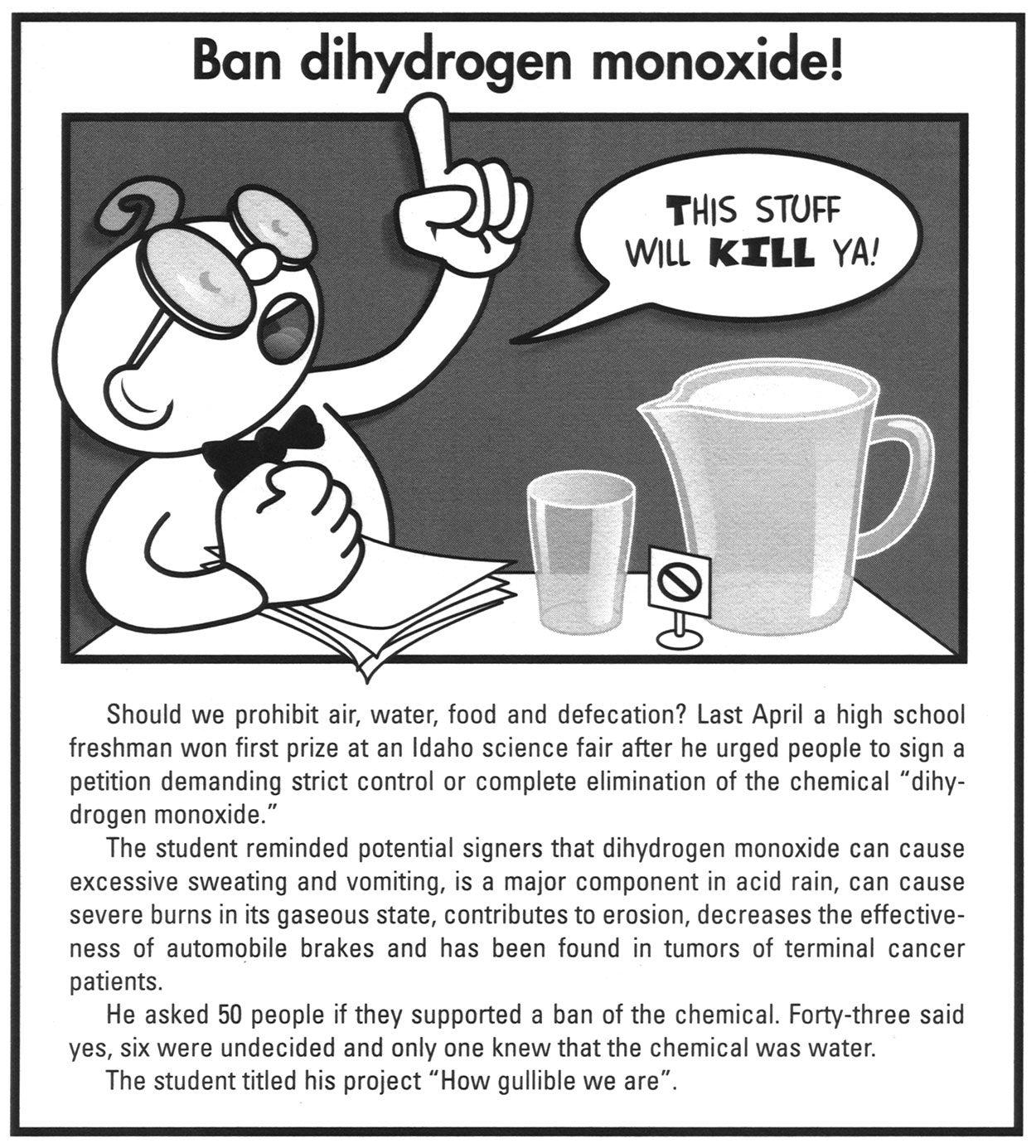
You've probably seen the warnings. They’re everywhere online, usually shared by someone who looks genuinely terrified. The warnings claim that dihydrogen monoxide is a colorless, odorless chemical compound. It's found in our rivers. It's in our food. If you inhale it, you die. It sounds like a massive environmental scandal or a government cover-up.
But it isn't.
Actually, it's just water. That's the whole joke. The chemical name $H_2O$ literally translates to dihydrogen (two hydrogen atoms) monoxide (one oxygen atom).
This is perhaps the most successful "rationality test" in internet history. It works because it uses factual, terrifying-sounding language to describe something mundane. It exploits our lack of scientific literacy and our very human tendency to panic when we hear "chemical" names. Honestly, it’s a brilliant bit of social engineering that teaches us more about psychology than chemistry.
Why Dihydrogen Monoxide Sounds So Scary
The prank works because every single "danger" listed is technically true.
Think about it. If I tell you that dihydrogen monoxide is a major component of acid rain, I'm not lying. Water is the primary medium in which the sulfur and nitrogen oxides react to form acid rain. If I say it causes "severe burns" in its gaseous state, I’m talking about steam. If I mention it’s found in the tumors of terminal cancer patients, well, water is in every cell of the human body.
The trick relies on chemophobia.
We’ve been conditioned to think that long, Latinate names mean "toxic." We assume that if something is used as an industrial solvent, it shouldn't be near our sandwiches. Yet, water is the "universal solvent." It dissolves more substances than any other liquid on Earth.
It’s kinda funny, right? We’re 60% water, yet we can be convinced to sign a petition to ban it if the framing is scary enough.
The Famous 1997 Science Fair Project
The most famous instance of this happened in Idaho. A 14-year-old student named Nathan Zohner conducted a science project titled "How Gullible Are We?" He gave 50 of his classmates a report on the dangers of dihydrogen monoxide.
He told them it could cause excessive sweating, vomiting, and that it was a "major component of acid rain."
The results were staggering.
Forty-three out of fifty students voted to ban the substance. Only one person figured out he was talking about water. This became known as "Zohnerism"—the use of a true fact to lead a scientifically illiterate public to a false conclusion. It’s a phenomenon that remains incredibly relevant in an era of "fake news" and viral TikTok health scares.
Real-World Consequences of the DHMO Hoax
While it’s mostly a joke used to mock alarmists, it has caused real-world panic.
In 2004, officials in Aliso Viejo, California, almost considered banning foam cups after a paralegal read a "warning" about dihydrogen monoxide being used in their production. They were ready to put it on the city council agenda. They actually thought it was a dangerous additive.
A similar thing happened in 2013 on April Fool's Day. Two radio DJs in Florida told their listeners that "dihydrogen monoxide" was coming out of their taps. People panicked. The police had to get involved. The DJs were suspended.
It wasn't because they lied.
It was because they told the truth in a way that people didn't understand. It highlights a massive gap in our education system. We teach kids to memorize the periodic table, but we don't always teach them how to parse information or recognize when they’re being manipulated by jargon.
The Chemistry of the Name
Technically, "dihydrogen monoxide" is a valid IUPAC name for water, though it's rarely used by actual chemists. They prefer "oxidane" or just, you know, "water."
- Hydrogen is the most abundant element.
- Oxygen is what we breathe.
- Put two of one and one of the other together, and you get the basis of all life.
If you want to be a real nerd about it, you could also call it "hydric acid" or "hydroxyl acid." Both sound even more terrifying. Imagine a headline: "Hydric Acid Found in Baby Formula." People would lose their minds. But it's just the stuff you put in a kettle.
How to Spot This Kind of Manipulation
The dihydrogen monoxide prank is a "canary in the coal mine" for modern misinformation. If you can be fooled by this, you can be fooled by anything involving "toxins" or "chemicals."
The first step to not getting tricked is to look for "scare quotes" and appeals to emotion. If a post says something is "linked to" or "found in" something scary, ask yourself: What is the concentration? and What else is this used for? Everything is a chemical.
Everything.
The air you breathe is a mixture of nitrogen, oxygen, and argon. The "organic" apple you bought is a complex cocktail of chemicals like cyanidin and malic acid. The dose makes the poison. Even water—yes, dihydrogen monoxide—can kill you if you drink too much of it (water intoxication) or if you try to breathe it (drowning).
The Role of E-E-A-T in Science Communication
In the world of Google rankings and expert authority, "Experience, Expertise, Authoritativeness, and Trustworthiness" (E-E-A-T) are everything. This prank is basically an E-E-A-T test for the reader.
True experts don't use scary jargon to hide simple truths. They do the opposite. They take complex ideas and make them accessible. When you see a "health influencer" using long, scary-sounding words to sell you a detox, they are basically doing the dihydrogen monoxide prank, but with the intent to take your money instead of just making a point about science literacy.
What This Teaches Us About Public Policy
The DHMO hoax has even reached the halls of government.
In 2007, a member of the New Zealand Parliament fell for it. In 2001, a staffer for an Australian MP did the same. These are people who make laws. It’s a reminder that we need more scientists in government, or at least better advisors.
When we lack a basic understanding of chemistry, we become easy targets for lobbyists and fear-mongers. We might ban things that are harmless while ignoring actual risks. For example, people might freak out about a tiny amount of "dihydrogen monoxide" in a vaccine but ignore the very real risks of not getting vaccinated.
Practical Steps to Avoid Being Tricked by Jargon
The next time you see a viral post about a "dangerous new chemical," do these things:
- Search the IUPAC name. If the name sounds weird, Google it. You'll likely find out it's something common like salt, baking soda, or water.
- Check the source. Is the warning coming from a peer-reviewed journal or a Facebook group with "Truth" in the name?
- Assess the mechanism. How exactly is this chemical supposedly killing you? If the explanation is vague—like "it disrupts your energy"—it’s probably nonsense.
- Look for the "dihydrogen monoxide" red flags. Does the list of dangers include things like "found in the cooling systems of nuclear power plants"? That's a classic sign of the DHMO prank.
Science is meant to be understood, not feared. The dihydrogen monoxide story isn't just a funny prank from the early days of the internet; it's a vital lesson in critical thinking. It teaches us that truth can be used to deceive and that a little bit of knowledge can be a dangerous thing if it isn't paired with context.
Keep your water cold, your skepticism high, and always check your formulas.
Actionable Next Steps
- Audit your social media feed: Look for "fear-based" science posts and research the chemical names mentioned. You’ll be surprised how often common substances are vilified.
- Read "The Demon-Haunted World" by Carl Sagan: This book is the gold standard for learning how to spot pseudoscience and "baloney."
- Brush up on basic nomenclature: Spend ten minutes on a chemistry site learning the prefixes for chemical names (mono, di, tri, tetra). It’s the easiest way to demystify scary labels.
- Share the joke: If you see someone panicking over a "chemical" in their food, gently introduce them to the dihydrogen monoxide prank. It’s a great way to start a conversation about science literacy without being condescending.