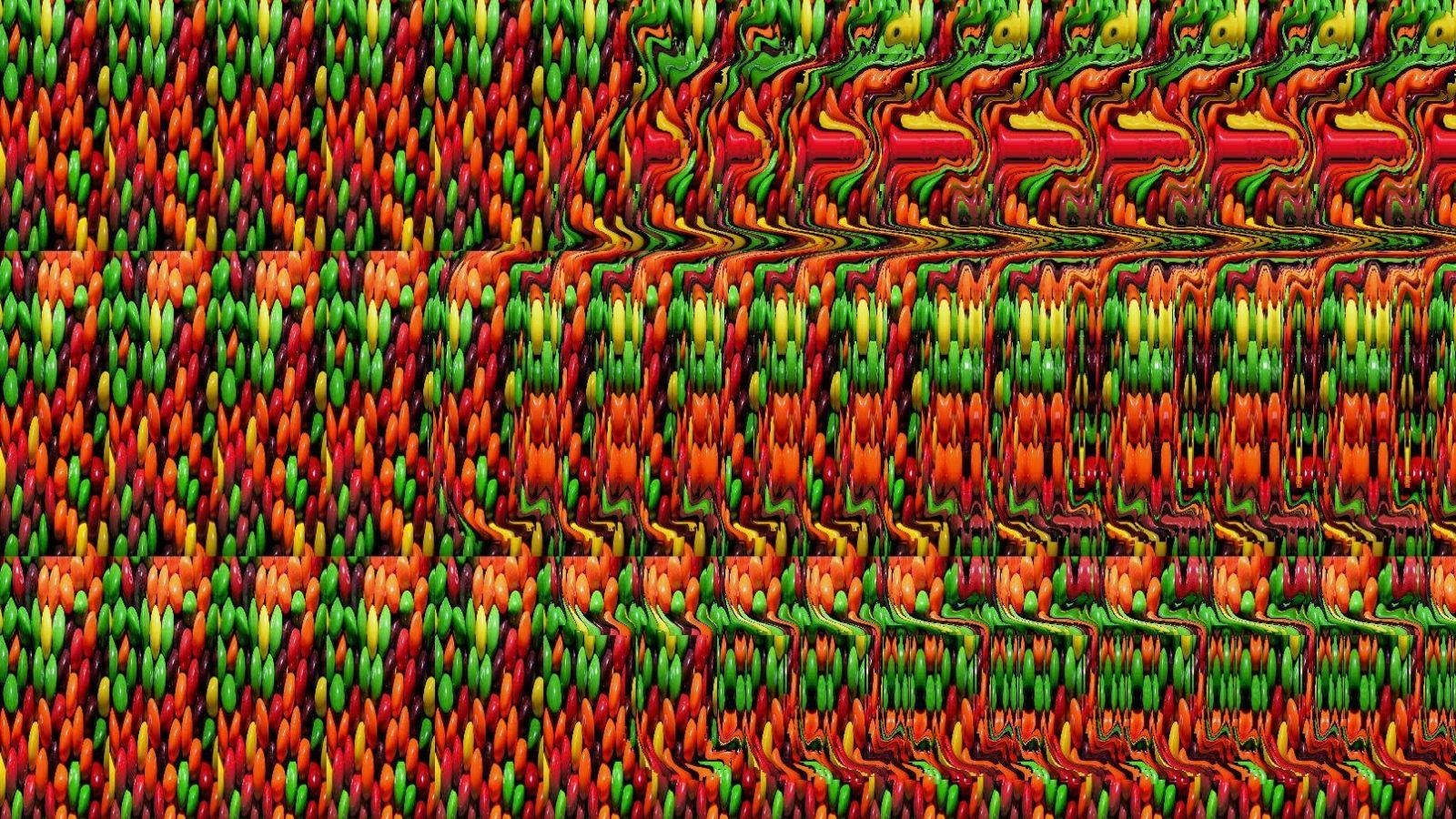
Staring at a wall of static until your eyes water. It’s a 90s core memory for millions. You’re at the mall, leaning into a kiosk, while some kid next to you screams, "Whoa, it's a dolphin!" You see nothing but neon gravel. Honestly, it’s frustrating. But easy magic eye pictures aren’t actually about "looking" at all. They’re about tricking your brain into misinterpreting depth.
Most people fail because they try too hard. They focus. They squint. They treat it like a "Where’s Waldo" book. That is exactly what you shouldn't do.
The Science of the Shimmer
These images are technically called autostereograms. Back in 1959, Dr. Bela Julesz—a vision scientist and psychologist—invented them to test how humans perceive 3D shapes. He wanted to know if we could see depth with just one eye or if it required both working in tandem. Turns out, it's both.
Standard vision uses binocular disparity. Your eyes are about 2.5 inches apart, so they see the world from slightly different angles. Your brain merges these two views into a single 3D image. With easy magic eye pictures, the artist repeats a pattern horizontally. When you decouple your eyes, your left eye looks at one repetition of the pattern while your right eye looks at the next one over. Your brain, being a bit of a shortcut-taker, thinks it's looking at the same object and fuses them together. Because the patterns have tiny, intentional offsets, that fused image appears to have depth.
It’s a glitch in your biology. A beautiful, colorful glitch.
Why Some Patterns are "Easy" While Others Are a Nightmare
Not all stereograms are created equal. If you’re a beginner, you want high-contrast patterns. A busy, chaotic background of pebbles or leaves is actually better than a smooth, blurry one because it gives your eyes "anchors" to latch onto.
The complexity of the hidden 3D object matters too. A simple sphere or a heart is much easier to resolve than a complex scene like a pirate ship with rigging. When a 3D model is too "deep," it stretches the pattern too much, making it harder for your brain to believe what it's seeing.
The Divergent Technique vs. The Cross-Eyed Method
There are actually two ways to see these. Most easy magic eye pictures are designed for the "divergent" method. This means you look through the image, as if you’re staring at the horizon. Your eyes stay parallel.
Then there’s the "cross-eyed" method. This involves—you guessed it—crossing your eyes so they meet in front of the image. If you use the cross-eyed method on a standard Magic Eye, the 3D effect will be inverted. The object will look like a hole cut into the paper rather than a shape popping out. It’s weird. It’s inverted. It’s usually not what the artist intended.
Breaking the "I Can't See It" Curse
If you’ve spent thirty years failing at this, you probably have a "dominant eye" that is refusing to let go of control. Your brain trusts one eye more than the other, and it won't let the "fusing" happen.
Try the "Nose-to-Screen" trick. It sounds ridiculous. It looks even more ridiculous. But it works because it forces your eyes to defocus.
- Put your face right against the image. Your nose should be touching it.
- Don't try to look at anything. Just let everything be a blur.
- Very, very slowly, move your head back. Keep your gaze "lazy."
- Don't blink. Don't refocus on the surface of the paper or screen.
- Around six to ten inches away, the depth will suddenly "click."
Once you see it, it's like a light switch. Your brain locks onto the 3D data. You can even look around the "3D room" you’ve just entered, provided you don't make any sudden jerking movements with your pupils.
Common Myths and Vision Realities
People often think you need 20/20 vision to see easy magic eye pictures. That’s not true. I’ve seen people with heavy prescriptions nail it in seconds. However, if you have strabismus (lazy eye) or amblyopia, you might actually be physically unable to see the effect. If your eyes don't track together, the brain can't perform the "fusing" trick.
Also, digital screens make this harder than paper. Screens have glare. They have pixels. They have refresh rates that can distract the eye. If you’re struggling on a phone, try printing a high-resolution version. The matte texture of paper is much more forgiving for your optic nerve.
The 90s Cultural Explosion
Magic Eye Inc., the company that started the craze, wasn't just some random art collective. They were a massive commercial powerhouse. At one point, their books were topping the New York Times Bestseller list. Why? Because it was the first time "interactive" art felt like a biological superpower. It wasn't a movie; it was something your brain constructed.
It became a trope. Seinfeld had a whole episode about Mr. Pitt staring at a 3D poster of a 3D mallard duck for days, losing his mind. It perfectly captured the collective frustration of the era. The posters were everywhere—dentist offices, dorm rooms, Spencer’s Gifts.
Improving Your "3D Sight"
Like any muscle, your ciliary muscles (the ones that focus your lenses) can be trained. If you practice with easy magic eye pictures for five minutes a day, you’ll find you can "snap" into the 3D view almost instantly.
Some vision therapists actually use these images to treat minor binocular vision dysfunctions. It’s basically physical therapy for your eyeballs. You’re teaching your brain to separate "vergence" (where your eyes point) from "accommodation" (how your eyes focus). Usually, these two things are hard-wired together. When you look at something close, your eyes turn in and focus close. Magic Eye forces you to point your eyes far away while focusing on a close-up surface.
It’s a literal brain hack.
Actionable Steps to Master the Hidden Image
Stop trying to find the "shape." Look for the "depth."
- Check your lighting. Glare is the enemy. If you see a reflection of a lamp on your screen, you'll never see the hidden image.
- Stay level. If your head is tilted even slightly to the left or right, the horizontal patterns won't align. Your eyes must be perfectly level with the horizontal axis of the image.
- Start with "Hidden Depth" patterns. Look for images that use a "wallpaper" style pattern (repeating icons) rather than a "random dot" (static) pattern. The icons give your brain more familiar landmarks to align.
- Use the "Finger Method." Place a finger between your face and the image. Focus on your finger, then slowly move it toward the image while keeping your eyes locked on the finger. Watch the background pattern in your peripheral vision; it will start to shift and overlap.
- Relax your jaw. It sounds weird, but physical tension in your face makes it harder to "relax" your eye muscles into the divergent state.
Mastering easy magic eye pictures is ultimately about letting go of control. The moment you stop hunting for the image is usually the moment it reveals itself. Once you’ve conquered a few basic ones, move on to animated stereograms—they are a whole different level of mind-bending.