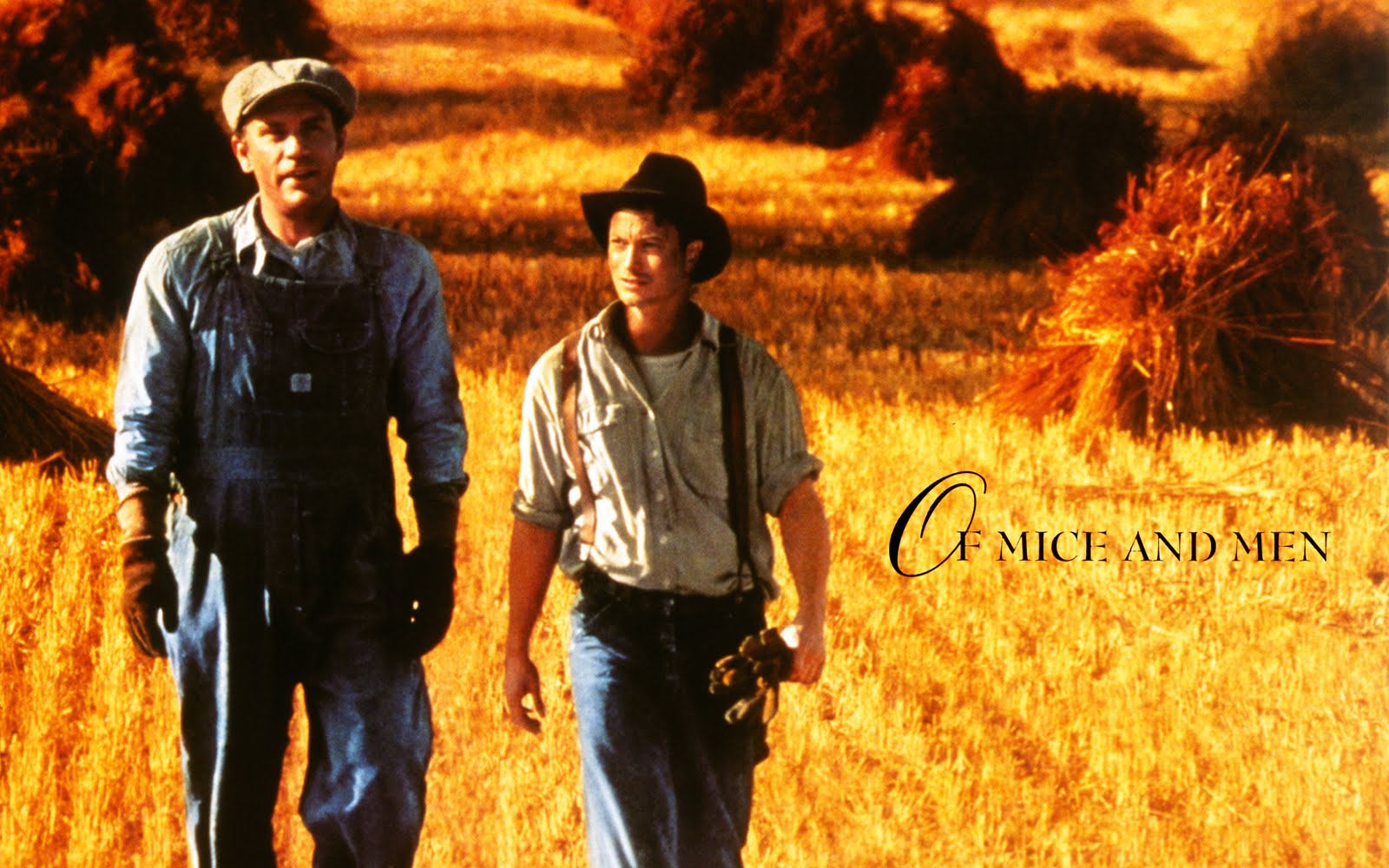
John Steinbeck didn't write a hero. He wrote a guy named George Milton who was just trying to keep his head above water in a world that wanted to drown him. Most people remember George from Of Mice and Men as the small, wiry guy who ends up doing something unthinkable in a Salinas riverbed. But if you actually sit with the text, George is way more than just Lennie’s keeper. He’s a living, breathing study in the cost of loyalty.
It’s easy to judge him. People do it all the time in high school English classes. They ask why he didn't just walk away or why he felt he had the right to make a "God-like" decision at the end of the novella. Honestly, though? George is arguably the most selfless character in American literature, even if his hands are dirty by the final page. He gave up a normal life—the "cat house" visits, the steady whiskey, the ability to keep a job for more than a month—just to make sure a man with the mind of a child didn't end up in an asylum or at the end of a lynch mob’s rope.
The Burden of the Bindlestiff
George isn't some saintly figure. He’s sharp, irritable, and frequently loses his temper. You can feel his blood pressure rising every time he tells Lennie to keep his mouth shut. Steinbeck describes him as "small and quick, dark of face, with restless eyes and sharp, strong features." He’s the physical opposite of Lennie Small. While Lennie is a shapeless force of nature, George is all defined edges and nervous energy.
He carries the "bindle"—the bedroll—but he also carries the mental weight of two men. In the 1930s, ranch hands were solitary creatures. They were "the loneliest guys in the world," as George famously says. They move from ranch to ranch, blow their stakes on "sustenance and flop," and have zero roots. George breaks that cycle. By staying with Lennie, he opts into a different kind of poverty: emotional exhaustion.
He’s constantly playing a game of chess against a world that doesn't care about him. When they arrive at the ranch near Soledad, George is the one navigating the power dynamics. He has to manage the boss’s suspicion, Curley’s insecurity, and Candy’s desperation. It’s exhausting. You can hear it in his voice when he snaps at Lennie about the dead mouse. He’s not just mad about a rodent; he’s mad that he can never, ever relax.
The Dream as a Survival Mechanism
Let’s talk about that farm. The ten acres, the windmill, the shack, and—of course—the rabbits.
Most critics, like those in the Steinbeck Review, point out that George doesn't actually believe in the dream for most of the book. It’s a bedtime story. He tells it to Lennie to keep him calm, like a parent reciting a fairy tale. It’s a piece of psychological armor. But there’s a specific moment where the tone shifts. When Candy, the old swamper, offers his $350 of "accident money," George’s eyes change.
Suddenly, the "fatta the lan'" isn't just a mantra. It’s a possibility.
For a brief window of time, George from Of Mice and Men experiences hope. It’s arguably the most tragic part of the story. He starts calculating the costs. He thinks about the cherry trees and the pigs. For a few chapters, George isn't just surviving; he’s planning. This makes the eventual crash so much more violent. When he realizes Lennie has killed Curley’s wife, George doesn't just lose a friend; he loses the only version of his future that didn't involve dying alone in a bunkhouse.
That Final Scene in the Brush
There is no getting around the ending. It is the most debated "mercy killing" in fiction.
When George tells Lennie to look across the river and imagine the farm one last time, he isn't being cruel. He’s being a protector. He hears Curley’s mob coming. He knows that if they catch Lennie, it won't be a quick death. It’ll be a terrifying, violent spectacle. George chooses to take the trauma onto himself to ensure Lennie dies happy, thinking about alfalfa and soft things.
What’s often missed is the sheer technical difficulty of what George does. His hands are shaking so hard he can barely pull the trigger of Carlson’s Luger. He has to find the strength to destroy the only thing he loves to save it from something worse.
Slim, the mule skinner and the moral compass of the ranch, is the only one who gets it. When he tells George, "You hadda, George. I swear you hadda," it’s a validation of the impossible position George was in. Slim sees the soul-crushing weight George is carrying. The others, like Curley and Carlson, just look at them in confusion. They don't understand why George is so upset. They lack the capacity for the kind of empathy George practiced every single day.
Common Misconceptions About George Milton
People get a lot wrong about him. Here are a few things to keep straight:
- He wasn't "mean" to Lennie. Sure, he yelled. But look at the context. Lennie’s mistakes literally threatened their lives. George’s "meanness" was a desperate attempt to keep Lennie safe in a world that had zero tolerance for disability.
- He didn't want to kill Lennie. Some weird interpretations suggest George was "looking for an out." That’s objectively false. George’s reaction to finding Curley's wife's body is one of pure, unadulterated grief because he knows exactly what it means: the dream is dead, and his friend is next.
- He wasn't a family member. He didn't have to be there. He tells the boss they’re cousins, but that’s a lie. He stayed with Lennie because of a promise he made to Lennie’s Aunt Clara—and because he realized that having someone to care about was the only thing making him human.
The Psychological Toll of Being the "Smart One"
Living as George from Of Mice and Men is a masterclass in hyper-vigilance. Imagine never being able to sleep soundly because your companion might wander off or get into trouble. George is a man who is "always on." This kind of chronic stress explains his temper. It’s not a character flaw; it’s a symptom of his environment.
Steinbeck uses George to highlight the tragedy of the American worker. George is intelligent, capable, and hardworking. In a fair world, he’d own his own land. But in the Great Depression, he’s reduced to a cog in a machine, hampered further by his loyalty to a man who makes him "unemployable" in the eyes of society.
He represents the "best laid schemes" of the title. No matter how much he planned, no matter how many times he told Lennie to hide in the brush if there was trouble, he couldn't beat fate. The world was too big and too cruel for a guy like George to win.
Real-World Insights: What We Can Learn from George
Reading about George isn't just a literary exercise. It’s a look at how we treat caretakers and the marginalized. George is essentially an unpaid, untrained social worker in a time before social safety nets existed.
If you're studying the text or just revisiting the story, look at these specific elements to understand George’s complexity:
- The Soliloquy of Regret: Notice how often George talks about how easy his life would be without Lennie. He’s not just venting; he’s reminding himself of the sacrifice he’s making. It makes his decision to stay even more powerful.
- The Power of Narrative: George is a storyteller. He uses words to create a reality for Lennie that doesn't exist. This shows George’s creative side—a side that is totally suppressed by the harsh manual labor of the ranch.
- The Silence: After the shooting, George goes almost completely silent. This is a man whose internal world has just collapsed.
How to Apply These Insights
If you're writing an essay or analyzing the character, don't just call him "the protagonist." Call him the moral center of a world without morals. Compare his relationship with Lennie to the relationship between Candy and his old dog. Steinbeck mirrors those two situations perfectly. When Carlson kills Candy’s dog, it foreshadows what George will have to do. The difference is that Candy let a stranger do it and regretted it. George made sure he was the one there at the end.
Actionable Steps for Readers and Students:
- Track the "Dream" dialogue: Mark every time the farm is mentioned. Notice how George’s tone changes from cynical to hopeful and finally to a flat, dead monotone.
- Analyze the Ranch Hierarchy: Look at how George interacts with different "levels" of the ranch. He treats Slim as an equal but is instantly guarded with Curley. This shows his high social intelligence.
- Read the Stage Play: Steinbeck wrote the novella almost like a play (it’s often called a play-novelette). Reading the dialogue out loud helps you catch the rhythm of George’s exhaustion.
George Milton is the face of the Great Depression’s quiet agony. He is a man who did everything "right" for his friend and still ended up with nothing but the clothes on his back and a heavy conscience. He reminds us that sometimes, the "right" choice is the one that breaks your heart.
To truly understand the story, you have to look past the tragedy of Lennie and see the man left standing in the clearing—the man who has to go on living after the curtain falls. That's the real weight of being George from Of Mice and Men.