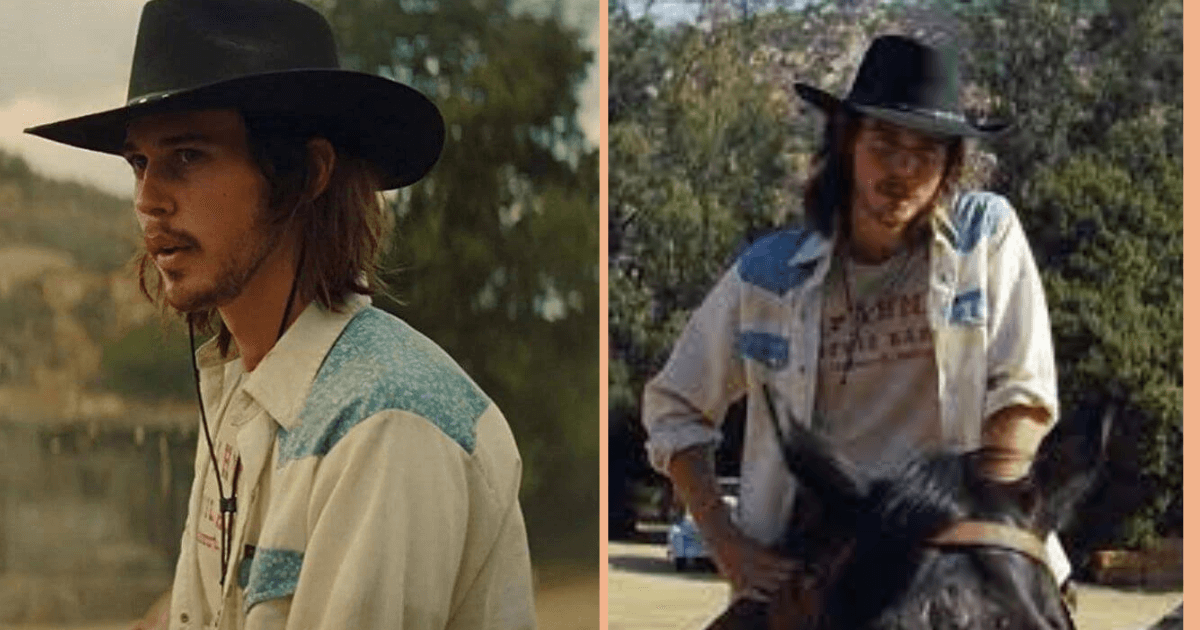
Before the sparkly jumpsuits and that permanent Memphis drawl, there was Tex. Most people look back at Quentin Tarantino’s 2019 masterpiece and remember the chemistry between Brad Pitt and Leonardo DiCaprio. They remember the feet. They definitely remember the flamethrower. But if you look closer at the dusty, menacing fringe of the Manson Family, you’ll see the exact moment the industry realized Austin Butler was a movie star. It’s wild to think about now, but Austin Butler in Once Upon a Time in Hollywood was essentially the bridge between his "Disney boy" past and his Oscar-nominated future.
He didn't have much screen time. He didn't have a ton of lines. Yet, he carried this specific, eerie gravity that felt dangerous.
The Audition That Almost Didn’t Happen
Hollywood is full of "what if" stories, but this one is particularly stressful. Austin was actually at a crossroads. He’d spent years doing teen dramas like The Shannara Chronicles and The Carrie Diaries. He was pigeonholed. He was the "pretty boy." Honestly, he was close to being stuck in that lane forever.
Then came the tape. Tarantino is notoriously picky about casting. He doesn't just want a good actor; he wants a specific "vibe" that fits his hyper-stylized version of reality. Austin submitted a self-tape that caught the eye of casting director Victoria Thomas. But here’s the kicker: Tarantino doesn't really do traditional auditions for big roles. He wants to talk to you. He wants to see if you "get" the era.
Austin spent hours researching Tex Watson. He didn't just look at the Manson Family history; he looked at the physicality of the real Charles "Tex" Watson. When he finally got in the room with Quentin, they didn't just read lines. They talked about cinema. They talked about the 1960s. That’s how you get a Tarantino gig. You have to be a cinephile first and an actor second.
That Long, Creepy Ride to Cielo Drive
Let’s talk about the scene. You know the one.
Tex Watson and the girls are driving up the hill in that beat-up, rattling car. The muffler is dragging. The sound design is doing most of the heavy lifting to make you feel uneasy. Austin is driving. He’s wearing that dark, western-style shirt and a cowboy hat that shadows his eyes.
What’s brilliant about the performance of Austin Butler in Once Upon a Time in Hollywood is the silence. He isn't playing a cartoon villain. He’s playing a guy who genuinely believes he is a soldier in a revolution. He’s calm. Too calm. When they encounter Cliff Booth (Brad Pitt) on the road, Austin plays Tex with this sort of "country boy" politeness that makes your skin crawl.
It’s a masterclass in stillness.
Most young actors would try to "act" more. They’d twitch. They’d snarl. Austin just sat there. He let the shadow of the hat do the work. This is where he learned the power of the "gaze," something he would later use to transform into Elvis Presley. He understood that in a movie this big, with stars this bright, you don't compete by being louder. You compete by being more grounded.
The "I'm the Devil" Moment
If there is one line that defined his role, it’s the chilling declaration: "I’m the devil, and I’m here to do the devil’s business."
Now, fun fact for the history buffs: the real Tex Watson actually said this during the Tate-LaBianca murders. In the film, Tarantino flips the script. Instead of a horrific tragedy, we get a hyper-violent revisionist revenge fantasy.
Austin delivers the line to a confused and high Cliff Booth. The way he says it is fascinating. It’s not a scream. It’s a statement of fact. He’s basically telling us that he has fully surrendered his soul to Manson. The contrast between his youthful, almost angelic face and that line is what makes the scene pop.
And then, of course, the dog happens.
The climax of the film is pure chaos. Tex gets his arm bitten by Brandy the Pitbull. He gets kicked. He gets humiliated. Austin had to do some serious physical acting here. He wasn't just a stoic killer anymore; he was a failing one. He had to balance the menace of a cult leader's right-hand man with the pathetic reality of a guy getting beat up by a stuntman and a dog.
Why This Role Was a Turning Point
Before this movie, casting directors saw Austin as a "CW guy." After this movie, they saw him as a "Tarantino guy." That distinction is worth millions in Hollywood.
Working with Tarantino is like getting a PhD in acting. You’re on a set where digital cameras are banned. You’re shooting on film. You’re surrounded by veterans. Austin has mentioned in interviews how he would just stay on set even when he wasn't filming. He wanted to watch Brad Pitt work. He wanted to see how Leo handled a breakdown scene.
It paid off. Shortly after Once Upon a Time in Hollywood hit theaters, the buzz started. People were asking, "Who was the guy on the horse?" (Remember, he also had that eerie scene riding into Spahn Ranch).
This role is the reason Baz Luhrmann took him seriously for Elvis. Baz has openly said that he was looking for someone who could hold the screen with a certain "dangerous" quality. He didn't want a mimic; he wanted an actor who could disappear into a persona. Austin’s work as Tex Watson proved he could shed his own personality entirely.
The Spahn Ranch Atmosphere
The Spahn Ranch sequences are arguably the most tense parts of the film. While Tex Watson isn't the primary focus of the "house visit" by Cliff Booth, his presence looms over the whole place.
Austin had to inhabit a space that felt genuinely dirty and cult-ish. The actors playing the Manson followers lived in a sort of communal vibe on set. They spent time together. They stayed in character to an extent. When you see Tex riding that horse toward Brad Pitt, that isn't a stunt double. That’s Austin. He learned to ride specifically to make sure his physicality matched the "cowboy" persona Tex had adopted.
It’s about the details. The way he holds the reins. The way he slumps in the saddle. He looked like he belonged in 1969.
Comparing Tex to Elvis and Feyd-Rautha
If you look at Austin’s career as a trilogy of transformations, it starts here.
- Tex Watson: The Quiet Menace.
- Elvis Presley: The Vulnerable Icon.
- Feyd-Rautha (Dune: Part Two): The Psychotic Warrior.
There is a direct line between Tex and Feyd-Rautha. Both characters are killers. Both are loyal to a dark father figure (Manson vs. The Baron). But in Once Upon a Time in Hollywood, Austin was more restrained. He was testing the waters of how much "evil" he could project through the screen.
Many critics noted that while his role was small, it was the most "grounded" version of the Manson family ever put to film. He didn't play Tex as a monster; he played him as a man who thought he was a hero. That’s a much scarier performance.
What You Can Learn From Austin’s Career Strategy
If you're looking at Austin Butler's trajectory as a blueprint for success, there are a few "non-obvious" takeaways. It wasn't just luck.
1. Small Roles in Big Rooms Matter
Austin could have held out for a lead role in a mediocre indie film. Instead, he took a supporting role for a legendary director. Being the 10th most important person in a Tarantino movie is better for your career than being the #1 person in a movie nobody sees.
2. Physicality is a Language
He didn't rely on dialogue. He focused on his posture, his walk, and how he sat on a horse. If you're trying to make an impression in any field, remember that how you carry yourself often speaks louder than what you say.
3. Shed Your Past Identity
He had to work twice as hard to make people forget his Disney/Nickelodeon days. He did that by picking the grittiest, least "pretty" role possible. He got dirty. He got his face smashed in (cinematically). He proved he wasn't afraid to look ugly.
4. Preparation is Everything
He didn't just show up. He read the books. He listened to the tapes. He knew the history of the Spahn Ranch. When you're prepared, you have the confidence to be "still" on camera.
The Reality of the "Tarantino Bump"
Is the "Tarantino Bump" real? Absolutely. Look at Margot Robbie, or even the career resurgence of John Travolta. For Austin, this wasn't a resurgence—it was a birth.
He managed to survive a movie that featured some of the greatest actors of all time without being forgotten. When the credits rolled, people weren't just talking about the ending; they were talking about the terrifyingly calm blonde guy in the car.
If you haven't revisited the film lately, go back and watch the Spahn Ranch entrance again. Ignore the main characters for a second. Just watch how Austin moves. He’s like a predator in slow motion. It’s a chilling performance that serves as the foundation for everything he’s doing now in Hollywood.
To really understand Austin Butler's range, you have to start with Tex. It's the role that proved he was more than just a head of hair and a nice smile. He was a chameleon in the making.
Next Steps for Film Enthusiasts:
- Watch the "Spahn Ranch" sequence in Once Upon a Time in Hollywood and focus specifically on the background actors' reactions to Tex; it highlights his perceived authority within the cult.
- Compare his vocal patterns in this film to his performance in Dune: Part Two to see how he uses "vocal fry" and pitch to establish different types of villainy.
- Check out the behind-the-scenes footage of the car stunt rehearsals to see the technical precision required for that final confrontation.