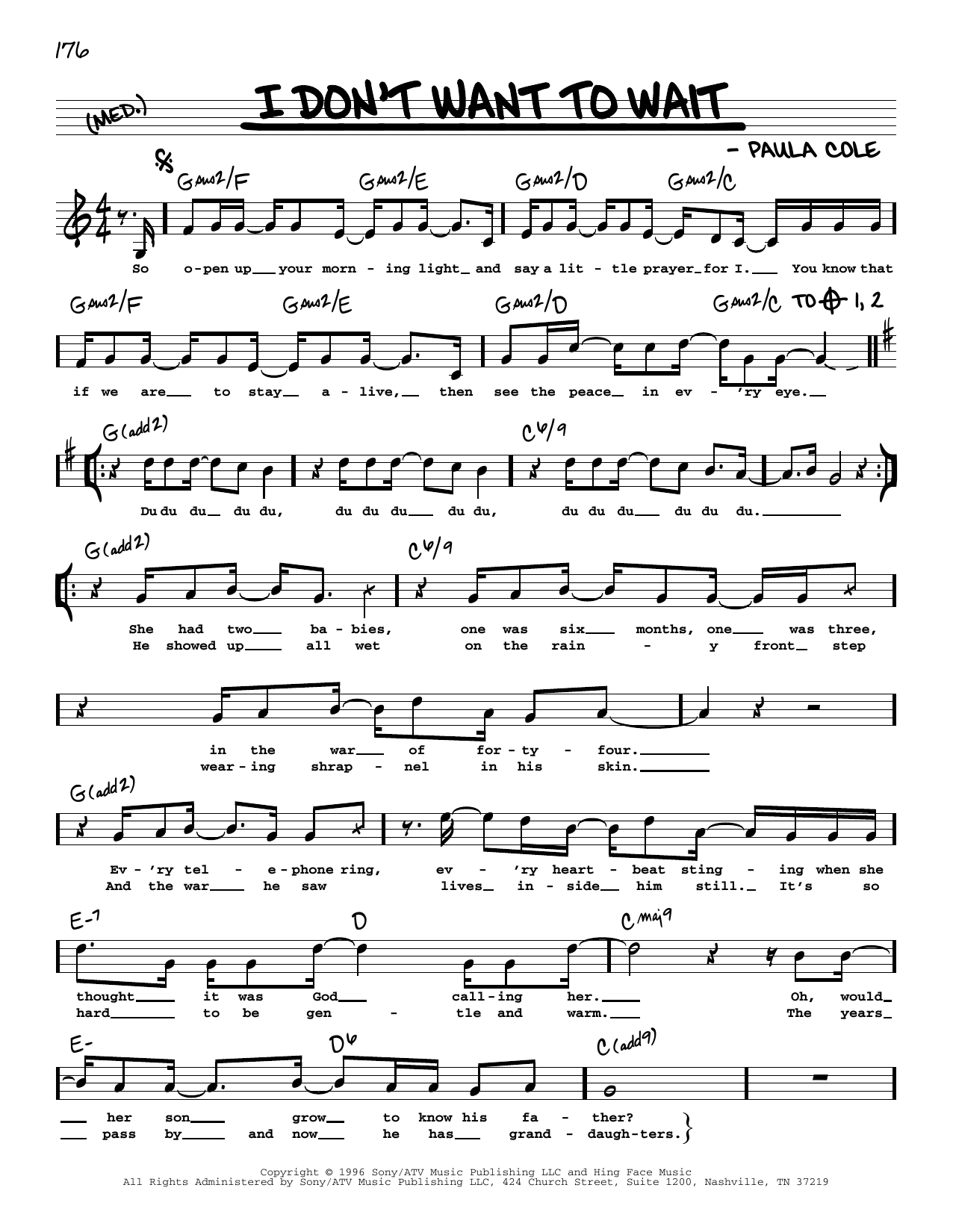
If you close your eyes and think of 1997, you probably hear that rolling drum fill. Then comes the "Oh-h-h," and suddenly you’re back in Capeside with Joey Potter. Paula Cole’s hit I Don't Want to Wait is one of those rare songs that became so synonymous with a TV show—specifically Dawson's Creek—that it almost swallowed the artist whole. It’s a bit of a tragedy, honestly. While the world remembers the WB promos, the actual song is a dark, multi-generational story about war, trauma, and breaking the cycle of unhappiness. It's not just a "90s jam." It’s a plea for survival.
Paula Cole didn't just stumble into the charts. She was a jazz-trained powerhouse who had already toured with Peter Gabriel. By the time her second album, This Fire, dropped in 1996, she was producing her own tracks, which was basically unheard of for a woman in the major label system back then. I Don't Want to Wait was the second single, following the success of "Where Have All the Cowboys Gone?" It wasn't written for a teen drama. It was written for her grandfather.
The Secret History of I Don't Want to Wait
People get the meaning wrong all the time. They think it's about a girl waiting for a guy to ask her out. Nope. Not even close.
Paula wrote the song while sitting at her piano in 1991, years before it became a hit. She was thinking about Everett, her grandfather. He was a veteran who came back from World War II a changed man. He was "the son of a son of a son," carrying the weight of traditional masculinity and unspoken trauma. When she sings about him coming home from the war "with a gift and a curse," she’s talking about the literal PTSD that rippled through her family. It’s heavy stuff for a song people used to hum while buying low-rise jeans.
The lyrics move through generations. She looks at her grandmother, who spent her life in the kitchen, "waiting for the man to come home." There’s a palpable sense of frustration in the line "Will she leave him? No, she'll never leave him." It’s about the stagnation of the soul. Cole was looking at her elders and realizing that life is terrifyingly short. She was terrified of becoming them—of waiting for a life that never actually starts.
The Dawson's Creek Connection
We have to talk about the creek. You can't separate I Don't Want to Wait from James Van Der Beek’s crying face. But here’s the kicker: Cole didn't even want the song on the show initially.
The producers of Dawson's Creek originally wanted "Hand in My Pocket" by Alanis Morissette, but they couldn't get the rights. They pivoted to Paula. For years, that song was the sonic wallpaper of the late 90s. It was everywhere. It was so ubiquitous that it eventually became a parody of itself.
Then, the weirdest thing happened. Licensing issues with the theme song meant that for a long time, if you watched Dawson's Creek on DVD or early streaming services, I Don't Want to Wait was gone. It was replaced by a generic track called "Run Like Mad" by Jann Arden. Fans were furious. It felt like a piece of their childhood had been surgically removed. It wasn't until 2021 that Sony and Cole finally reached a deal to bring the original theme back to streaming platforms like Netflix and Max.
Why the Production Was Radical
Listen to the track again. Really listen.
Most pop songs in 1997 were overproduced gloss-fests. Cole, acting as her own producer, kept things surprisingly raw. The percussion has this stumbling, heartbeat quality. The "doo-doo-doo" backing vocals aren't sugary; they're almost haunting.
- The Vocals: She uses her jazz background to slide around notes. It’s not a straight pop delivery.
- The Scatting: Near the end, she starts ad-libbing in a way that feels more like Ella Fitzgerald than Britney Spears.
- The Bass: It’s thick and driving, pushing the song forward even when the lyrics are about being stuck.
She was nominated for seven Grammys in 1998, including Producer of the Year. She was the first woman to be nominated for that award solo. She ended up winning Best New Artist, which led to a "controversial" moment where she showed her unshaved armpits during her acceptance speech. The media lost its mind. Looking back, it’s hilarious how much that rattled people. She was just being a human, much like the characters in her songs.
The Longevity of the "90s Sound"
There is a specific texture to I Don't Want to Wait that modern music struggles to replicate. It’s the sound of real instruments in a room. In the mid-90s, the "Lilith Fair" movement—which Cole was a huge part of—celebrated female singer-songwriters who played their own instruments and wrote their own messy truths.
This song hit a nerve because it resonated with Gen X cynicism and Gen Y idealism simultaneously. It asked: Are we just going to repeat the mistakes of our parents? Or are we going to "open up our eyes" and do something different?
Common Misconceptions and Trivia
People often confuse Paula Cole with other artists from that era. No, she is not Sophie B. Hawkins. No, she isn't Meredith Brooks. She was more experimental than people give her credit for.
- The "Wait" isn't about romance. It's about mortality. The "wait" is the interval between birth and death.
- The "Fire" mentioned in the album title. This Fire refers to the creative and sexual awakening she was experiencing. It was an angry, passionate record.
- The "Cowboys" song. People thought "Where Have All the Cowboys Gone?" was a literal pining for traditional men. It was actually a sarcastic critique of gender roles. She’s a very ironic songwriter.
How to Appreciate the Song Today
If you want to actually "hear" the song again for the first time, stop thinking about the 90s. Forget the capes and the creek.
Listen to the bridge. When she sings, "So fine, so pure, a lovely son and daughter," she’s looking at the potential of the next generation. It’s a moment of hope buried in a song about generational trauma. It’s actually a very brave piece of writing.
Actionable Insights for the Music Fan
If you find yourself diving back into the Paula Cole discography, don't stop at the hits.
- Listen to the full album This Fire. Tracks like "Tiger" and "Hush, Hush, Hush" (which features Peter Gabriel) show a much darker, more avant-garde side of her artistry.
- Watch her live performances from 1997-1998. Her vocal control is insane. She does things with her voice that most pop stars wouldn't dream of attempting today.
- Check out her 2024 work. She’s still releasing music. Her recent album Lo proves she hasn't lost her edge or her ability to write a devastatingly honest lyric.
To truly understand the impact of I Don't Want to Wait, you have to look past the nostalgia. It’s a song about the fear of a wasted life. That's a universal anxiety. Whether it's 1997 or 2026, the question remains: are you going to stay in the kitchen waiting, or are you going to live?
Stop waiting for the perfect moment to revisit this era of music. Go back and listen to the lyrics. You'll realize that the song you thought was about a teenage crush was actually about the ghost of a grandfather and the weight of an entire family tree. It’s much heavier than you remember, and that’s exactly why it has survived for nearly thirty years.
To dig deeper into the 90s singer-songwriter revolution, look into the founding of the Lilith Fair tour. It was a pivotal moment for artists like Cole, Sarah McLachlan, and Tracy Chapman, proving that "women in rock" wasn't a niche—it was a powerhouse. Understanding that context makes Cole's production achievements even more impressive. She wasn't just a voice; she was the architect of her own sound.