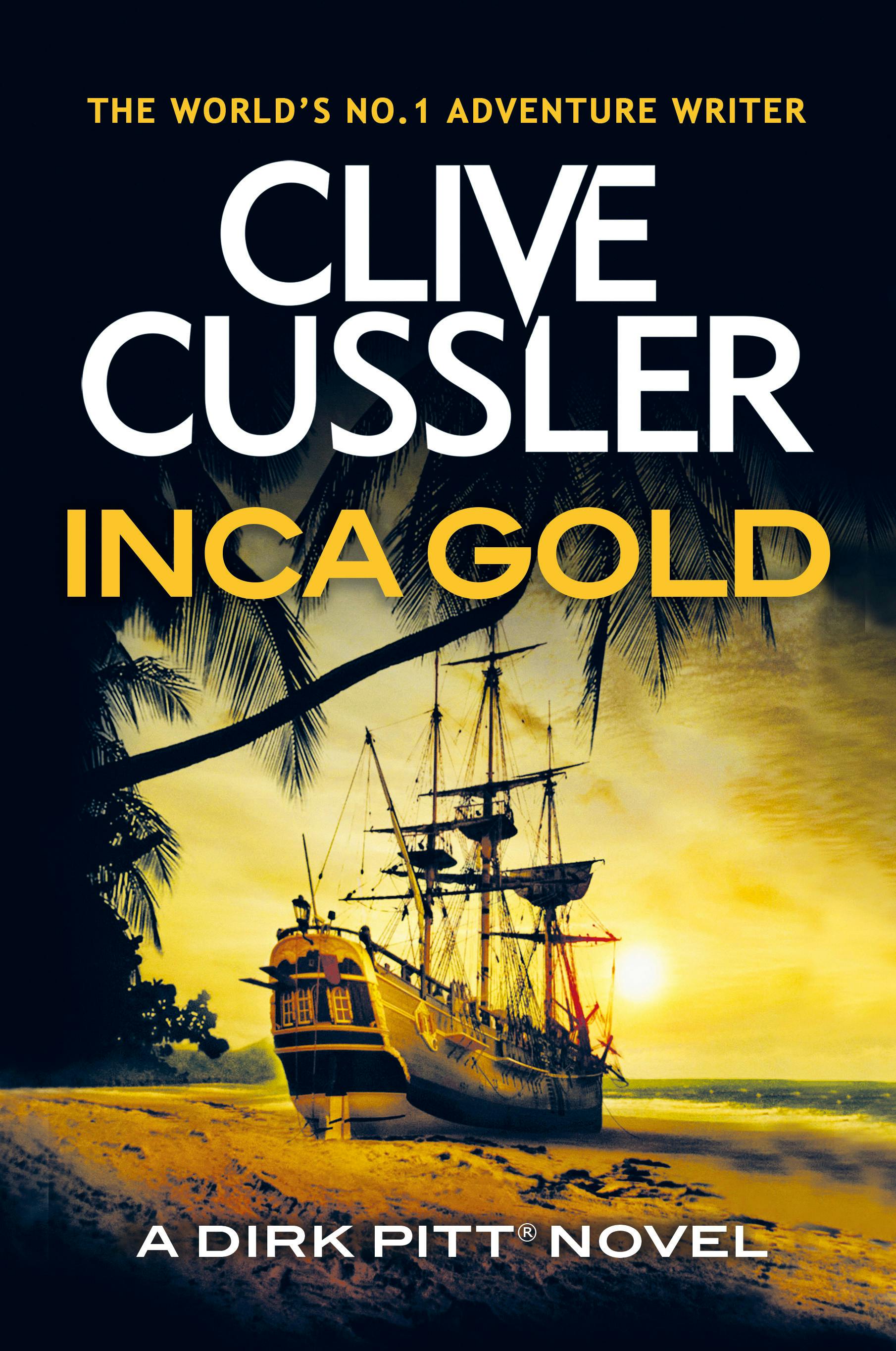
Ever had that feeling where you pick up a book from the 90s and expect it to feel like a dusty relic? Yeah, I thought so too. But then I cracked open Inca Gold again. Honestly, it’s kinda wild how Clive Cussler managed to make a story about 16th-century treasure feel more high-stakes than most modern technothrillers.
It's the twelfth Dirk Pitt novel. If you've been around the block with NUMA, you know the drill. Pitt is basically what happens if Indiana Jones had a government salary and a better hair stylist.
The Setup That Hooked a Generation
The book starts exactly how a Cussler novel should: in the past. We're talking 1578. Sir Francis Drake, the legendary privateer, captures a Spanish galleon. Standard stuff, right? Except this ship is carrying a secret that could break the world’s economy—a massive golden chain that belonged to the last Inca king.
Then a tsunami happens. Because of course it does.
The ship gets swept miles into the jungle and vanishes. Fast forward to 1998 (which was the "near future" when Cussler wrote this in '94). Our hero, Dirk Pitt, is doing his usual thing—diving into a sacrificial pool in the Andes to save two archaeologists. He’s not even supposed to be there. He’s just a guy who happens to be in the right place at the exactly most dangerous time.
What Most People Get Wrong About the History
People love to call Cussler's work "pulp fiction," and sure, it’s got that vibe. But the guy did his homework on the Chachapoyas. This was a real civilization, the "Cloud People" of Peru. They weren't just a plot device; they were a fierce group that resisted the Inca Empire for years.
Cussler weaves in these details about their circular stone houses and cliffside mummies that are actually based on real archaeological finds like Kuelap.
There’s this one specific item in the book: the Golden Body Suit of Tiapollo.
- It’s covered in hieroglyphics.
- It’s the "map" everyone is killing each other for.
- Real talk? The Incas didn't actually have a written language in the way we think of it.
They used quipus—knotted strings. Cussler knows this, so he blends the two. He turns a jade box containing a quipu into a high-stakes puzzle. It’s a clever bit of writing because it takes a real historical mystery and gives it a Hollywood face-lift.
The Villains: More Than Just Cartoon Bad Guys
The Solpemachaco. Sounds like a tongue-twister, but in the book, they are a terrifying international crime syndicate. They aren't just looking for gold to buy yachts. They deal in "stolen history."
The Zolar brothers, who run the show, are basically the dark mirror of Pitt. They have the resources, the intelligence, and the passion for antiquities. The only difference is they’re willing to murder a few archaeologists to get what they want. It makes the conflict feel personal. You’re not just rooting for the good guys to find the shiny stuff; you’re rooting for them to stop the desecration of history.
Why Inca Gold Matters in 2026
You might wonder why we're still talking about a book that features a "supercomputer" that looks like a toaster by today's standards.
It’s about the escapism.
Dirk Pitt and Al Giordino have a dynamic that modern writers struggle to replicate. It’s that effortless, "I’d die for you but I'm going to make fun of your shirt first" friendship. When they’re navigating an underground river in Mexico—a scene that is arguably one of the best action sequences Cussler ever wrote—you feel every bump in the raft.
The pacing is relentless. One minute you're in a high-altitude sinkhole in the Andes, the next you're on a boat in the Sea of Cortez. Cussler was a master of the "one more chapter" hook. He used his real-life experience as the founder of the actual National Underwater and Marine Agency (NUMA) to ground the technobabble. When Pitt talks about decompression sickness or the structural integrity of a submersible, it’s because Cussler actually knew his way around a wreck.
Real-World Takeaways for Treasure Hunters
If you're looking to dive into the world of Cussler or just want to appreciate the genre more, keep these points in mind:
- Check the real sites: If the book mentions Kuelap or the Chachapoyan mummies, look them up. The real history is often just as weird as the fiction.
- Watch the cameos: Cussler famously writes himself into his books. In Inca Gold, he shows up in a way that’s actually pretty funny if you’re paying attention.
- Pay attention to the tech: It’s a trip to see what was considered "cutting edge" in 1994. It reminds you how fast the world moves, even if the ancient treasures stay buried.
The book doesn't just offer a story; it offers a vibe. It’s a reminder that there are still "blank spots" on the map, even if we have GPS and satellites. It captures that 90s optimism where a guy with a mechanical watch and a lot of nerve could save the day.
If you haven't read it in a decade, give it another look. It’s a masterclass in how to build a world that feels both impossibly big and incredibly tight. The gold might be fictional, but the craft is the real deal.