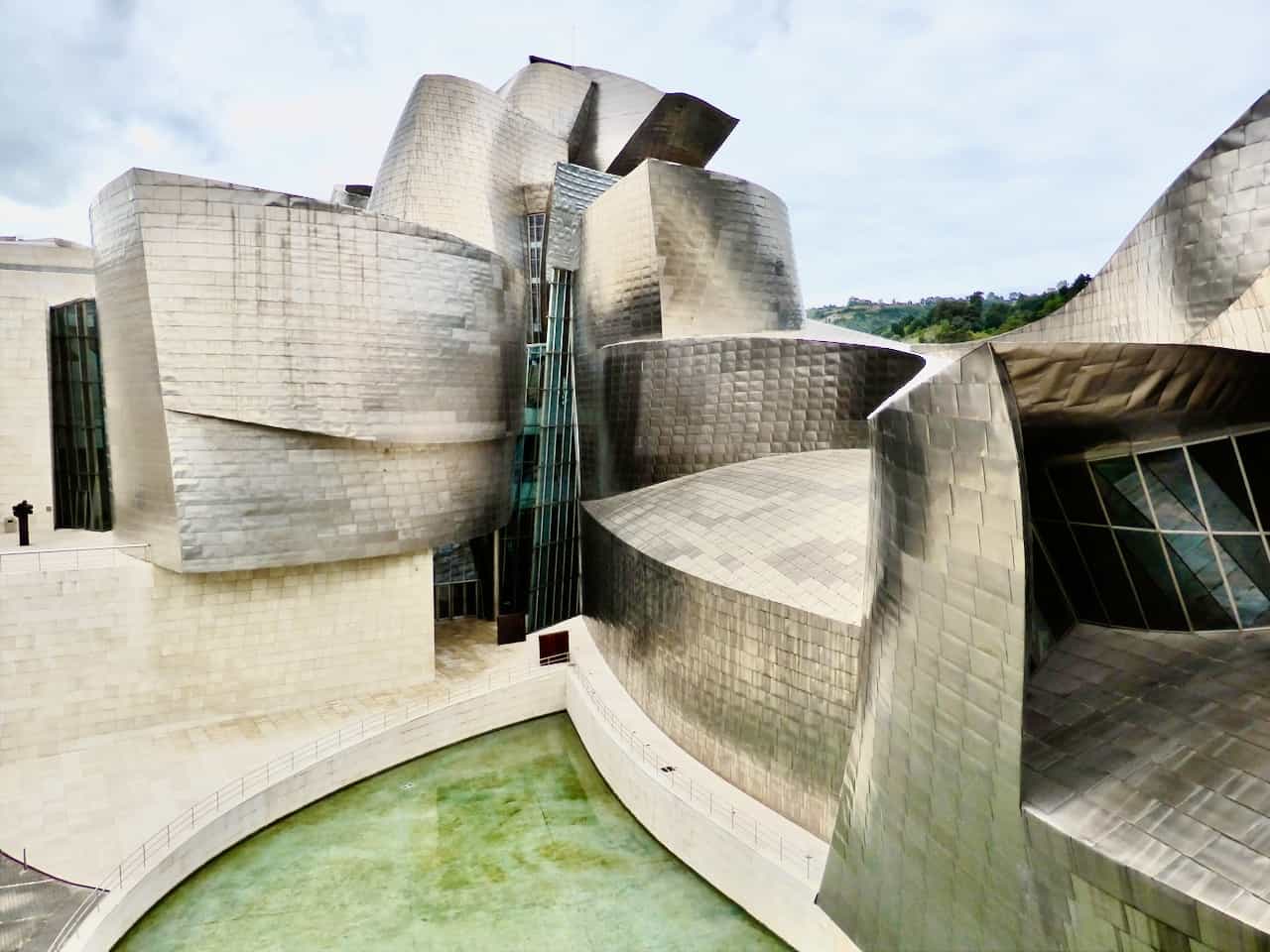
Walk into the Guggenheim Museum Bilbao interior and you’re immediately hit by a sense of vertigo that feels, weirdly, like a warm hug. It’s massive. Most people focus on the titanium "fish scales" on the outside, but honestly? The inside is where the real architectural magic happens. It isn’t just a gallery; it’s a 24,000-square-meter labyrinth that somehow manages to feel intimate and overwhelming at the exact same time.
You’ve probably seen the photos. That soaring Atrium. The white limestone. The glass curtains. But photos don't tell you how the air feels inside or how the light shifts every ten minutes because the Basque weather is notoriously moody. When Frank Gehry designed this place, he wasn't just trying to make a pretty box for art. He was trying to reinvent how we move through a building. It's disorganized. It's chaotic. And it’s brilliant.
The Atrium: The Heart of the Beast
The Atrium is the anchor. Everything else orbits around it. Standing at the base and looking up at that 55-meter ceiling—which, by the way, is way taller than the rotunda in the New York Guggenheim—you get this feeling that the building is alive. Gehry called it "The Flower." You can see why. The curved walkways, the glass elevators, and the massive stone pillars all sort of bloom upward.
What most people get wrong about the Guggenheim Museum Bilbao interior is thinking it's all about the titanium. Inside, it's actually about the limestone and the glass. The stone is a warm, honey-colored calcarenite brought in from Huéscar, Spain. It grounds the space. Without it, the whole thing would feel too cold, too industrial. Instead, you have this organic, almost skeletal vibe.
Light is the secret weapon here. Gehry used "light wells" that pull the gray Bilbao sky right into the center of the building. On a rainy day, the interior feels cozy and silver. When the sun actually decides to show up, the whole Atrium glows. It’s basically a massive light sculpture you happen to be walking through.
Navigating the Chaos
It’s easy to get lost. Really easy.
The layout doesn't follow a standard 1-2-3-4 floor plan. You have nineteen galleries scattered across three levels. Some are perfectly rectangular and "boring" because, let’s be real, you need flat walls to hang a painting. Others are so distorted and curved that you feel like you’re inside a giant’s ribcage.
The way the catwalks connect is what usually trips people up. You’ll be on the second floor, looking across a chasm at someone on the third floor, and you have no idea how they got there. But that’s the point. The museum encourages "aimless wandering." You aren't supposed to follow a map. You’re supposed to experience the volume of the space.
The Fish and the Curves
Ever wonder why everything is so curvy? Gehry used Catia, a French software originally designed for aerospace engineering. Without it, these shapes would have been impossible to calculate, let alone build.
There’s this one gallery on the ground floor—Gallery 104. It’s nicknamed the "Fish Gallery" or the "ArcelorMittal Gallery." It is massive. It’s 130 meters long and 30 meters wide. No pillars. Just a giant, cavernous void. It houses Richard Serra’s The Matter of Time. If you haven't walked through these weathering steel spirals, you haven't really seen the Guggenheim Museum Bilbao interior. The echoes in there are wild. You can whisper at one end and feel like the sound is wrapping around your head. It’s a physical manifestation of how architecture can manipulate your senses.
Why the White Walls Matter
People often complain that modern art museums are "too white." At Bilbao, the white walls serve a specific purpose. They act as a palate cleanser. Between the crazy titanium exterior and the complex limestone curves of the Atrium, your brain needs a break.
The galleries themselves vary wildly:
- The "Classical" galleries: These are the ones with the square shapes. They house the permanent collection and works that need a stable, quiet environment.
- The "Irregular" galleries: These are the ones that make the Guggenheim Museum Bilbao interior famous. High ceilings, tilted walls, and weird angles.
- The Interstitial spaces: These are the "in-between" spots. The stairwells, the balconies, the nooks. Honestly, some of the best views of the art are from the stairs.
Looking at Jeff Koons' Tulips from the balcony inside is a completely different experience than seeing them from the terrace. You see the scale differently. You see the reflection of the limestone in the stainless steel.
The Practical Realities of Designing a Masterpiece
Gehry faced a lot of flak. Critics thought the building would overshadow the art. To be fair, sometimes it does. If you’re looking at a small, delicate drawing on a wall that’s 20 feet high, the drawing loses.
But for large-scale installations? Nothing beats this. The interior was built to handle the "unhandleable." It was a gamble by the Basque government and the Solomon R. Guggenheim Foundation. They wanted a "Bilbao Effect"—a way to turn a dying industrial port city into a cultural titan. It worked. But it only worked because the interior feels authentic to the city's maritime and industrial roots. The elevators look like something out of a futuristic shipyard. The metal finishes feel like a nod to the steel mills that used to line the Nervión River.
Things You Might Miss If You Don't Look Up
Don't just stare at the art on the walls. Look at the junctions. Look at where the glass meets the stone.
There’s a specific spot on the third floor where you can look down into the Atrium and see the "water garden" through the glass walls. It blurs the line between the Guggenheim Museum Bilbao interior and the outside world. It’s a trick of transparency. Gehry wanted the river to feel like it was flowing into the building.
Also, pay attention to the acoustics. Despite the hard surfaces—stone, glass, steel—the museum isn't as loud as you'd think. The sheer volume of the space swallows sound. It creates this weird, hushed atmosphere that makes you want to whisper, even when you aren't in a "quiet zone."
Actionable Tips for Your Visit
If you're actually planning to head there, don't just wing it. You'll miss the best parts.
- Start at the top. Take the elevators straight to the third floor. It’s easier to work your way down and get a bird's-eye view of the Atrium layout before you get lost in the weeds.
- Find the "secret" balconies. There are several small outdoor terraces accessible from the interior galleries. Most people walk right past the heavy glass doors. Go out there. The view of the Puppy (the giant flower dog by Koons) from the upper levels is spectacular.
- Visit the Serra installation last. It’s physically exhausting to walk through those steel coils. Do the light, airy galleries first, then go down to the "belly" of the museum for the heavy stuff.
- Check the light at sunset. If the museum is open late, the way the light hits the limestone inside during the "golden hour" is worth the price of admission alone.
- Download the app beforehand. The physical signage inside is intentionally minimal. If you want to know what you’re looking at without squinting at a tiny wall plaque, use your own headphones and the official guide.
The Guggenheim Museum Bilbao interior isn't just a place to look at paintings. It’s an argument. It’s an argument that a building can be just as expressive, temperamental, and complex as the art it holds. It’s messy and confusing, but that’s exactly why it’s one of the few pieces of modern architecture that actually lives up to the hype.