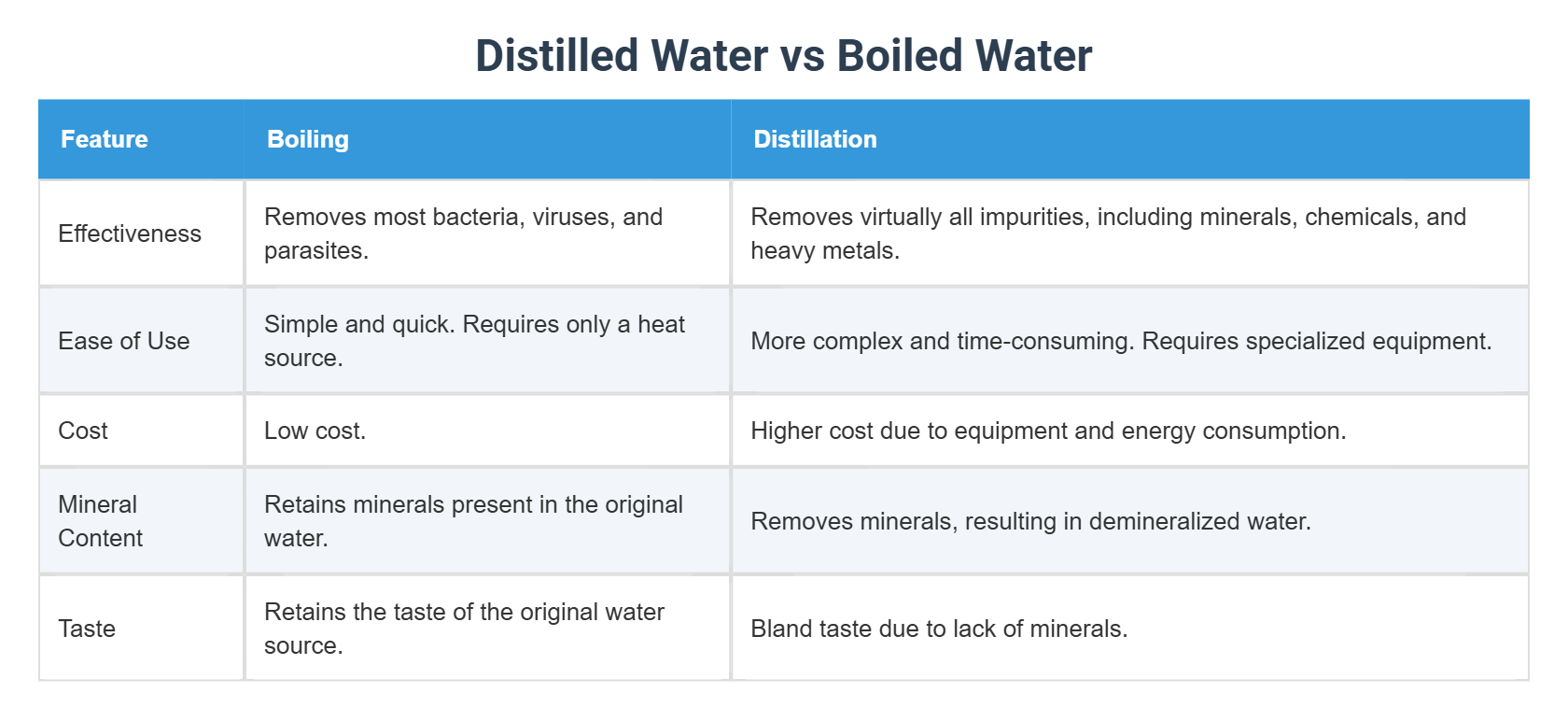
You're standing in your kitchen. Maybe you’re looking at a crusty white buildup inside your humidifier, or perhaps you’re about to fill up a high-end espresso machine and don't want to ruin it. You think to yourself, "Is distilled water just boiled water?"
Most people think so. It makes sense, right? You heat it up, it bubbles, and you’re done. But honestly, if you take a pot of tap water, bring it to a rolling boil for five minutes, and then pour it into your CPAP machine, you might be in for a rude awakening. Boiling and distilling are related—they’re like cousins—but they are definitely not the same thing.
Boiling is a kill-mission. It's about safety. Distilling is a purification process. It’s about total removal.
The fundamental difference: Kill vs. Remove
When you boil water, you’re basically playing "Survivor" with microorganisms. You are cranking the heat to $100°C$ ($212°F$) to make sure things like Cryptosporidium or Giardia don’t stand a chance. It’s effective. It makes the water safe to drink if there’s a local "boil water" advisory because of a broken pipe or a flood.
But here is the kicker.
Boiling doesn't get rid of the "stuff." If your water has lead, arsenic, or just plain old calcium and magnesium (the stuff that makes water "hard"), boiling actually makes it worse. As the water turns to steam and escapes the pot, the concentration of those minerals and chemicals in the remaining liquid goes up. You’re essentially making a mineral soup.
Distillation, however, is the act of capturing that steam and turning it back into liquid in a separate container.
The steam is the pure part. It leaves the heavy metals, the salts, and the dirt behind in the original pot. So, while distilled water is technically boiled during the process, boiled water is almost never distilled.
How distillation actually works in the real world
Think back to middle school science. Or maybe just look at the lid of a pot while you’re making pasta. Those droplets clinging to the underside of the lid? That is distilled water.
In a professional setting, or even with a home countertop distiller like a Megahome or a Vevor, the process is a closed loop. The water is heated until it vaporizes. That vapor travels through a cooling coil (often made of stainless steel or glass) where it condenses back into droplets. These droplets drip into a clean carafe.
The result?
Pure $H_2O$.
No fluoride. No chlorine. No calcium buildup. No nitrates from farm runoff. It’s empty water. This is why it tastes so flat. We are used to the "flavor" of minerals in our water. When you take them away, your tongue kind of freaks out at the lack of sensation. It’s sterile.
Why you can't just substitute one for the other
If you’re a hobbyist or someone managing a health condition, the distinction is everything. Let's talk about CPAP machines for a second. Manufacturers like ResMed are very specific: use distilled water.
Why?
Because if you use boiled tap water, the minerals don't go away. They just sit in your humidifier chamber. Over time, they create a "scale" that can harbor bacteria and eventually flake off into the air you’re breathing. It can also crust over the heating element, causing the machine to fail prematurely.
Then there are car batteries. If you have an older lead-acid battery that needs topping off, using boiled water is a death sentence for the cells. The minerals in boiled water can cause internal shorts. You need that pure, mineral-free distilled stuff to keep the chemistry balanced.
What about your houseplants?
Some plants are divas. Peace lilies and Spider plants are notorious for getting brown, crispy tips if they are given tap water. Even if you boil that tap water, the fluoride and chlorine byproducts are still there. Distilled water is often the only thing that keeps them looking like they actually live in a rainforest instead of a dusty corner of your living room.
The "health" debate: Is distilled water bad for you?
This is where things get a bit spicy in the wellness community. You’ll hear some people claim that distilled water "leaches" minerals from your body.
Is it true?
Sorta, but it’s mostly exaggerated. Because distilled water is so pure, it wants to bond with things. When you drink it, it can pick up tiny amounts of minerals from your saliva or stomach as it passes through. However, the idea that it’s going to suck the calcium right out of your bones is basically a myth.
The real concern is what you aren't getting.
Most people get a decent chunk of their daily magnesium and calcium from tap or mineral water. If you switch to 100% distilled, you’re cutting off that supply. According to the World Health Organization (WHO), long-term consumption of demineralized water can lead to certain electrolyte imbalances if you aren't getting those minerals from your food.
If your diet is rich in greens, nuts, and dairy, you probably won't notice a difference. But if you're a "junk food vegan" or someone with a restricted diet, drinking only distilled water might make you feel a bit sluggish over time.
Can you make distilled water at home?
Yes. You can. But it’s a giant pain in the neck without a machine.
You have to float a bowl in a large pot of water, put a curved lid on upside down, and pile ice cubes on top of the lid. The steam hits the cold lid, drips down to the center, and falls into the bowl. It takes forever. You’ll spend two hours and a bag of ice just to get a liter of water.
If you actually need distilled water for a medical device or a laboratory-style hobby, just buy it for a couple of dollars at the grocery store. Or, if you use a lot of it, invest $100 in a countertop distiller. It’s way more reliable than the "upside-down lid" method.
Other types of "pure" water you'll see
While we are on the subject, don't get distilled confused with "purified" or "deionized" water. They are the same family but different species.
- Purified Water: This is usually tap water that has gone through carbon filtration and Reverse Osmosis (RO). It’s very clean, but might still have a tiny bit of mineral content left. Most bottled waters like Dasani or Aquafina are purified water with minerals added back in for "taste."
- Deionized (DI) Water: This is the hardcore stuff. It uses ion-exchange resins to strip every single charged ion out of the water. It’s used in factories and labs. You shouldn't really drink DI water; it's so "hungry" for ions that it tastes metallic and can be quite aggressive on your digestive tract.
- Spring Water: This is just water from an underground source. It’s usually filtered for safety but keeps all the minerals. It’s the exact opposite of distilled.
The verdict
Boiled water is for when the city tells you the water is contaminated with bacteria. It’s for survival.
Distilled water is for when you need a blank slate. It’s for machines, specific plant types, and people who want to remove every single trace of heavy metals or chemicals.
If you’re just thirsty and your tap water is safe, boiling it is a waste of electricity. And if you’re trying to keep your iron from spitting white gunk on your favorite shirt, boiling the water won't help one bit. You need the stuff that's been evaporated, traveled through a tube, and reborn as a pure liquid.
Actionable takeaways for your home
Stop treating these two as interchangeable. It'll save you money and headaches in the long run.
- Check your appliances: If the manual says "distilled," do not use boiled tap water. You are shortening the life of your device by years.
- Emergency prep: Keep a gallon of distilled water for medical needs, but keep a way to boil water for drinking. If the power goes out, boiling is your best friend for safety.
- Taste test: If you hate the taste of distilled water but want the purity, add a tiny pinch of sea salt or "trace mineral drops" to a gallon. It brings the "life" back to the water without the chlorine and lead.
- Storage: Distilled water absorbs $CO_2$ from the air once opened, which makes it slightly acidic over time. Keep the cap tight and store it in a cool, dark place to keep it "dead" and pure.
Distilled water is a tool. Boiled water is a safety precaution. Knowing the difference means you won't be the person wondering why their $800 espresso machine is clogged with lime deposits after only six months.