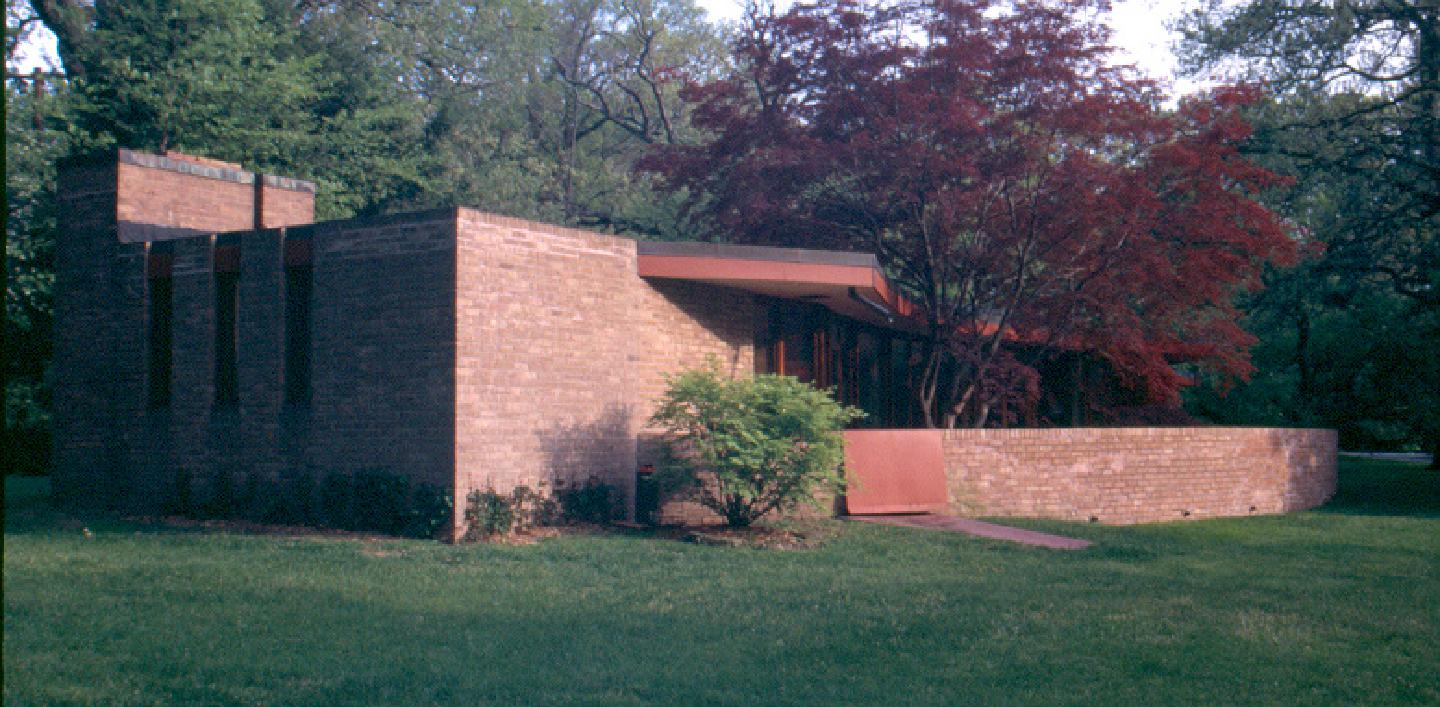
You’ve probably seen the black-and-white photos of Frank Lloyd Wright—the cape, the cane, the dramatic flair. He wasn't exactly known for being "accommodating." He was a man who told clients how to live, what furniture to buy, and even where to sit. But in 1948, he received a letter that changed the way he thought about space. It came from Kenneth Laurent, a World War II veteran who had been paralyzed from the waist down after a spinal tumor surgery.
Ken didn't want a "handicapped house." He wanted a home.
The result was the Laurent House in Rockford, Illinois. It is, quite literally, the only building Wright ever designed specifically for a person with a physical disability. Honestly, when you walk through it today, it doesn’t feel like a medical facility or a series of "fixes." It feels like a masterpiece of human-centric design that happened 40 years before the Americans with Disabilities Act (ADA) even existed.
Why the Laurent House is Wright’s Most Empathetic Work
Most people know Wright for the "wow" factor of Fallingwater or the sheer scale of the Guggenheim. But the Laurent House is different. Wright called it his "little gem."
Ken and Phyllis Laurent had seen a magazine article in House Beautiful about Wright’s Usonian homes. These were meant to be the "everyman" houses—affordable, organic, and sleek. Ken wrote to Wright, basically saying, "I'm in a wheelchair. Can you build me something I can actually live in?"
Wright didn't just add a ramp and call it a day. He reimagined the entire flow of the home based on a seated perspective.
- The Hemicycle Curve: The house is shaped like an arc, or a solar hemicycle. This isn't just for looks. The curve allows for an open floor plan where Ken could navigate without hitting sharp 90-degree corners.
- The View from 38 Inches: This is the most fascinating part. Wright designed the windows, the furniture, and the built-ins to be viewed from a seated position. If you stand up, the house feels a bit low. If you sit down, the proportions are perfect.
- Wide and Low: Doorways are 36 inches wide. Light switches and doorknobs are positioned lower than usual. The fireplace is massive but set at a height where someone in a wheelchair can enjoy the warmth and the view of the embers directly.
Life Inside a "Work of Art"
Ken and Phyllis lived in this house for nearly 60 years. That’s almost unheard of for a Wright home; usually, people find them too difficult to maintain or too cramped for modern life. But the Laurents stayed. They raised two kids here.
Ken once said, "This house helps me focus on my capabilities, not my disability."
Think about that for a second. In the 1950s, the world was a nightmare for wheelchair users. Curbs didn't have cutouts. Public buildings had stairs everywhere. But inside these walls of Chicago common brick and red tidewater cypress, Ken was just a man in his home.
The Famous Window Wall
The back of the house features a 50-foot curved wall of glass. It’s the longest continuous window wall Wright ever designed for a residence. It looks out over a gently sloping 1.2-acre lot with a stream. Every other pane of glass is a French door that opens onto a terrace.
Because the floors are poured concrete with radiant heat (a classic Wright move), there are no bulky radiators or floor vents to trip over or block a wheelchair's path. It's seamless.
The Architecture of Dignity
When we talk about the Laurent House, we have to mention the materials. Wright used "rosy-hued" Chicago common brick. It sounds fancy, but at the time, common brick was exactly what the name implies—cheap and local. He paired it with tidewater red cypress.
The colors are vintage Wright: Cherokee red floors, orange, avocado green, and maize.
The house is roughly 2,600 square feet now (it was smaller originally, around 1,400, until an addition was added in 1960), but it feels larger because of the "compression and expansion" trick. The entryway is narrow and tight—it almost makes you feel slightly claustrophobic. Then, you turn a corner and the space explodes into the living room with that massive wall of glass.
It’s high drama in a suburban Rockford neighborhood.
What Most People Get Wrong
There's a misconception that Wright was a "difficult" genius who didn't care about his clients' comfort. While he certainly had an ego, his correspondence with the Laurents shows a different side. He visited them. He invited them to Taliesin. He even designed the furniture specifically so that when guests sat down, they were at or below Ken’s eye level.
In most houses, everyone towers over a person in a wheelchair. At the Laurent House, Ken was the tallest person in the room. That wasn't an accident. That was Wright's way of giving a veteran back his stature.
Visiting the Laurent House Today
If you’re a fan of mid-century modern design or just cool history, you’ve gotta get to Rockford. The house is now a museum, and it’s remarkably well-preserved. Because the Laurents were the only owners until 2012, almost everything is original—the furniture, the light fixtures, even some of their personal items.
Practical details for your trip:
- Seasonality: The house usually opens for public tours in April and runs through December. In 2026, the season kicks off on April 3rd.
- Reservations: Don't just show up. They do docent-led tours that usually last about an hour to 90 minutes, and they sell out fast.
- The Joint Tour: If you have time, do the joint tour with Anderson Japanese Gardens. Wright was heavily influenced by Japanese architecture, and seeing the two together makes a lot of his design choices "click."
- Accessibility: Irony alert—the house is historically preserved, so while it was built for a 1940s-era manual wheelchair, some modern, massive motorized scooters might be too big for certain tight spots. If you have a specific mobility device, call ahead. They are super helpful.
The Legacy of the "Little Gem"
The Laurent House isn't just a cool building. It's a case study in "Universal Design" before that was even a term. It proves that you don't have to sacrifice beauty for functionality. You can have the mitered glass corners and the cantilevered roofs and still have a house that works for someone who can't walk.
It stands as a reminder that great architecture isn't about how much money you spend or how many floors you can stack. It’s about how a space makes you feel. For Ken Laurent, it made him feel free.
Actionable Next Steps:
- Book a Tour: Visit the official Laurent House website to snag tickets for the 2026 season. Public tours are generally Thursday through Sunday.
- Virtual Prep: Before you go, look up Andrew Pielage’s photography of the house. He captured it from Ken’s eye level, which gives you a totally different perspective on the "solar hemicycle" design.
- Explore the Trail: If you’re making a weekend of it, the house is part of the Illinois Wright Trail. You can hit the Pettit Memorial Chapel in Belvidere (just 20 minutes away) to see Wright’s earlier "Prairie Style" work and compare it to the Usonian vibe of the Laurent House.