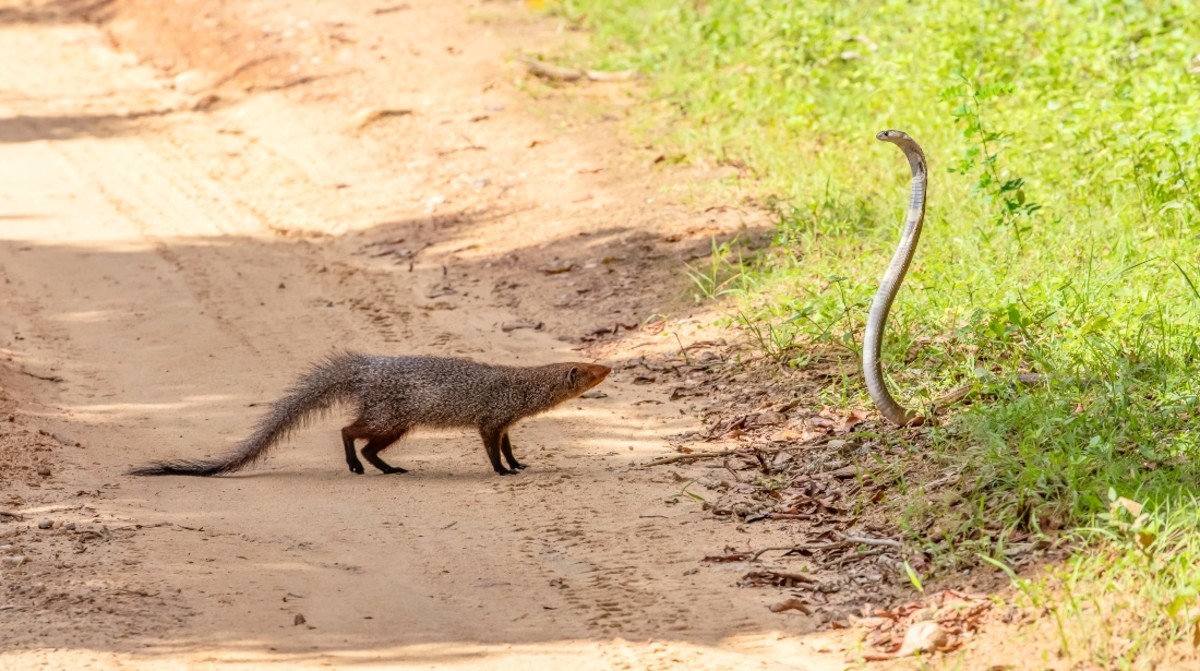
Ever seen those old grainy nature documentaries where a fuzzy little mammal goes toe-to-toe with a hood-flaring nightmare? It looks like a suicide mission. Honestly, if you were betting on size and lethality, you’d pick the cobra every single time. One bite from a King Cobra packs enough neurotoxin to drop an elephant, or about twenty grown men, in less than thirty minutes. Yet, the mongoose just doesn't seem to care. It’s one of nature’s most lopsided rivalries, but not in the way you’d think.
The mongoose is basically a furry lightning bolt.
When a mongoose fighting a cobra actually happens in the wild—not some staged roadside attraction in India—it isn’t just a brawl. It is a high-stakes chess match played at speeds the human eye can barely track. We’re talking about a predator that has evolved specifically to dismantle the defense systems of some of the world's most dangerous reptiles. It isn't just luck. It’s a combination of freakish biology and specialized combat tactics.
The Secret Biology of the Cobra-Killer
Most people think the mongoose is just too fast to get bitten. That’s a huge part of it, sure. But it’s not the whole story. What really makes this animal a "snake-killer" is tucked away inside its DNA.
Most mammals have nicotinic acetylcholine receptors that are shaped in a way that allows snake venom (specifically alpha-bungarotoxins) to bind to them. When that happens, the toxin blocks the signals from your brain to your muscles. You stop breathing. You die. But the mongoose? Evolution gave it a "shield." Its receptors are shaped differently, so the venom molecules literally cannot "plug in." They just bounce off.
While a mongoose isn't 100% immune—a massive dose from a King Cobra can still kill it—it can survive bites that would instantly paralyze almost anything else. It's like bringing a bulletproof vest to a gunfight.
Even with that biological backup, the mongoose prefers not to get hit. It relies on its "reaction time." A cobra’s strike is fast, moving at roughly 8 to 12 feet per second. But the mongoose’s reflexes are significantly faster. It exploits the "reload" time of the snake. Once a cobra misses, it has to pull back and reset its coil. That’s when the mongoose strikes.
How a Mongoose Fighting a Cobra Actually Goes Down
It starts with the dance. You’ve probably seen the footage: the mongoose bristles its fur. This is a brilliant trick. By making its hair stand on end, it looks twice its actual size. More importantly, it creates a "buffer zone." If the cobra strikes, it’s likely to get a mouthful of thick, wiry fur instead of flesh.
The mongoose circles. Constant movement. It’s trying to tire the snake out.
Cobras are cold-blooded. They have incredible explosive power but very poor stamina. Every time the cobra strikes and misses, it burns through its limited energy reserves. The mongoose, being a warm-blooded mammal with a high metabolism, can keep this up for an hour. The snake gets sluggish. Its strikes become predictable.
Then comes the finale.
The mongoose isn't looking to nip or scratch. It’s looking for the skull. It waits for that one split second when the cobra’s head is extended and low. With a burst of speed that looks like a blur, the mongoose lunges and delivers a crushing bite to the back of the snake's head. It has incredibly sharp teeth and a jaw pressure that can crack the snake's vertebrae or cranium instantly. Game over.
Misconceptions About the King Cobra
We have to talk about the King Cobra specifically because it's the one everyone asks about. Technically, the King Cobra (Ophiophagus hannah) isn't a "true" cobra. It's in its own genus. It’s also much, much larger than the Spectacled Cobras or Monocled Cobras that mongooses usually hunt.
In the wild, a typical Grey Mongoose usually avoids a full-grown King Cobra. It’s just basic math. A 15-foot snake is too big to kill with one bite, and the sheer volume of venom might overcome the mongoose's natural resistance. However, smaller cobra species? They are regularly on the menu. The mongoose is an opportunist. It eats birds, seeds, and rats, but it genuinely enjoys the taste of snake.
The Cultural Impact of the Rivalry
This isn't just a biology lesson. This fight is baked into human history.
Rudyard Kipling’s Rikki-Tikki-Tavi is probably why most of us even know what a mongoose is. While that story is a bit of a romanticized fable, Kipling actually got a lot of the mechanics right. He described the "red eyes" and the "scuttling" movement.
In parts of India and North Africa, mongooses were historically kept almost like cats to keep cobras and vipers away from homes. Ancient Egyptians actually revered the Ichneumon (the Egyptian mongoose). They saw it as a protector. There are even depictions in ancient art of mongooses fighting winged serpents. It’s one of the oldest "hero" stories in nature.
What Happens When the Snake Wins?
It does happen. Don't let the documentaries fool you into thinking the mongoose is invincible.
If a cobra manages to land a clean bite on a limb or the underbelly where the fur is thinner, the mongoose is in trouble. Even with mutated receptors, a high-volume injection of neurotoxin will lead to "respiratory distress." The mongoose will become slow. Once it loses its speed, it loses its only real defense.
Usually, if a mongoose realizes it’s outclassed—say, the snake is too large or the terrain is bad—it will just leave. It’s a professional killer, not a gladiator looking for glory. It wants a meal, not a fair fight.
Why This Matters Today
Understanding the mongoose fighting a cobra isn't just about watching a "nature's greatest hits" video. It has real-world applications in medical research. Scientists study the mongoose's nicotinic receptors to figure out how to create better antivenoms for humans. If we can mimic that "molecular shield" in the human bloodstream, we could potentially neutralize the effects of some of the world's deadliest snakes.
Also, the mongoose teaches us a lot about "niche evolution." In areas where cobras are common, mongooses thrive. They have filled a gap in the ecosystem that almost no other predator can touch. Most animals see a cobra and run. The mongoose sees a cobra and sees a high-protein dinner.
Practical Insights for Wildlife Enthusiasts
If you’re ever in a region where these animals coexist—like rural India, Southeast Asia, or parts of Africa—keep these facts in mind:
- Don't expect to see this in your backyard. Both animals are generally shy. The mongoose is a nervous, twitchy creature that prefers to stay hidden in the brush.
- The "Snake Charmer" myth. Many "fights" staged for tourists are incredibly cruel. Often, the cobra’s fangs are pulled or its mouth is sewn shut. It isn't a real display of nature; it’s animal abuse. Real encounters are rare and happen in deep cover.
- Respect the speed. If you ever see a mongoose move, you’ll realize why humans struggle to photograph them. They don't run; they liquidize.
- Safety first. If you find a cobra, do not wait for a mongoose to show up and save you. Back away slowly. Cobras generally don't want to waste venom on something they can't eat (like you), but they will defend themselves if cornered.
The battle between the mongoose and the cobra is a perfect example of the "evolutionary arms race." The snake develops deadlier venom; the mongoose develops a resistance. The snake gets faster; the mongoose gets better at dodging. It’s a cycle that has been spinning for millions of years, and it’s a masterclass in how life adapts to the most lethal challenges imaginable.
Your Next Steps for Exploring Wildlife Biology
To dive deeper into how these specialized predators work, start by looking into the specific species found in your region or the region you plan to visit. The Indian Grey Mongoose (Urva edwardsii) is the most famous snake-hunter, but there are over thirty species of mongoose globally, each with different habits.
If you're interested in the science of venom, research "molecular mimicry" and "acetylcholine receptor mutations." These are the technical terms for the mongoose’s secret weapon. You can also look up the work of Dr. Bryan Fry, a leading venom expert who has spent years deconstructing how these toxins interact with different animal species.
Finally, if you want to see the "dance" without supporting unethical animal tourism, look for verified high-speed footage from reputable sources like National Geographic or the BBC's Planet Earth series. They use specialized cameras that can slow down the action, allowing you to see the exact millisecond the mongoose makes its move. This provides a much clearer understanding of the physics involved than any grainy viral video ever could.