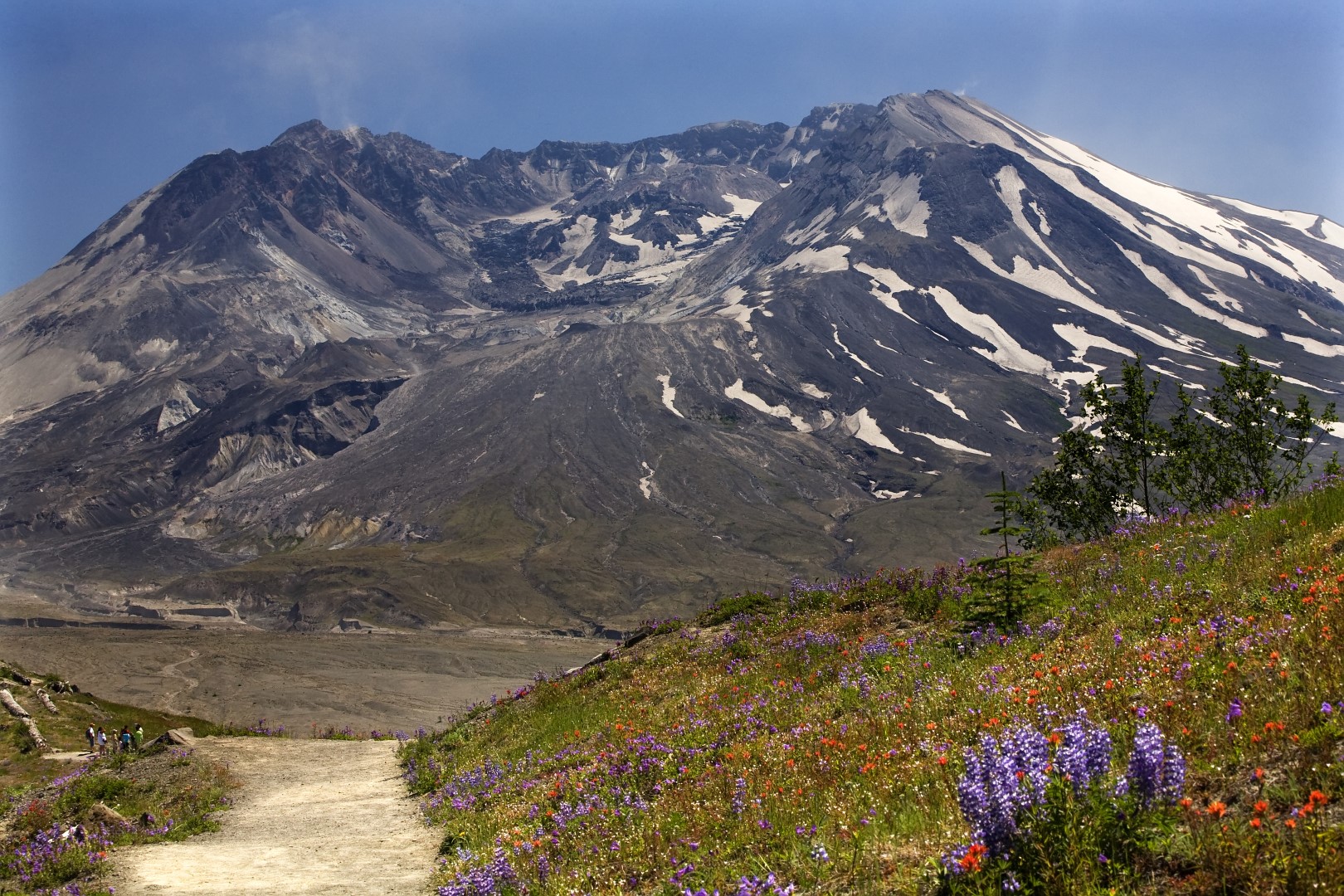
If you look at a photo of Mt. St. Helens before and after the 1980 eruption, the first thing you notice is the shape. It went from a "Fuji of America" symmetrical peak to a hollowed-out horseshoe. But honestly? The shape is the least interesting part of the story. What really changed was the very definition of how we understand planetary recovery.
Before May 18, 1980, the mountain was a playground. It was 9,677 feet of postcard-perfect alpine beauty. Then, in a few seconds, it lost 1,300 feet of its height. It didn't just blow its top; it fell apart sideways. This was the largest landslide in recorded history, and it moved at over 100 miles per hour. People think of lava when they think of volcanoes, but at Mt. St. Helens, the real killer was the debris and the lateral blast. It was a grey, suffocating mess that turned a lush evergreen forest into a lunar landscape.
The Mountain That Was
Spirit Lake used to be the crown jewel of the Cascades. If you were there in 1979, you’d see heavy timber—centuries-old Douglas firs—lining the shores. It was a destination for Boy Scout camps and families staying at Harry R. Truman’s lodge. Truman, the 83-year-old crusty caretaker who refused to leave, became a folk hero of sorts. He had 16 cats and a lot of Pink Floyd records, and he basically told the authorities where to shove their evacuation orders. He’s still there, buried under hundreds of feet of debris.
The ecosystem was "climax forest." That's a fancy way of saying it was stable, old, and deep. The air smelled like pine needles and damp earth. If you hiked the trails back then, you were shaded by a canopy so thick that the sun barely hit the forest floor. It felt permanent. It felt indestructible.
The 57 Seconds That Changed Everything
At 8:32 a.m., a 5.1 magnitude earthquake shook the ground. The north face of the mountain didn't just crack; it slid. It was like pulling the cork out of a pressurized champagne bottle. Because the pressure was released laterally, the blast went sideways.
The heat was enough to vaporize water instantly.
Trees were snapped like toothpicks. Not just snapped—de-barked. The force of the wind was so intense it stripped the bark off massive logs before tossing them miles away. About 230 square miles of forest vanished. Just gone. What was left behind was a "pumice plain," a sterile, searing hot field of volcanic rock that looked like it belonged on the moon. Scientists at the time, including those from the U.S. Geological Survey (USGS) like David Johnston, were stunned. Johnston’s last words over the radio were, "Vancouver! Vancouver! This is it!" He was five miles away at an observation post and didn't survive.
Mt. St. Helens Before and After: The Shocking Biological Rebirth
Everyone thought it would take centuries for life to come back. They were wrong.
Basically, the "after" isn't just a story of destruction; it’s a story of "biological legacies." This is a term scientists like Jerry Franklin use to describe the stuff that survived under the snow or underground. Because the eruption happened in spring, there were still patches of snow. That snow acted as a shield for small saplings and hibernating animals like pocket gophers.
The pocket gopher is the unsung hero of Mt. St. Helens.
These little guys survived in their burrows. When they started digging after the blast, they churned up fresh soil and seeds that had been buried under the ash. They literally plowed the way for the first plants. Then came the lupine. These purple flowers are "nitrogen fixers." They don't need rich soil to grow; they create their own nutrients. They paved the way for everything else.
If you visit today, the Mt. St. Helens before and after contrast is still jarring, but the "after" is surprisingly green. Spirit Lake is still covered in a "log mat"—thousands of those old-growth trees that were swept into the water 40 years ago are still floating there. They move with the wind like a giant, wooden jigsaw puzzle.
Why the "After" is Still Dangerous
The volcano isn't dead. It's just resting. Between 2004 and 2008, the mountain went through a massive "dome-building" phase. It didn't explode, but it oozed thick, pasty lava that built a new mini-mountain inside the crater. If you look at high-res satellite imagery now, you can see the glacier that formed around that dome. It’s the youngest glacier on Earth. It’s growing, despite global warming, because the crater walls shade it and the volcanic rock insulates it. Nature is weird like that.
The danger now isn't just an eruption; it's lahars. These are massive mudflows. The Toutle River valley is still full of volcanic sediment. A heavy rain can turn that ash into a slurry with the consistency of wet concrete that can wipe out bridges miles downstream.
Misconceptions About the Recovery
People often think the "after" photo should look like the "before" photo by now. It doesn't. And it shouldn't.
Some people were mad that the Forest Service didn't replant everything. But the Mount St. Helens National Volcanic Monument was created specifically to let nature do its thing without human interference. This gave us a front-row seat to "primary succession." We learned that nature doesn't need a head start. It's resilient.
- The Ash: It wasn't soft like wood ash. It was pulverized rock. It ruined car engines and killed crops across three states.
- The Heat: The pyroclastic flows reached 1,300 degrees Fahrenheit.
- The Lake: Spirit Lake’s surface rose by 200 feet. It went from a clear alpine lake to a black, boiling soup of bacteria and logs in minutes.
Actionable Insights for Your Visit
If you’re planning to see the Mt. St. Helens before and after reality for yourself, don't just go to the gift shop. You need to see the scale.
- Check the Johnston Ridge Observatory: This is the closest you can get. You are staring right down the throat of the volcano. You can see the path the landslide took. (Note: Check for road closures, as the 2023 debris flow damaged access roads recently).
- Hike the Hummocks Trail: These "hummocks" are actually giant pieces of the mountain that were carried miles away by the landslide. It feels like walking through a maze of mini-mountains.
- Look for the "Ghost Logs": Go to the viewpoints overlooking Spirit Lake. The logs you see floating there are the same ones from the 1980 eruption. They are a literal bridge to the past.
- Ape Cave: If you want to see the volcanic history from before 1980, go to the south side. The lava tubes there are from an eruption nearly 2,000 years ago. It’s a completely different environment—cool, dark, and damp.
The most important takeaway is that the mountain isn't "broken." It’s just different. The "after" is a living laboratory that has taught us more about ecology than almost any other event in the 20th century. The grey is being replaced by green, but the scars are deep, and they are beautiful in their own haunting way.
To truly understand the transition, you have to look past the missing peak and look at the floor of the crater. Life is thriving in a place that was once sterilized by 1,000-degree heat. That’s the real story of Mt. St. Helens.