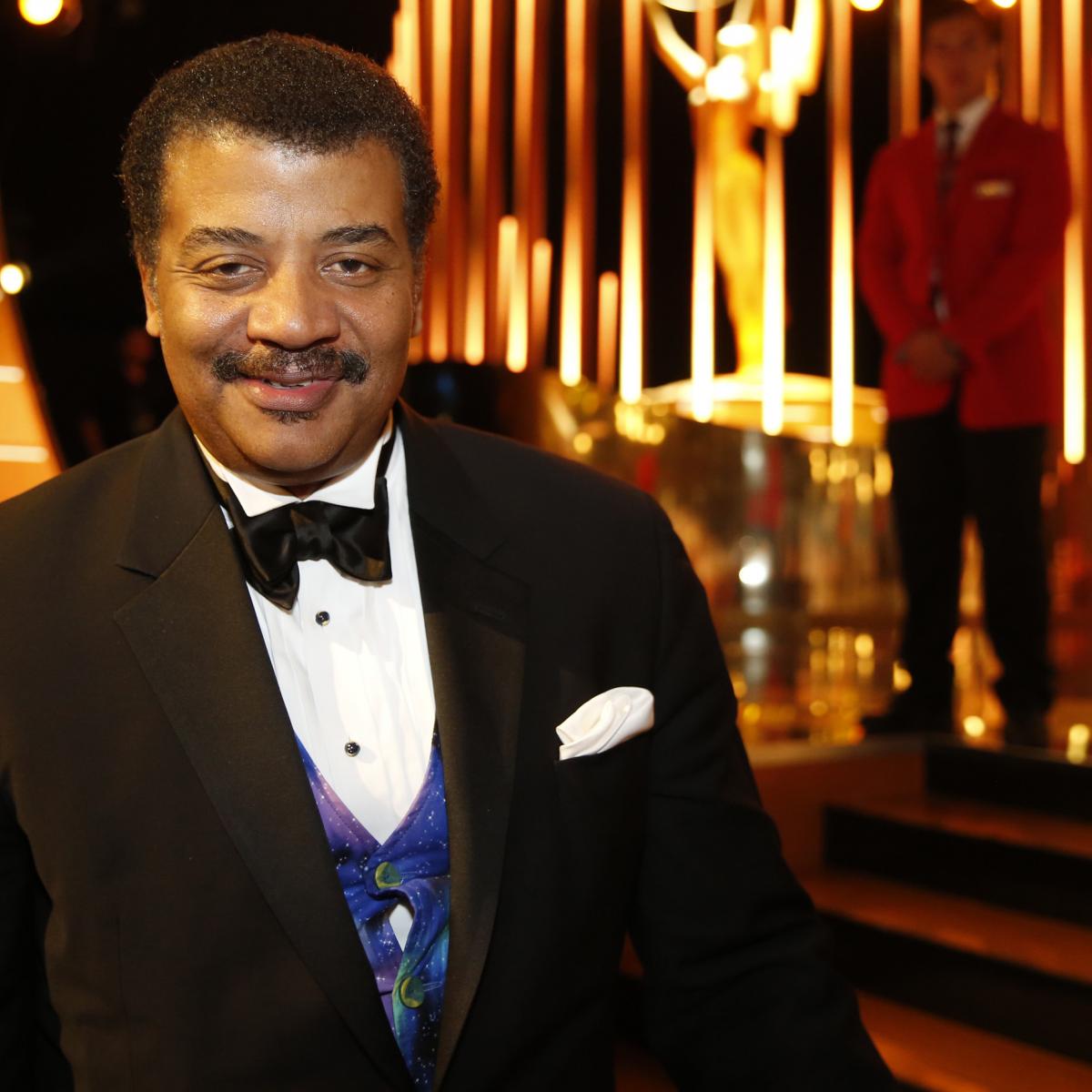
It usually starts with a notification. You look down at your phone and see that familiar profile picture—the one with the vest and the cosmic backdrop—and you just know. Neil deGrasse Tyson has posted another tweet.
Maybe he’s dunking on the physics of a blockbuster movie three days after it premiered. Perhaps he’s pointing out that technically, New Year’s Day is an arbitrary point in Earth’s orbit that doesn't actually signify anything in the vacuum of space. Or, in what has become a weirdly specific tradition, he’s reminding everyone on December 25th that Isaac Newton was also born on that day.
Whatever it is, it’s going to go viral. And half the people reading it are going to be annoyed.
The Art of the "Actually"
Let’s be real: Neil deGrasse Tyson has perfected the "well, actually" of social media. He isn't just an astrophysicist; he’s the internet's unofficial high school science teacher who refuses to let you enjoy a movie if the stars are in the wrong place.
Take his 2024 and 2025 activity. Even as the platforms change—moving from Twitter to X and beyond—the vibe remains remarkably consistent. He’s obsessed with the "truth," even when the truth feels like a wet blanket. For example, he recently spent time explaining why the "supermoon" isn't actually that much bigger than a regular moon, effectively telling everyone to stop staring at the sky in awe because, scientifically, it’s just a 7% difference.
Why does he do it? Honestly, he’s told us. In several interviews, including a notable chat with AV Club, Tyson defended his pedantic streaks. He says these tweets aren't meant to be "spoiler" moments or "gotchas." Instead, he views them as a way to "enhance your viewing pleasure."
He thinks that by knowing the real science behind Interstellar or Top Gun: Maverick, you’re actually getting a deeper, richer experience. It’s like knowing the ingredients in a five-star meal. To him, the science is the seasoning. To the rest of us? Sometimes it just feels like he’s trying to prove he’s the smartest guy in the digital room.
When Data Meets Drama
There is a specific type of Neil deGrasse Tyson tweet that goes beyond movie science and enters the territory of genuine controversy. We saw a massive example of this when he tried to use "objective data" to contextualize a mass shooting.
He listed various ways people die—medical errors, the flu, car accidents—and compared those numbers to the victims of a recent tragedy. The backlash was immediate. It was visceral. People weren't just annoyed; they were furious.
The problem? Humans aren't data-processing machines. We are emotional, messy, grieving creatures. Tyson later apologized on Facebook, admitting he "miscalculated" how the information would be received. He realized that a fact can be 100% true but 0% helpful in a moment of collective trauma.
This brings up a bigger question about his role in 2026. Is he a scientist or a celebrity?
Lately, his feed has taken some unexpected turns. In April 2025, he posted a photo holding four different red hats, including a "Make America Great Again" hat, alongside variations like "Make Lying Wrong Again." He asked his 14 million followers which one he should wear. It sparked a frenzy. People on the left thought he was "going Rambo"; people on the right thought he was mocking them.
Then there was the post about his wife, Alice Young, at a shooting range, where he mentioned she was a student member of the NRA. For a guy who usually sticks to the curvature of spacetime, these forays into the culture war feel like a sharp left (or right) turn.
The Pluto Grudge is Real
You’d think after twenty years, people would move on. Nope.
Tyson recently told People magazine that he still gets "hate mail" from former elementary school students. Why? Because he was the guy who helped "kill" Pluto. He’s the "accessory to the demotion."
It’s hilarious when you think about it. There are grown adults walking around today who still harbor a grudge against this man because their third-grade poster of the solar system became obsolete. He doesn't seem to mind, though. He leans into it. He’ll tweet about how Earth’s moon is five times more massive than Pluto and just tell everyone to "get over it."
That’s the core of his brand: cold, hard facts delivered with a smirk.
Why We Can't Unfollow
Despite the eye-rolling, his engagement numbers are astronomical. He’s one of the few scientists who has successfully transitioned into a full-blown "science influencer."
- He makes science accessible. He compared black holes to a "human version of the roach motel"—you check in, but you don't check out.
- He forces us to look up. Even if he’s being a buzzkill about the moon, he’s getting millions of people to look at the sky.
- He’s authentic. Love him or hate him, those tweets are clearly written by him, not a PR team. The "dad joke" energy is too specific to be manufactured.
What’s the Takeaway?
If you're following Neil deGrasse Tyson, you have to accept the package deal. You get the mind-blowing facts about the James Webb Space Telescope, but you also get the tweet about how a "leap year" is actually a misnomer because we aren't leaping anywhere.
He is a bridge. Sometimes that bridge is made of high-quality steel, and sometimes it's a bit rickety and annoying to cross. But in a world where scientific literacy is often in short supply, having a guy who can trend on X by talking about Isaac Newton’s birthday isn't the worst thing in the world.
If you find yourself getting heated over a Neil deGrasse Tyson tweet, just remember his own advice: curiosity is a fundamental part of discovery, but there's a limit to how much you should let it stress you out.
Check out your own local planetarium’s schedule this month to see the stars without the Twitter commentary. Or, if you’re feeling spicy, go reply to his latest post with a "well, actually" of your own. He’d probably respect the hustle.