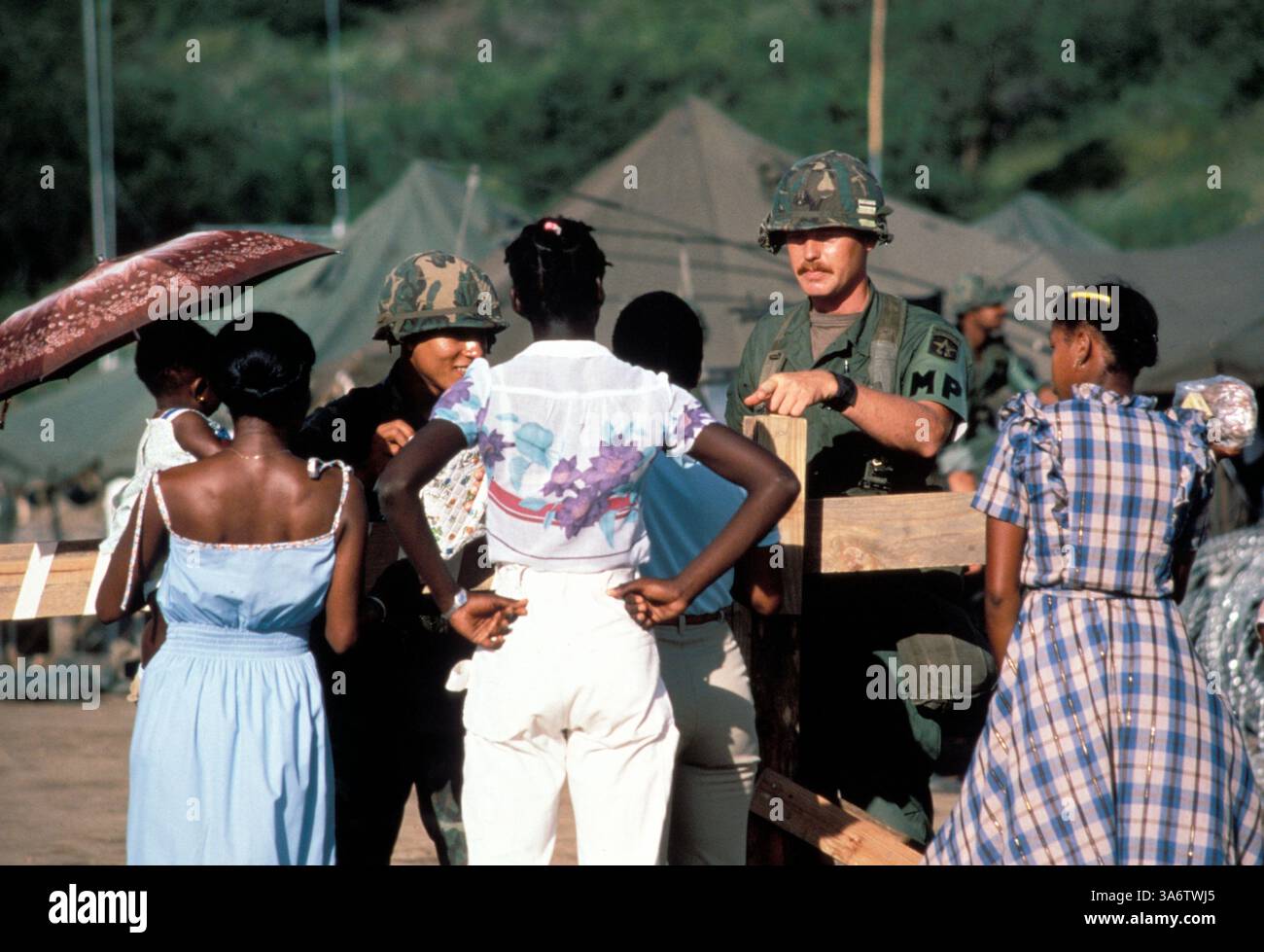
It was barely dawn on October 25, 1983, when the silence over the "Spice Isle" shattered. Most Americans woke up to news of a war they didn't see coming, in a place many couldn't find on a map. Grenada. A tiny Caribbean island known more for nutmeg than geopolitics suddenly became the flashpoint of the Cold War.
People still argue about it. Was it a rescue mission? A blatant violation of international law? Or just a superpower flexing its muscles after the nightmare of the Vietnam War? Honestly, the invasion of Grenada 1983—codenamed Operation Urgent Fury—was a chaotic, messy, and surprisingly pivotal moment in military history that changed how the U.S. fights to this day.
The Spark: A Bloody Coup and 600 Scared Students
Context is everything here. You can't understand why Reagan sent in the Rangers without looking at the internal meltdown of Grenada’s government. Since 1979, the island had been run by Maurice Bishop, a charismatic leader of the New Jewel Movement. He was a Marxist, sure, but he was also trying to maintain some level of pragmatism.
Things went south fast in October 1983.
A hardline faction within his own party, led by Bernard Coard and backed by the military, thought Bishop wasn't radical enough. They placed him under house arrest. When thousands of Grenadians freed Bishop and marched to Fort Rupert, the military opened fire. They executed Bishop, several cabinet ministers, and even pregnant women. The island was under a 24-hour shoot-to-kill curfew.
Basically, the place was a powderkeg.
Meanwhile, at St. George’s University School of Medicine, about 600 American medical students were caught in the middle. This became the official "why" for the U.S. intervention. After the Iran Hostage Crisis just a few years prior, the Reagan administration was terrified of another long-term hostage situation. They weren't going to let it happen again.
Why the Pentagon Was Actually Worried
While the students were the public face of the mission, the real "big picture" concern was a 9,000-foot runway being built at Point Salines.
Construction was being handled by British contractors but—and this is the part that kept D.C. up at night—hundreds of Cuban "construction workers" were doing the heavy lifting. The U.S. claimed this wasn't for tourists. They argued it was a refueling base for Soviet and Cuban planes heading to insurgencies in Africa or Central America.
Fidel Castro insisted it was just for jumbo jets and Caribbean tourism. Reagan didn't buy it.
The Organization of Eastern Caribbean States (OECS) actually made a formal request for U.S. intervention. They were terrified the violence in Grenada would spill over and destabilize the whole region. So, with a mix of humanitarian concerns and Cold War strategy, the wheels started turning.
Fast. Maybe too fast.
The Chaos of Operation Urgent Fury
Military buffs often point to the invasion of Grenada 1983 as a "successful failure." On paper, the U.S. won in days. In reality, the coordination was a nightmare.
Because the mission was slapped together in about 48 hours, the intelligence was garbage. Delta Force operators and Navy SEALs were sent in with tourist maps because the military didn't have updated topographical charts of the island. Imagine trying to coordinate an airstrike using a map you bought at a gift shop.
Communication was even worse.
There's a famous (and true) story of an Army officer who couldn't reach the Navy ships offshore to call in fire support because their radios weren't compatible. He ended up using a credit card at a payphone to call his base in North Carolina, who then patched him through to the Pentagon, who then signaled the ships.
It sounds like a comedy, but people were dying.
The Fighting on the Ground
On the morning of the 25th, the 1st and 2nd Ranger Battalions performed a daring low-level parachute jump onto the Point Salines airfield. They didn't even have time to pack their chutes—they just jumped at 500 feet to stay under the radar.
They expected light resistance. They got heavy anti-aircraft fire.
The "construction workers" from Cuba turned out to be well-trained soldiers. They fought hard. Over at the Richmond Hill Prison and Fort Rupert, the resistance was stiff. It took three days of intense, sometimes confused fighting to secure the island. By the time it was over, 19 Americans were dead, and over 100 were wounded. The Grenadian and Cuban forces suffered much higher casualties—at least 45 Grenadians and 24 Cubans died.
What Most People Get Wrong About the Aftermath
If you read the international press at the time, you'd think the U.S. had just started World War III. The UN General Assembly actually passed a resolution calling the invasion a "flagrant violation of international law." Even Margaret Thatcher, Reagan's closest ally, was furious. She hadn't been properly consulted about an invasion of a Commonwealth realm.
But here’s the twist: The Grenadians themselves were largely thrilled.
Journalists who arrived on the island shortly after the smoke cleared found a population that felt liberated from a murderous military junta. "God Bless America" signs popped up. Today, October 25th is still celebrated as Thanksgiving Day in Grenada. It’s a rare instance where the "liberator" label actually stuck with the locals, despite the geopolitical controversy.
The Long-Term Impact on the US Military
The invasion of Grenada 1983 was the ultimate "lessons learned" moment. The logistical failures were so embarrassing that they led directly to the Goldwater-Nichols Act of 1986.
This law completely overhauled how the U.S. military operates. It forced the Army, Navy, Air Force, and Marines to actually talk to each other—a concept called "jointness." If you look at the precision of the Gulf War in 1991, that was the direct result of the botched radio calls and tourist maps in Grenada.
It also boosted Reagan's popularity. After the "Vietnam Syndrome," where Americans were wary of any military intervention, Grenada felt like a win. It was quick. It was (mostly) successful. It brought the "hostages" home.
Nuance and Divergent Views
Of course, not everyone agrees it was necessary. Skeptics, like historian Hugh O'Shaughnessy, argued the "threat" to the medical students was exaggerated to justify a regime change. They point out that the school’s chancellor, Charles Modica, initially said the students weren't in danger—though he later changed his mind after seeing the violence firsthand.
Then there's the Cuban angle. Castro was actually furious with the Grenadian hardliners for killing Maurice Bishop. He sent orders to the Cubans on the island to defend themselves if attacked, but not to initiate combat. It was a weird, three-way tension that could have gone very differently if diplomacy had moved faster than the paratroopers.
Actionable Insights for History Enthusiasts and Travelers
If you're interested in the legacy of 1983, there are a few things you can actually do to see the history for yourself.
- Visit the Point Salines Airport: Now renamed Maurice Bishop International Airport, you can still see the massive runway that caused all the fuss. There’s a small memorial nearby for the fallen.
- Check the National Archives: If you're a researcher, look for the "Grenada Documents." The U.S. seized tons of communist government records during the invasion, which provide a fascinating look into how the New Jewel Movement functioned.
- Explore St. George’s: You can visit Fort George (formerly Fort Rupert), where Maurice Bishop was executed. The bullet holes are still visible in some of the walls—a stark reminder of the internal violence that triggered the intervention.
- Read the Goldwater-Nichols Act: For those into policy, reading the summary of this act shows exactly how a tiny Caribbean island forced the most powerful military on earth to rewrite its entire playbook.
The invasion of Grenada 1983 wasn't just a footnote. It was the end of one era of American hesitation and the beginning of a new, more assertive—and more organized—foreign policy. Whether you see it as a rescue or an overreach, its fingerprints are all over modern history.