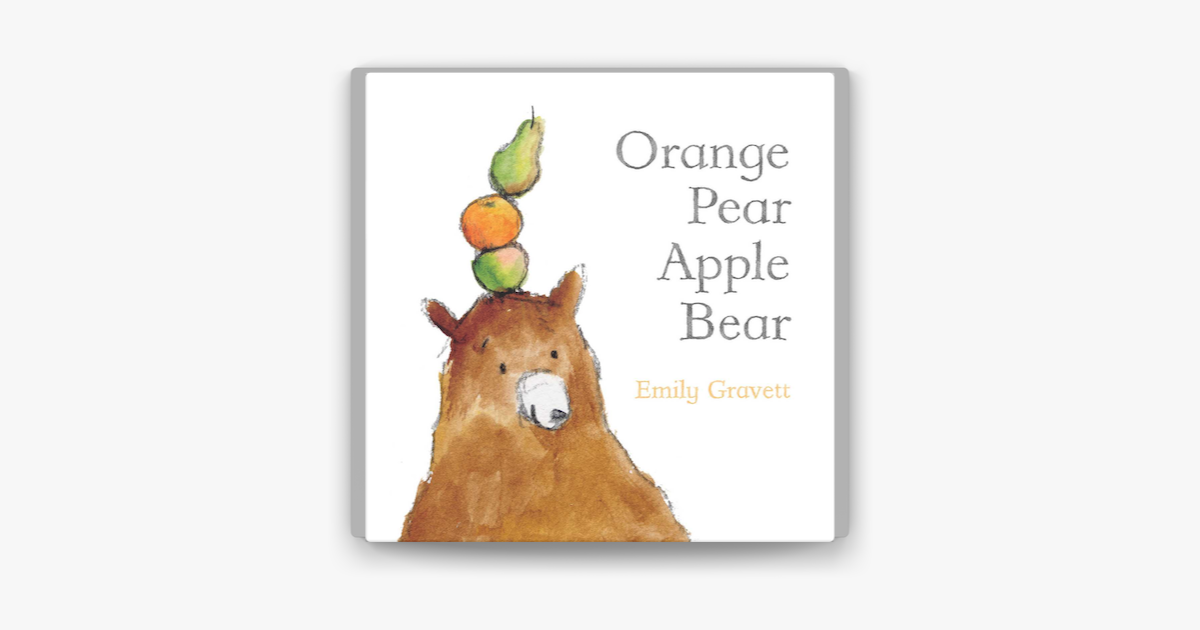
Most children’s books try too hard. They cram in complex morals, frantic plot twists, or vocabulary words that feel like homework. Then there is Orange Pear Apple Bear.
It’s basically five words. Seriously.
Emily Gravett, the mastermind behind this modern classic, managed to create a narrative arc using nothing but the four nouns in the title plus the word "there." It sounds impossible. It sounds like it shouldn't work. Yet, since its release in 2006, it has become a staple in nurseries and early childhood classrooms globally because it understands something fundamental about how the human brain—especially a tiny, developing one—processes language and art.
The Genius of Emily Gravett’s Minimalism
If you’ve ever sat down with a toddler, you know their attention span is roughly the length of a sneeze. Most "educational" books ignore this. They over-explain. Gravett does the opposite.
By using only Orange Pear Apple Bear, she forces the reader to look at the illustrations to find the story. The magic isn't in the text; it's in the space between the words. You see a bear. You see an apple. Then, suddenly, you see a "bear-shaped pear." It's a bit surreal, honestly. It’s a lesson in syntax and adjectives without ever using the word "adjective."
The book uses a pale, cream-colored background. No clutter. No distracting landscapes. This was a deliberate choice by Gravett, who often uses "white space" as a character in itself. By stripping away the noise, the colors of the fruit and the soft brown of the bear pop. It’s a visual palette cleanser for kids who are usually bombarded by high-contrast, neon digital media.
Why Your Toddler is Actually Learning Logic
We often think of reading as just decoding sounds, but Orange Pear Apple Bear is a masterclass in logic and permutations.
Think about it.
The book rearranges the words:
- Apple, pear, orange, bear.
- Apple, pear, bear, orange.
- Orange, pear, apple, bear.
It’s essentially a mathematical combinatorics lesson disguised as a bedtime story. Kids start to predict the pattern. They realize that changing the order of words changes the reality of the image. When the book says "Orange Pear," we see the fruit. When it says "Orange Bear," we see a bear that is literally the color orange. This is a massive "aha!" moment for a two-year-old. It teaches them that language is a tool for manipulation and creation, not just a set of labels.
Beyond the Words: The Art of the Watercolor
Emily Gravett didn't just draw a bear. She gave the bear a personality through posture and eye contact.
The bear in the book is somewhat apathetic, somewhat curious, and entirely charming. Gravett’s use of watercolors provides a soft, tactile feel that digital illustrations often lack. There’s a specific texture to the "pear" that makes you almost feel the grain of the skin.
Interestingly, Gravett has mentioned in various interviews and talks—including her features with the BookTrust—that her process involves a lot of trial and error with physical media. She doesn't just click a button. She layers the paint. This gives the book a "human" thumbprint. In an era where AI can generate a thousand images of a bear eating an apple in seconds, the hand-drawn imperfections in Orange Pear Apple Bear feel increasingly vital.
It’s also worth noting the pacing.
A lot of people breeze through this book in thirty seconds and think, "That's it?"
But they're doing it wrong.
The book is designed for "slow looking." You're supposed to pause. You're supposed to let the child point at the "apple bear" and laugh. The brevity of the text is an invitation for the parent to engage in "dialogic reading," which is just a fancy way of saying "talking about the pictures."
A Quick Reality Check on Early Literacy
Experts in early childhood education, like those at the National Association for the Education of Young Children (NAEYC), often emphasize that phonological awareness starts with rhythm.
This book is rhythmic.
Orange. Pear. Apple. Bear.
It’s a trochaic beat. It’s catchy. It sticks in the head like a pop song. This helps kids identify individual word boundaries, which is a precursor to actual reading. If you give a kid a book with forty words on a page, they see a wall of text. If you give them this, they see four distinct units of meaning.
The "Orange Pear Apple Bear" Misconception
People think this book is too simple.
"I could have written that," is a common refrain from skeptical parents. But you didn't. Because it’s incredibly hard to be this simple without being boring. Gravett avoids the "boring" trap by introducing a twist at the end. (Spoiler alert for a 20-page board book: the bear eats the fruit).
The ending—"there!"—is one of the most satisfying conclusions in children's literature. It provides a sense of closure and completion. The chaos of the fruit-swapping is over. Everything is where it should be (inside the bear).
Practical Ways to Use This Book at Home
Don't just read it. Use it as a springboard.
- The "Color Swap" Game: Grab an orange and an apple from your kitchen. Call the orange an "apple" and the apple an "orange." Watch your kid lose their mind. It helps them understand that names are arbitrary but specific.
- Create Your Own Version: Grab three toys and one fruit. "Lego, Truck, Banana, Bear." This helps with categorization skills.
- Focus on the "There": Use the final "there!" as a cue for clean-up time. It associates the word with a finished task.
Final Thoughts on the Gravett Legacy
Emily Gravett has won the Kate Greenaway Medal twice, and while her other books like Wolves or Tidy have more complex plots, Orange Pear Apple Bear remains her most "pure" work. It’s art. It’s a toy. It’s a lesson.
It reminds us that we don't need to overcomplicate childhood. Sometimes, you just need a bear, some fruit, and a bit of imagination.
To get the most out of your next reading session, try slowing down your pace significantly. Instead of reading the words as a list, treat each page as a standalone gallery piece. Ask your child what the bear is feeling on each page—you'll be surprised how much they project onto such a simple character. If you're looking to expand your library, seek out other minimalist board books that focus on "concept over content," such as those by Chris Haughton or Janik Coat, to build a foundational love for visual storytelling.