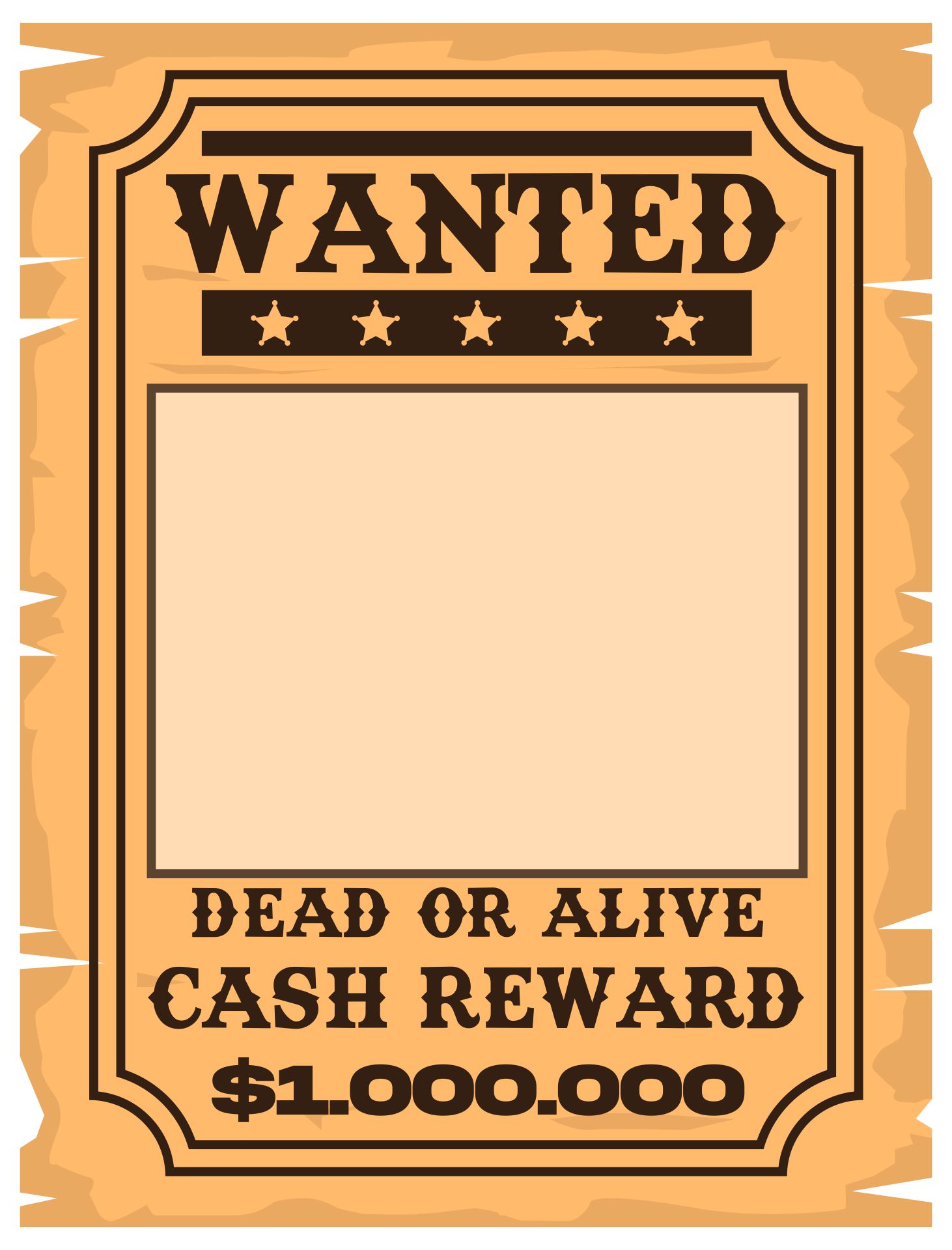
You’ve seen them in every cowboy movie ever made. A dusty piece of parchment tacked to a saloon door with a grainy photo of a scowling outlaw and "DEAD OR ALIVE" printed in massive, blocky letters. It’s iconic. It’s gritty. It's also, for the most part, a total fabrication.
Real wanted posters from the Old West were rarely that dramatic. Honestly, if you were walking down a street in Tombstone or Cheyenne in 1880, you probably wouldn't have seen many posters at all. They weren't these ubiquitous decorations we see in cinematic recreations. Most were actually small, text-heavy circulars or handbills distributed to lawmen, not the general public.
History is messy.
The "Dead or Alive" trope is one of the biggest misconceptions out there. While it did happen, it was exceptionally rare. Why? Because the legal system in the 19th-century United States actually cared about due process, even on the frontier. If a sheriff or a Pinkerton agent brought in a corpse instead of a breathing defendant, they often had a much harder time collecting the reward. They had to prove the identity of the deceased, which was no small feat in an era before fingerprinting or DNA. You couldn't just drop a body on a desk and ask for a bag of gold.
The Reality of Frontier Justice and Paper Trails
When we talk about real wanted posters from the Old West, we’re usually talking about "Reward Circulars." These were basically the LinkedIn of the outlaw world. They were sent through the mail to postmasters, sheriffs, and marshals. They weren't meant to be flashy; they were meant to be functional.
The Pinkerton National Detective Agency was the king of this. They were a private entity, and they were meticulous. A Pinkerton circular for someone like Butch Cassidy didn't just say "He's a bad guy." It listed his height, his weight, the color of his eyes, and any identifying scars or "peculiarities of gait." If a guy walked with a slight limp in his left leg, that went on the paper.
Why Photos Were So Rare
Think about the tech. Photography in the 1870s wasn't exactly a "point and shoot" situation. It was expensive. It was slow. If a criminal was on the run, how was the law supposed to get a photo of them?
Unless the outlaw had been arrested before or was vain enough to sit for a professional portrait in a studio—which, surprisingly, many did—the law had nothing to go on. This is why so many real wanted posters from the Old West are just walls of text. They describe the clothes, the horse, and the way the person talked.
Take the hunt for the James-Younger gang. After the disastrous Northfield, Minnesota raid in 1876, the posters didn't have high-def photos of Jesse James. They had descriptions of his missing fingertip. That's a real detail. Jesse James was missing the tip of his left middle finger from a mishap with a pistol. That's the kind of thing a lawman looked for, not a stylized drawing.
The "Dead or Alive" Myth vs. Hard Cash
We need to talk about the money. Most rewards were surprisingly small. We’re talking $50 to $200. While that was a lot of money when a cowboy made a dollar a day, it wasn't "retire on a private island" money.
The huge rewards—the $5,000 or $10,000 bounties—usually came from private companies, not the government. If you robbed a Union Pacific train or a Wells Fargo stagecoach, those corporations put up the bounty. They wanted their money back and they wanted to send a message.
One of the most famous real wanted posters from the Old West involved Billy the Kid. Governor Lew Wallace of New Mexico Territory offered a $500 reward for him. That sounds like a lot, but Wallace was actually criticized for it. People thought it was too much for a "petty thief." Imagine that. The Kid, arguably the most famous outlaw in history, was seen by some as a nuisance not worth the paper his name was printed on.
The Famous Jesse James Poster
The most "Hollywood-looking" poster is arguably the one issued for Jesse James by Governor Thomas T. Crittenden of Missouri. It offered $5,000 for his arrest and another $5,000 for his conviction.
Crucially, it did not say "Dead or Alive."
Crittenden actually got into a massive amount of legal and political hot water because he essentially conspired with Robert and Charley Ford to kill Jesse. When Bob Ford shot Jesse in the back of the head while he was dusting a picture in his home, the "reward" was paid out, but the public was disgusted. It wasn't the heroic justice people imagined. It was a dirty deal.
The Anatomy of an Authentic Circular
If you’re looking at a "vintage" poster today and trying to figure out if it's a fake, look at the font. Real 19th-century printers used a variety of typefaces. They loved "Wood Type" for headers. It was bold and irregular.
The paper wasn't usually burnt at the edges or stained with tea to look "old." It was high-quality rag paper or newsprint. It was meant to be folded up and put in a pocket.
Common elements included:
- The word REWARD in the largest font at the top.
- The name of the agency or the Governor issuing the notice.
- A date. Fakes often forget the date.
- A specific list of crimes. "Train Robbery" or "Grand Larceny" were more common than "Being a Desperado."
- Contact info for a specific Marshal or Express Company agent.
Collectors today pay thousands for the real deal. A genuine Pinkerton circular for the Sundance Kid (Harry Longabaugh) is a holy grail. Most of what you see in tourist shops in Tombstone? Total junk. They use the same fake "Billy the Kid" photo and a font that didn't exist until the 1950s.
Why These Documents Still Captivate Us
It's about the chase. These posters represent a time when the law was a thin, fragile line. In a world without GPS, cell phones, or a centralized FBI, a piece of paper was the only way to bridge the gap between a crime in one state and a capture in another.
They were the first real "viral" media.
But they also reveal the darker side of the West. Many posters weren't for famous outlaws. They were for "runaway servants" or people who had defaulted on debts. The West was built on credit and labor, and the law was often used to protect those interests above all else.
The Evolution of the Bounty
Eventually, the posters changed. By the early 1900s, the "Wild" part of the West was being tamed by the telegraph and the telephone. The posters became more standardized. They started looking like the mugshot-style flyers we see in post offices today. The romance was dying.
The last "Old West" style posters were arguably for the likes of John Dillinger or Bonnie and Clyde in the 1930s, but even those had a different feel. They lacked the frontier grit of a hand-pressed circular from 1880.
How to Spot a Fake (And What to Do if You Find a Real One)
If you happen to be digging through an old trunk in a basement in Kansas and find a "wanted" notice, don't assume it's a fortune. Most are reproductions from the 1960s.
First, check the paper. If it feels like parchment or is unnaturally "crinkly," it’s probably a fake. Real 19th-century paper was often made of linen or cotton fibers. It feels more like fabric than wood pulp.
Second, look at the ink. Real printing from that era leaves a slight "bite" or indentation in the paper because of the pressure of the printing press. Modern digital printing is flat.
Third, check the names. If it lists "The Daltons" or "The James Gang" collectively, it's likely a souvenir. Real posters usually targeted specific individuals.
If you think you have a real one, don't laminate it. Seriously. That ruins the value instantly. Keep it in a PVC-free plastic sleeve and contact an appraiser who specializes in "Westerniana" or paper ephemera. Organizations like the Wild West History Association (WWHA) are great resources for vetting these types of items.
Real wanted posters from the Old West provide a window into a world that wasn't nearly as black-and-white as the movies suggest. They show a society trying to organize itself, using ink and paper to fight back against the chaos of the frontier.
To truly understand the era, stop looking at the Hollywood posters. Look at the small, text-heavy circulars that were actually carried in the pockets of weary U.S. Marshals. That’s where the real history is.
To get started on your own historical deep dive, look into the digital archives of the Library of Congress or the National Archives. They have scanned thousands of original law enforcement documents from the 1800s. Comparing a real historical document to a movie prop is the best way to train your eye for authenticity. If you're interested in collecting, start by visiting specialized auctions rather than general marketplaces like eBay, where fakes are rampant. Focusing on "Express Company" circulars (like those from Adams or Wells Fargo) is often a more accessible entry point for new collectors than aiming for high-profile outlaws immediately.