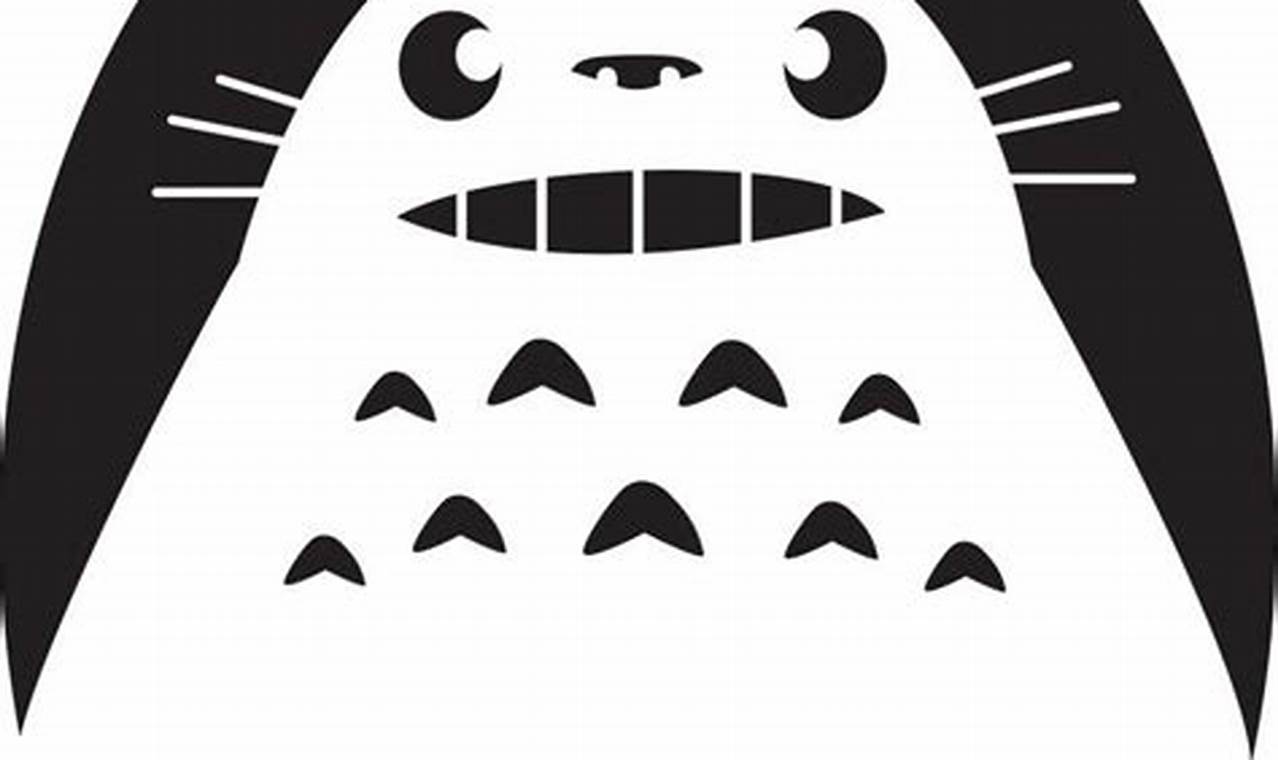
Let’s be real. Standard triangle eyes and toothy grins are boring. If you’re anything like me, your autumn mood board is less "slasher flick" and more "mossy forest vibes." That’s where Studio Ghibli pumpkin stencils come in. They turn a grocery store gourd into a piece of hand-carved art that feels like it just drifted out of a Hayao Miyazaki dreamscape.
But carving a Totoro isn’t just about being a superfan. It’s about the aesthetic. There is something deeply satisfying about seeing a glowing Soot Sprite on your porch when the October wind starts kicking up.
The Problem With Most Ghibli Stencils
Most people download the first blurry JPEG they see on Pinterest and realize—too late—that the physics of a pumpkin don’t work like paper. You cut out a circle for a Kodama head, and suddenly the whole face falls inward because there’s no "bridge" holding it together. It’s heartbreaking. You’ve spent forty minutes scraping out pumpkin guts only to have a structural collapse.
I’ve seen it happen. Honestly, it’s a tragedy.
To get a Studio Ghibli pumpkin stencil to actually work, you have to think about negative space. You aren't just drawing; you're engineering light. If you’re going for a complex design like the Catbus, you need to be surgical. Most experts suggest a "shaving" technique rather than a full cut-through for the finer details. This involves removing the skin and some of the flesh but leaving enough wall so the light glows through a warm orange instead of a bright, empty hole.
Finding the Right Pattern for Your Skill Level
Don't overreach. If this is your first time using a linoleum cutter or a tiny serrated blade, don't start with Howl’s Moving Castle. That thing has more moving parts than a Swiss watch.
- Beginner: Go for a No-Face (Kaonashi). His mask is basically two triangles and two semi-circles. It’s hard to mess up, and it looks incredibly eerie when lit from within.
- Intermediate: Totoro is the gold standard. You get to play with his belly markings, which are great for practicing those "island" cuts. Just remember to keep the whiskers thick enough that they don't snap off if a squirrel breathes on them.
- Expert: Princess Mononoke’s mask or the intricate clockwork of the Castle. These require "etching." You aren't cutting through the pumpkin at all; you're skinning it.
The Tools You Actually Need (And the Ones You Don’t)
Forget those cheap plastic kits from the drugstore. They break. They're dull. They make you want to give up on Halloween entirely.
If you’re serious about your Studio Ghibli pumpkin stencils, grab a X-Acto knife for the outlines and a small clay looping tool for the thinning. A clay loop allows you to scrape away the pumpkin wall from the inside or outside with way more control than a spoon. Also, keep some toothpicks or T-pins nearby. If a piece of Totoro’s ear snaps off, you can pin it back into place, and nobody will know the difference once the sun goes down.
Pro tip: use a bright LED instead of a real candle if your design is intricate. Real flames produce heat that can warp the thin walls of a detailed carving, causing it to wilt within hours.
Why We Are Still Obsessed With This Aesthetic
There is a specific term in Japanese called mono no aware. It basically translates to the pathos of things—a bittersweet realization that everything is temporary.
Pumpkins are the ultimate example of this. You spend three hours carving a perfect Jiji the cat, and in four days, it’s a moldy pile of mush. That’s very Ghibli. It’s that intersection of nature, hard work, and the inevitable passage of time.
Beyond the philosophy, these designs stand out because they aren't "scary" in the traditional sense. A Studio Ghibli pumpkin stencil brings a sense of wonder. It’s whimsical. In a neighborhood full of plastic skeletons and bloody zombies, a glowing forest spirit feels like a quiet rebellion. It turns your front step into a portal to another world.
The Best Characters for Shadow Projection
Have you ever tried "wall-casting"?
If you carve the back of your pumpkin with a large, simple silhouette—like the silhouette of Kiki flying on her broom—and leave the front mostly intact or lightly etched, the light will project the image onto the wall behind the pumpkin. This works best with Studio Ghibli pumpkin stencils that have clear, iconic outlines. Calcifer is a top-tier choice for this because the flickering light of the candle (or a flickering LED) makes the "fire" look like it’s actually dancing.
Avoiding the "Rot" Factor
Humidity is the enemy. Once you break the skin of the pumpkin, the clock starts ticking. Since Ghibli designs often require thin walls for that signature glow, they dry out or rot faster than a standard jack-o'-lantern.
- The Bleach Soak: After carving, dunk the whole thing in a bucket of water with a splash of bleach. This kills the bacteria and mold spores.
- Petroleum Jelly: Smear a thin layer of Vaseline on the cut edges. It seals in the moisture so the pumpkin doesn't shrivel up like a raisin.
- The Fridge Method: If you're carving this for a party that's two days away, wrap it in plastic and put it in the fridge. It sounds weird, but it works.
Making Your Own Stencil from Movie Stills
Can't find the exact scene you want? You can make your own. Find a high-contrast image from Spirited Away or Ponyo. Use a photo editor to turn it into a black-and-white "threshold" image.
The black parts are what you keep; the white parts are what you cut.
Just keep an eye out for "islands"—white spots completely surrounded by black. You have to create a "bridge" (a thin line of pumpkin) to connect that island to the rest of the gourd. If you don't, that piece has nowhere to hang onto and will just fall out, leaving you with a giant, unrecognizable hole.
Where to Look for Inspiration
I always tell people to look at the "art of" books published by Studio Ghibli. The concept sketches by Miyazaki himself are often more "carvable" than the finished animation frames. His lines are deliberate. They have a certain energy that translates well to woodcarving or pumpkin carving.
Also, don't ignore the soot sprites. They are the easiest Studio Ghibli pumpkin stencils to execute. You can do ten of them on one large pumpkin. Just a bunch of fuzzy circles with big eyes. It looks intentional and stylized rather than "I ran out of time."
Actionable Steps for a Perfect Ghibli Glow
To get started on your own masterpiece, follow these specific technical steps to ensure the structural integrity of your gourd:
- Select a "Flat-Faced" Pumpkin: For detailed stencils, a smooth, flat surface is much easier to work on than one with deep ribs. Look for "Pie Pumpkins" or "Cinderella" varieties if you want a more unique shape that fits the Ghibli vibe.
- Transfer the Pattern with Precision: Do not tape the paper to the pumpkin and start cutting through it. Instead, use a needle or a small awl to poke holes through the paper into the pumpkin skin every 1/8th of an inch. When you take the paper off, you'll have a "connect-the-dots" guide that is much more accurate.
- Carve from the Center Outward: This is the golden rule. If you start at the edges and move inward, the pumpkin becomes weaker as you go, and you’re more likely to break the delicate interior details. Always do the smallest, most central cuts first.
- Vary the Depth: Use your scraping tools to create different levels of light. A deep scrape will be bright yellow; a shallow scrape will be a deep, moody red. This "shading" is what separates a professional-looking Ghibli pumpkin from a standard one.
- Preserve the Interior: Scrape the inside wall of the pumpkin until it is about 1 inch thick in the area where you plan to carve. Any thicker and the light won't shine through your etches; any thinner and the pumpkin will collapse under its own weight.
By focusing on these technical nuances, you move beyond simple Halloween decorating and into the realm of seasonal craftsmanship. The goal isn't just a pumpkin; it's a tribute to the storytelling and artistry that makes Studio Ghibli a permanent fixture in our cultural lexicon. Get your tools ready, find a sturdy pumpkin, and let the forest spirits guide your hand.