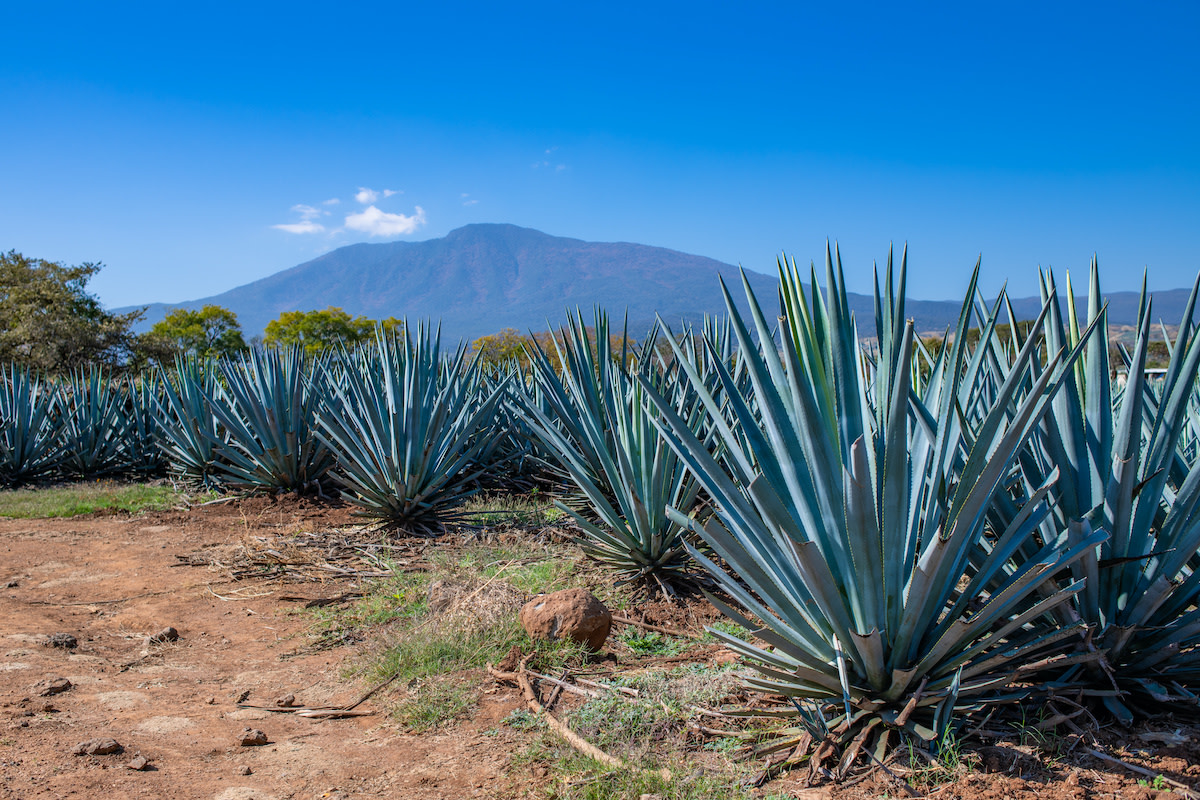
It's the question that usually hits right after the second round of margaritas. You’re looking at the bottle, noticing the prickly-looking logo, and wondering about tequila made from what plant exactly. Most people just shrug and say "cactus."
They're wrong. Totally wrong.
Tequila comes from the Agave tequilana Weber blue variety. It isn't a cactus. It’s actually a succulent, more closely related to the lilies in your garden or the onions in your pantry than to a Saguaro. If you touch one, you’ll find out quickly that those "leaves" are actually razor-sharp pencas that can slice a finger open in a heartbeat.
The Blue Agave: More Than Just a Pretty Succulent
The plant behind the spirit is a beast. We call it Blue Agave because of that distinct, dusty-blue hue caused by a waxy coating that helps the plant retain moisture in the brutal sun of Jalisco, Mexico. It takes roughly seven to ten years for one of these plants to reach maturity. Think about that for a second. While a bourbon maker can grow corn in a single season, a tequila producer has to wait a decade before they even think about harvesting.
This creates a massive economic ripple. If a disease hits or a frost freezes the fields, the supply chain doesn't just "reset" next year. It breaks for a generation.
Why the "Blue" Weber Matters
In Mexico, there are hundreds of types of agave (or maguey), but the law is incredibly strict. To call it "Tequila," it has to be tequila made from what plant the government dictates: specifically the Blue Weber. If you use a different agave, like Espadín or Tobalá, you're making Mezcal. If you grow Blue Weber in the wrong state—outside of Jalisco and specific parts of Guanajuato, Michoacán, Nayarit, or Tamaulipas—you can't call it Tequila. You’d essentially be making an "agave spirit," which doesn't carry the same weight (or price tag) on the shelf.
The Life and Death of a Piña
The part of the plant used for booze isn't the leaves. It’s the heart. When a jimador—the field worker whose job is a brutal mix of manual labor and artistry—decides a plant is ready, they use a long-handled tool called a coa to shave off the leaves. What’s left looks exactly like a giant pineapple. In fact, it's called a piña.
These things are heavy. A mature piña can weigh anywhere from 80 to over 200 pounds.
Once harvested, the plant's life is over. Unlike a grapevine that produces year after year, the agave is a one-shot deal. You kill the plant to make the drink. This is why sustainable farming in the tequila industry has become such a massive talking point lately. Brands like Patrón and Cascahuín are constantly under the microscope for how they manage their fields because if you over-harvest, you destroy the genetic diversity of the crop.
The Sweet Science of Starch
Basically, the piña is a storage locker for complex carbohydrates called fructans. You can’t just ferment a raw agave. If you bit into a raw piña, it would taste like bitter, starchy wood. You have to cook it. This process converts those fructans into fermentable sugars.
Traditionally, this happened in brick ovens called hornos for about two or three days. Modern industrial giants often use autoclaves (think giant pressure cookers) to speed it up to under 24 hours. Some purists, like the folks at Fortaleza, still use the old-school methods because they swear the slow bake caramelizes the sugars better, giving you those notes of roasted yam and vanilla.
The "100% Agave" Trap
You’ve seen it on the label. You probably look for it. But do you actually know why it’s there?
If a bottle doesn't say "100% de Agave," it’s a mixto. This means the producer only had to use 51% sugar from the tequila made from what plant we discussed—the Blue Weber. The other 49% can be basically anything else, usually cheap cane sugar or corn syrup. This is the stuff that gave you that legendary hangover in college. The additives and impurities in mixtos are far more punishing to your head the next morning than the agave itself.
Honestly, if you're buying anything that isn't 100% agave, you're not really drinking tequila; you're drinking a tequila-flavored sugar spirit.
The Diffuser Controversy
There is a growing rift in the tequila world regarding "diffusers." A diffuser is a massive machine that uses high-pressure water and sometimes chemicals to extract sugars from raw agave, skipping the roasting process entirely. It's efficient. It's fast. It’s also considered "soulless" by aficionados.
Experts like Grover Sanschagrin, who runs the Tequila Matchmaker database, have been vocal about identifying brands that use these industrial methods. While it’s technically still tequila made from what plant the law requires, the flavor profile is often stripped of its natural earthiness, leading brands to add artificial vanilla or oak flavors back in to make it palatable.
Terroir: Lowlands vs. Highlands
Just like wine, the dirt matters.
- Los Altos (The Highlands): These agaves grow at higher altitudes in red, iron-rich soil. The plants get bigger and hold more sugar. The resulting tequila tends to be sweeter, fruitier, and more floral.
- El Valle (The Lowlands): These plants grow in volcanic soil. They’re usually smaller and produce a spirit that is earthier, spicier, and a bit more "masculine" in its flavor profile.
If you ever want to impress a bartender, ask for a "Highland Blanco." It shows you actually give a damn about the geography of the plant.
How to Actually Drink It
Stop shooting it. Just stop.
If you have a quality spirit made from the Blue Weber agave, the salt and lime are distractions. They were originally used to mask the burn of poorly made, cheap tequila. A real Blanco should be sipped from a flute or a small glass. You want to smell the cooked agave, the citrus, and the black pepper.
When you move into Reposados (aged 2 to 12 months) or Añejos (aged 1 to 3 years), you’re tasting the interaction between the plant oils and the wood of the barrel. It’s a marriage of desert botany and French or American oak.
Practical Steps for Your Next Purchase
If you want the best experience with tequila made from what plant nature intended, follow these rules:
- Check the NOM: Every bottle has a four-digit number called a NOM. This tells you which distillery made it. Use a site like Tequila Matchmaker to see if that distillery also makes 20 other cheap brands. If they do, skip it.
- Look for "100% de Agave": If this isn't on the label, put it back on the shelf. No exceptions.
- Avoid the "Crystal Clear" Añejos (Cristalinos): These are aged tequilas that have been filtered through charcoal to remove the color. While trendy, the process often strips away the very character that the plant worked for ten years to create.
- Stick to Additive-Free: Brands like G4, Cascahuín, and Siete Leguas are famous for not using "abocantes" (additives). This is the purest expression of the plant you can find.
Understanding the botany behind the bottle changes the way you taste the drink. It’s no longer just a cocktail base; it’s a decade of Mexican sunshine and volcanic soil distilled into a glass. Next time you're at the store, ignore the celebrity-backed brands with the fancy bottles. Look for the ones that respect the agave.
Check the back label for the NOM. Search it online to see if they use a diffuser. If they don't, and it’s 100% Blue Weber, you’ve found the real deal.