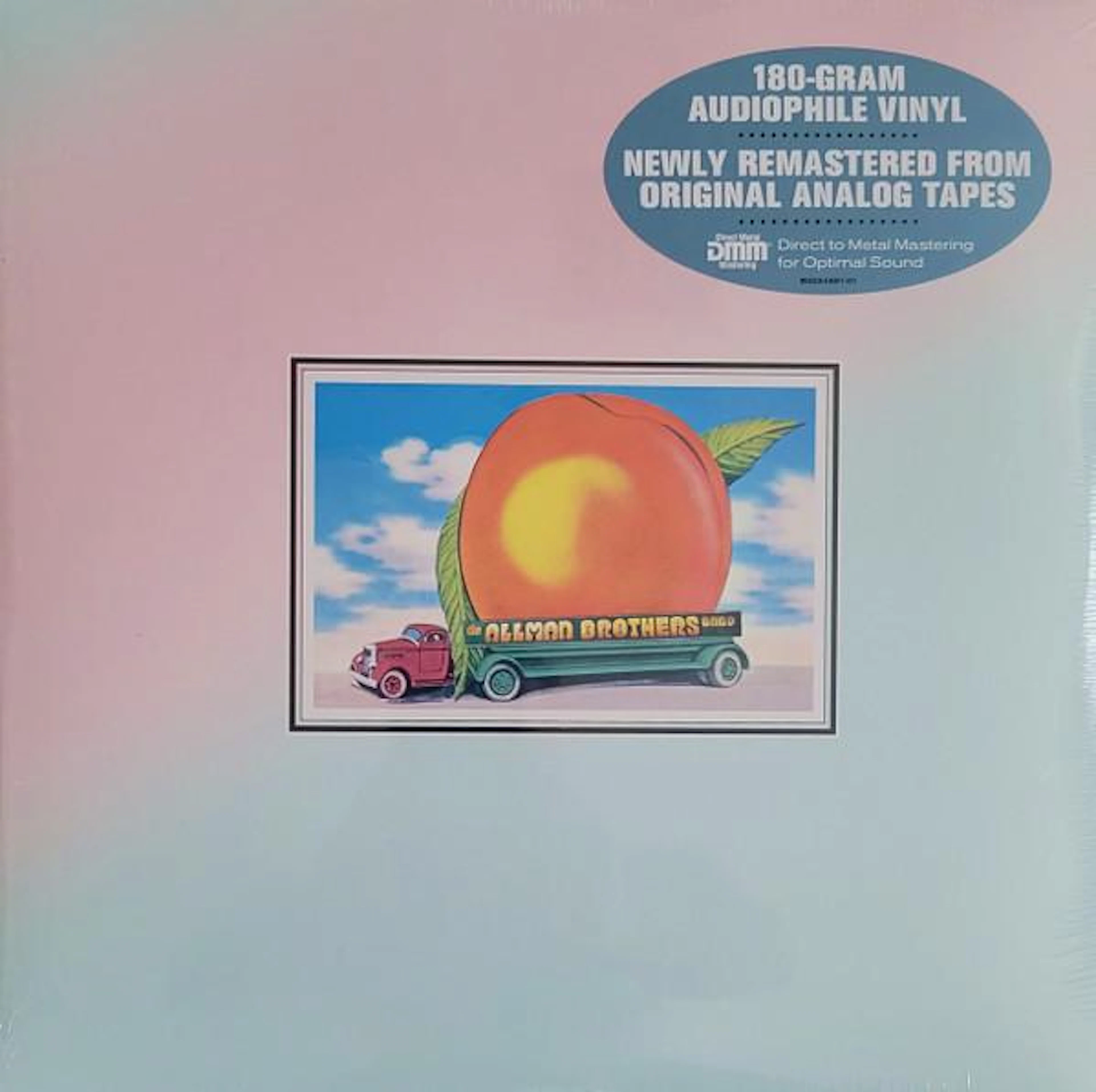
It is a giant peach on a flatbed truck. That is the image etched into the brain of every classic rock fan who has ever flipped through a milk crate of vinyl. But the Allman Brothers Band Eat a Peach album cover isn't just a quirky bit of 1970s surrealism. It is a heavy, bittersweet piece of history that marks the exact moment a band was forced to grow up way too fast.
You probably know the basics. Duane Allman, the undisputed heart and soul of the group, died in a motorcycle accident in October 1971. The band was in the middle of recording. They were exhausted. They were grieving. And they had to figure out how to package a double album that was half-studio, half-live, and entirely haunted by their missing leader. The resulting artwork, created by W. David Powell and Florentine Art Studio, became an icon of the era, but the story behind it is a lot less "hippie-dippie" than the bright colors suggest.
Why the Peach? (It’s Not Just About Fruit)
There is a persistent myth that the title and the Allman Brothers Band Eat a Peach album cover were a direct tribute to Duane’s love of peaches. People love a sentimental story. But the truth is a bit more cynical, or maybe just more rock-and-roll.
Duane was once asked by a reporter how he was helping "the revolution." He gave a classic Duane answer: "There ain't no revolution, only evolution, but every time I'm in Georgia, I eat a peach for peace." That quote is the seed. However, the decision to use the peach imagery for the cover was largely driven by the art directors at Warner Bros. and the band’s desire for something that didn't feel like a funeral.
The cover itself is a gatefold. On the front, you have that sun-drenched, yellowish-orange peach sitting on a truck. It looks like a postcard from a dream. But when you open it up? That’s where the real magic—and the weirdness—happens.
The Psychedelic Mural and the "Eat a Peach" Philosophy
If the front cover is a simple statement, the inside is a sprawling, chaotic universe. W. David Powell and James Flournoy Holmes were the architects of this gatefold mural. It’s a watercolor wonderland filled with mushrooms, playing cards, strange creatures, and a sense of motion that feels like a Southern summer afternoon on acid.
Actually, it’s literally a watercolor.
The artists took a large piece of illustration board and just started building this world. It wasn't meticulously planned out in a corporate boardroom. They were trying to capture the "vibe" of Macon, Georgia, and the band’s loose, improvisational style. They used a technique involving liquid watercolors and airbrushing to get those soft, bleeding edges.
The Hidden Details in the Gatefold
Most people just glance at the mural, but if you look closer, you see the fingerprints of the era. You’ve got the "Mountain Jam" influence everywhere. The sheer scale of the art mirrors the 33-minute track that takes up two sides of the vinyl.
- The mushrooms are the obvious nod to the band’s extracurricular activities and the iconography that would follow them forever.
- The playing cards and the "Ace" references tie back to the band's gambling-man personas.
- The sense of a journey—the truck on the front is heading into this landscape.
The Allman Brothers Band Eat a Peach album cover succeeded because it didn't put a photo of the band on the front. Think about that for a second. This was their first release after their star died. Most labels would have insisted on a somber portrait of Duane or a "memorial" shot of the remaining five members looking sad in a graveyard. Instead, they gave us a giant piece of fruit. It was a defiant move. It said the music—and the "peace" Duane talked about—was bigger than the tragedy.
The Truck Stop Reality
The truck on the cover wasn't some high-concept prop. It was a real truck photographed at a real truck stop. Specifically, the photography was handled by a guy named Steve Smith. The band wanted something that felt like the road. Because for the Allmans, the road was home. They were the ultimate touring band.
When you see that peach on the flatbed, it’s a metaphor for the band’s output. They were "delivering" the goods. The contrast between the mundane truck and the oversized, impossible peach is what makes it "pop." It’s a precursor to the kind of surrealism you’d later see in 90s alternative art, but done with a 70s Southern grit.
Honestly, the color palette is what saves it from being too dark. The peaches are bright. The sky is clear. Even though the album contains "Ain't Wastin' Time No More"—a song Gregg Allman wrote specifically about his brother’s death—the packaging refuses to wallow.
Why Collectors Still Obsess Over the Original Pressing
If you find an original 1972 pressing of Eat a Peach in a thrift store, check the gatefold immediately. The texture of the paper matters. The original Capricorn Records releases had a specific matte finish that made the watercolors look like they were still wet. Later reissues, especially the cheap ones from the 80s, often used a glossy stock that ruined the depth of the mural.
The Allman Brothers Band Eat a Peach album cover was also one of the first to really utilize the "inserts" concept effectively. The early copies came with a heavy-duty sleeve that listed the credits in a way that felt like a personal letter.
The Typography Tussle
Have you noticed the font? It’s that classic, curvy, almost Art Nouveau lettering. It’s hard to read but perfectly "Allman." It feels organic. Nothing about this album cover feels like it was made by a computer—because, obviously, it wasn't. It feels like it was grown in the Georgia red clay.
The Cultural Ripple Effect
You can't talk about Southern Rock without talking about this imagery. Before Eat a Peach, Southern bands were often marketed as "outlaws" or "cowboys." This cover changed the aesthetic. It introduced a sense of whimsy and sophisticated surrealism to the genre.
It also solidified the "Peach" as the unofficial logo of the band. To this day, the Allman Brothers estate uses peach motifs on everything from t-shirts to credit cards. It all started with this one truck on a dusty road.
Technical Artistry: How It Was Made
W. David Powell didn't just paint a picture; he created a collage of American life. He used found images, old postcards, and hand-painted elements. This "mixed media" approach was revolutionary for a rock album in 1972. It wasn't just a photo of the band standing in front of a brick wall (which is what their debut album was).
The mural inside was actually painted on a single long strip. When the album was folded, the art had to line up perfectly across the spine. If the printer was off by even a fraction of an inch, the "Mountain Jam" landscape would look broken.
- Medium: Watercolor, gouache, and airbrush.
- Original Size: Several feet wide to allow for detail.
- Location of the "Truck": Near Macon, GA (the band's home base).
The "Eat a Peach" vibe is about the juxtaposition of the massive (the 33-minute song, the giant peach) and the intimate (the hand-drawn art, the grief of the band).
Misconceptions You Should Stop Believing
Let's clear the air. There is no "hidden message" in the seeds of the peach. There is no secret image of Duane's face hidden in the clouds of the mural. Fans have spent decades staring at the Allman Brothers Band Eat a Peach album cover through a hazy cloud of smoke, trying to find "Paul is Dead" style clues.
They aren't there.
The "clues" are the emotions. The mural is meant to be an explosion of life. It’s a celebration. The "mystery" is simply how a group of guys in their early 20s managed to make something so beautiful while their world was falling apart.
How to Appreciate the Art Today
If you really want to see the detail, stop looking at the tiny thumbnail on Spotify. It doesn't work. The digital version crushes the colors and hides the fine lines of Powell's brushwork.
Get the vinyl. Even if you don't have a turntable, buy the record for the art. Frame it. It’s one of the few album covers that genuinely qualifies as a standalone piece of American folk art.
Actionable Insights for Fans and Collectors
- Check the Matrix: If you're buying a vintage copy, look for "Sterling" stamped in the dead wax (the run-out groove). This indicates it was mastered at Sterling Sound, often providing the best audio to match the high-quality art.
- Inspect the Spine: On original gatefolds, the spine is often the first thing to crack. A "true" collector's item has a legible spine that reads "Eat a Peach - The Allman Brothers Band."
- Look for the Insert: Many original copies had a 2-page insert with photos of the band members. If you find one with the insert intact, you’ve found a gem.
- Preserve the Color: Watercolor-based art fades quickly in direct sunlight. If you frame your cover, use UV-protective glass to keep those Georgia peaches from turning grey.
The Allman Brothers Band Eat a Peach album cover remains a masterclass in how to handle a tragedy with grace and creativity. It turned a moment of potential collapse into a visual legacy that is just as enduring as the opening slide riff of "Statesboro Blues." It’s bright, it’s weird, and it’s quintessentially Southern. Just like the band themselves.