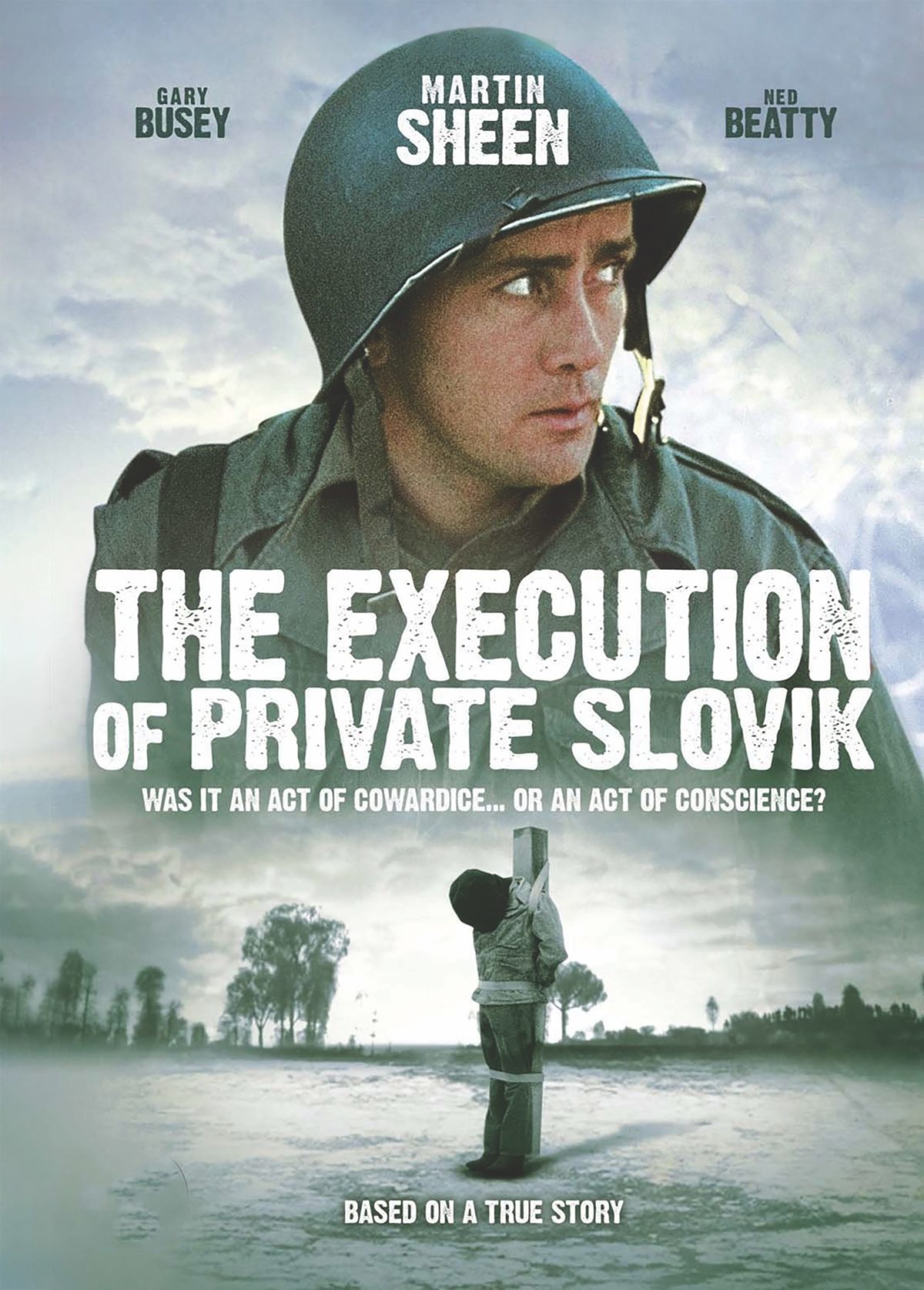
Eddie Slovik didn't want to be a hero. He just wanted to go home to his wife, Antoinette. But on a cold morning in January 1945, he became the only American soldier since the Civil War to be executed for desertion. It’s a heavy, uncomfortable piece of history that still feels wrong to a lot of people who look closely at the files.
The execution of Private Slovik wasn't just about one man running away. It was a message. By the time 1944 rolled around, the Allied forces were bleeding out in the forests of Europe. Thousands of men were slipping away from the front lines. The generals were panicked. They needed a scapegoat, and Eddie Slovik—a guy with a rap sheet and a sensitive soul—basically walked right into the crosshairs.
Who Was Eddie Slovik?
Before the war, Eddie was what you’d call a "hard luck" case. He grew up in Detroit and spent a chunk of his youth in and out of reform schools and jails for petty stuff like breaking and entering or stealing candy. Honestly, he wasn't a violent criminal; he was just a kid who couldn't catch a break. By 1942, he had finally straightened his life out. He got a job, met Antoinette, and got married. He was classified as 4-F—unfit for service—because of his criminal record.
Then the war got desperate.
The military reclassified him as 1-A. Suddenly, the guy who had finally found a sliver of happiness was shipped off to the 28th Infantry Division. He was terrified. Not the "I’m nervous about combat" terrified, but the "I physically cannot do this" kind of dread. He told everyone who would listen that he wasn't built for the infantry.
The Moment He Walked Away
It happened in France, near the town of Elbeuf. Slovik and a buddy, John Tankey, got separated from their unit during an artillery attack. Instead of rushing to find their company, they hung out with a Canadian military police unit for six weeks. It was a cozy arrangement. They helped with cooking and odd jobs. Eventually, they were turned back over to the US Army.
Most guys would have just taken their licks, rejoined their unit, and that would be that. But Slovik couldn't do it. He told his commanding officer that if he were sent back to the front, he’d just run away again.
He even wrote out a confession.
He handed it to a sergeant. The sergeant told him to tear it up. He told him he’d be shot if he kept it. Slovik didn't care. He literally signed his own death warrant because he thought the worst that would happen was a few years in a comfortable US prison. He’d survived jail before. He figured he could survive it again. He was wrong.
Why the Execution of Private Slovik Actually Happened
You have to understand the context of late 1944. This wasn't the triumphant march through Europe you see in the movies. This was the Battle of the Huertgen Forest. It was a meat grinder. The 28th Division—Slovik’s unit—was getting absolutely mauled. Replacement soldiers were arriving at the front and deserting in droves.
The generals were losing control of the ranks.
Major General Norman "Dutch" Cota, the commander of the 28th, was a hard-nosed guy. When Slovik’s case landed on his desk, he didn't see a misunderstood kid from Detroit. He saw a threat to the discipline of his entire division. If one guy could just "quit" and go to jail, why wouldn't everyone else do the same?
The Legal Chess Game
Slovik’s trial was fast. It lasted about 90 minutes. None of the nine officers on the court-martial board had ever seen a death sentence for desertion actually carried out. It was a "paper tiger" punishment—a way to scare people. They voted for death, likely assuming it would be overturned or commuted to life in prison by higher-ups.
Even the military lawyers thought it was a bluff.
But then the request for clemency reached General Dwight D. Eisenhower. "Ike" was under immense pressure. The Battle of the Bulge had just kicked off. The Germans had launched a massive counter-offensive, and American morale was on the brink. Eisenhower felt he had to make an example. He denied the appeal. On January 31, 1945, near the village of Sainte-Marie-aux-Mines, Eddie Slovik was tied to a post and shot by a firing squad of twelve soldiers.
The Aftermath and the Cover-Up
The Army didn't exactly shout this from the rooftops. Antoinette Slovik didn't find out how her husband died for years. She thought he had died in combat. When she finally learned the truth, she spent the rest of her life trying to get him pardoned and his remains brought home.
She died broke and heartbroken in 1979.
It wasn't until 1987 that Bernard V. Calka, a Polish-American World War II veteran, finally succeeded in getting Slovik’s body moved from a "hidden" cemetery in France (where he was buried alongside executed rapists and murderers) to Detroit. He’s now buried next to his wife.
Why People Still Argue About It
Was it fair? Probably not.
Thousands of men deserted during World War II. Many of them did far worse things than Slovik. Some deserted for months, some were repeat offenders, and some even joined the enemy. None of them were executed. Slovik was essentially the victim of bad timing and a bad reputation.
Because he had a criminal record, the military viewed him as "expendable" and "irredeemable." They didn't see a soldier with a mental breakdown; they saw a career criminal trying to dodge his duty.
Lessons From the Slovik Case
The execution of Private Slovik remains a haunting reminder of what happens when military necessity overrides individual justice. It’s a case study in "exemplary punishment"—killing one to scare a thousand.
If you're looking for actionable takeaways from this historical tragedy, consider these points for further research or discussion:
1. Research the "Section 8" history. Look into how the military handled mental health (then called "battle fatigue") in 1945 compared to now. You'll find that Slovik’s symptoms would likely be classified as PTSD or a severe anxiety disorder today.
2. Visit the Oakhill Cemetery in Detroit. If you’re a history buff, seeing the grave of Eddie and Antoinette side-by-side offers a somber perspective on the personal cost of war-time policy.
3. Read "The Execution of Private Slovik" by William Bradford Huie. This is the definitive book on the case. Huie was the one who broke the story wide open in the 1950s. It’s a masterclass in investigative journalism and shows how much the government tried to keep this under wraps.
4. Study the UCMJ changes. The Uniform Code of Military Justice was overhauled after the war, partly because of the inconsistencies seen in cases like Slovik’s. Understanding these legal shifts helps explain why an execution for desertion hasn't happened since.
Eddie Slovik wasn't a monster. He was a man who reached his breaking point at the exact moment the world was breaking, too. He paid the ultimate price for a crime that thousands of others committed and survived.