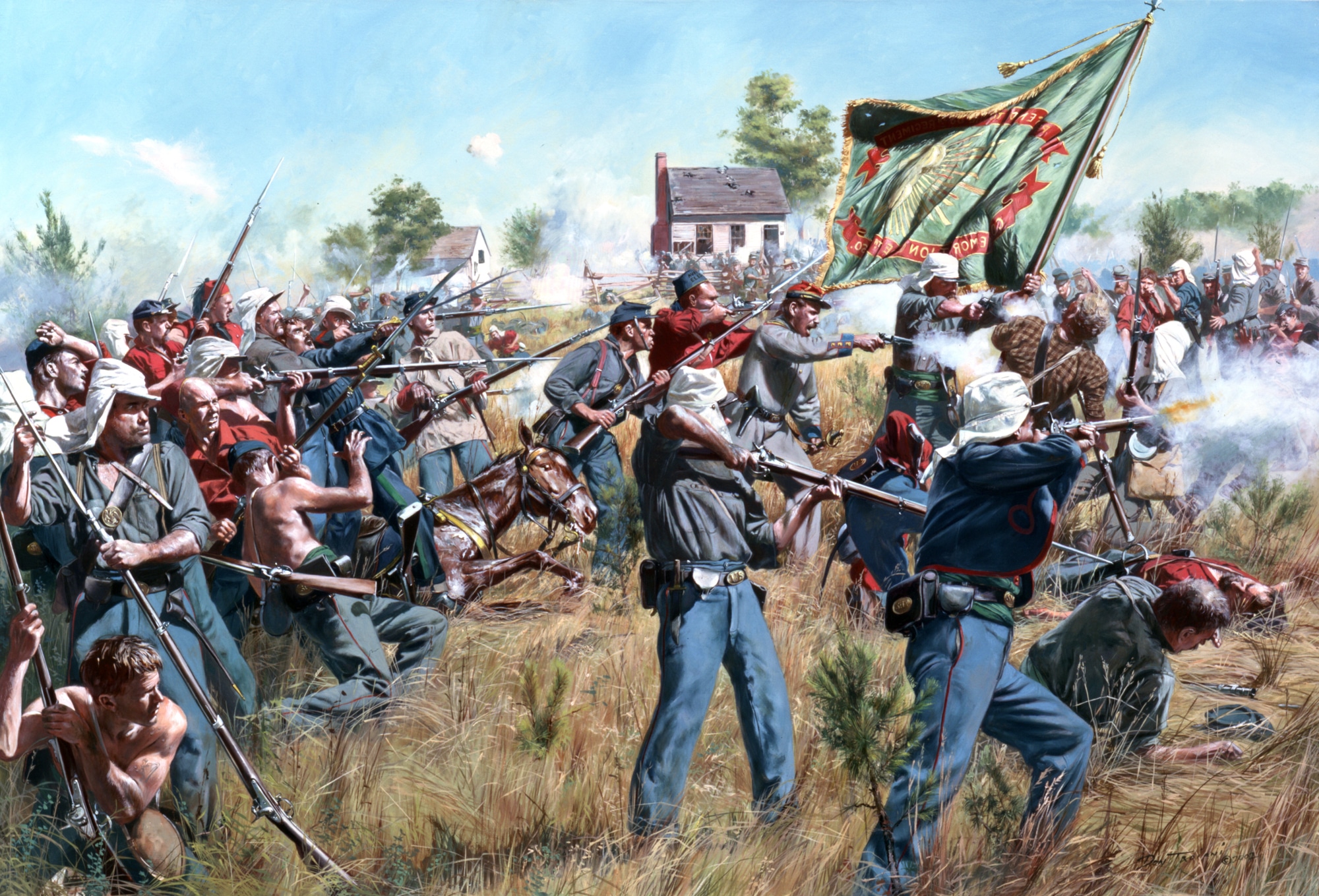
Nobody expected a bloodbath. On a sweltering Sunday in July 1861, people from Washington D.C. actually packed picnic baskets. They drove their carriages out to the Virginia countryside like they were heading to a summer festival. They wanted to watch the Union army crush the "rebellion" in a single afternoon and head home for dinner. Honestly, the delusion was staggering. By sunset, those same civilians were screaming in terror, trampling over their own picnic blankets as a panicked, broken army fled past them.
The First Battle of Bull Run—or First Manassas if you’re asking a Southerner—was the moment the United States realized the Civil War wasn't going to be a quick weekend skirmish. It was going to be a long, agonizing slaughter.
The Amateur Hour at Manassas Junction
War is usually a professional’s game, but in 1861, it was basically an amateur hour on both sides. President Abraham Lincoln was under immense pressure to "do something." The public was chanting "On to Richmond!" like it was a sports slogan. So, he pushed Brigadier General Irvin McDowell to attack, despite McDowell’s protests that his troops were green.
McDowell wasn't wrong. His men didn't know how to march in formation, let alone fight a coordinated battle. But the Confederate forces under P.G.T. Beauregard weren't much better. They were a ragtag collection of volunteers and local militias.
The two armies bumped into each other near a small stream called Bull Run, just north of a vital railroad hub at Manassas. If the Union could take that hub, they had a straight shot to the Confederate capital. It looked good on paper. It was a disaster in practice.
The heat was oppressive. Dust choked the men. Because there were no standardized uniforms yet, some Union units wore gray, and some Confederates wore blue. You can imagine the chaos. Soldiers were literally shooting at their own friends because they couldn't tell who was who in the smoke.
The Stone Bridge and the Great Confusion
The fighting started early on July 21. McDowell tried a flank maneuver, crossing the stream to get around the Confederate left. For a few hours, it actually worked. The Union pushed the Rebels back toward Henry House Hill.
This is where the legend of "Stonewall" Jackson was born. While other Southern units were breaking and running, Thomas Jackson’s Virginia brigade stood like—well, a stone wall. General Barnard Bee supposedly shouted to his retreating men, "Look, there is Jackson standing like a stone wall! Rally behind the Virginians!"
Whether Bee meant it as a compliment or was complaining that Jackson wasn't helping him is still debated by some historians. Regardless, the name stuck. The momentum shifted.
When the Picnic Ended
You have to picture the scene to really get how bizarre this was. Senators and socialites were perched on the hillsides with binoculars. They were drinking wine. They were cheering.
Then the tide turned.
The Confederates received reinforcements by rail—the first time in history troops were moved directly to a battlefield by train. These fresh soldiers, led by Joseph E. Johnston, slammed into the exhausted Union line. The Union troops, already tired and confused, simply snapped.
It wasn't a tactical retreat. It was a rout.
Soldiers dropped their muskets and ran. They collided with the carriages of the picnicking civilians. The road back to D.C. became a massive, muddy traffic jam of terrified people, discarded ham sandwiches, and abandoned artillery. The "Great Skedaddle," as it was called, was the ultimate reality check for a nation that thought war was a spectator sport.
The Casualties of Overconfidence
The numbers from the First Battle of Bull Run seem small compared to later nightmares like Gettysburg or the Wilderness, but at the time, they were horrifying.
- Union: About 460 killed, 1,100 wounded, and over 1,300 missing or captured.
- Confederate: Roughly 380 killed, 1,500 wounded.
These weren't just statistics; they were sons of prominent families and local farmers. The North was humiliated. The South was emboldened, perhaps dangerously so, leading them to believe one Rebel could whip ten Yankees. It was a false sense of security that would eventually cost them everything.
What Most People Get Wrong About Bull Run
People often think this battle was a clean Confederate victory. Technically, it was. They held the field. But the Southern army was so disorganized by their own success that they couldn't even follow up. They could have probably marched right into Washington D.C. and captured the White House that night. They didn't. They were too busy celebrating and trying to find their own units.
Another misconception is that the North was "weaker." In reality, the Union had more resources and more men; they just lacked the leadership and the stomach for the fight in 1861. Bull Run forced Lincoln to replace McDowell with George McClellan, a man who was great at training armies but notoriously terrified of actually using them.
The battle also proved that the "90-day volunteers" were a joke. Lincoln realized he needed a real army, not a group of guys who signed up for three months thinking they’d be home for the harvest.
The Myth of the Rebel Yell
It was during the climax of this fight that Union soldiers first heard the "Rebel Yell." It wasn't just a cheer. It was a high-pitched, terrifying scream that sounded like a cross between a coyote and a banshee. Veterans later said that if you weren't scared when you heard it, you weren't human. At Bull Run, that sound helped turn the Union retreat into a total stampede.
Why the First Battle of Bull Run Still Matters
We study this battle because it’s a masterclass in the dangers of hubris. It’s a reminder that political goals and military realities are often miles apart. The politicians in D.C. demanded a quick victory, ignoring the fact that their "army" wasn't ready to tie their own boots, let alone fight a war.
It changed the American psyche. Before Bull Run, the war was an abstraction—a political disagreement settled with gunpowder. After Bull Run, it was a tragedy. It was the moment the "Civil War" became the "Long War."
Actionable Steps for History Enthusiasts
If you really want to understand the First Battle of Bull Run, you can't just read about it. You have to see the terrain. Here is how to actually engage with this history:
- Visit Manassas National Battlefield Park: Walking Henry House Hill is the only way to understand why the Union couldn't break the line. The elevation changes look small on a map but feel massive when you're "charging" them in the Virginia humidity.
- Read the Primary Sources: Check out the letters of soldiers who fought there through the Library of Congress digital collections. The fear in their handwriting is more telling than any textbook.
- Track the Units: Look up if your home state had a regiment at Bull Run. Seeing the names of men from your own town who died in the "Great Skedaddle" makes the history personal rather than academic.
- Ditch the "Short War" Mindset: Apply the lesson of Bull Run to modern events. Whenever someone promises a "quick and easy" solution to a complex conflict, remember the picnickers at Manassas.
The war didn't end that day. It barely began. But the shadows of those hillsides still loom over American history, reminding us that the cost of being wrong about war is always paid in blood.