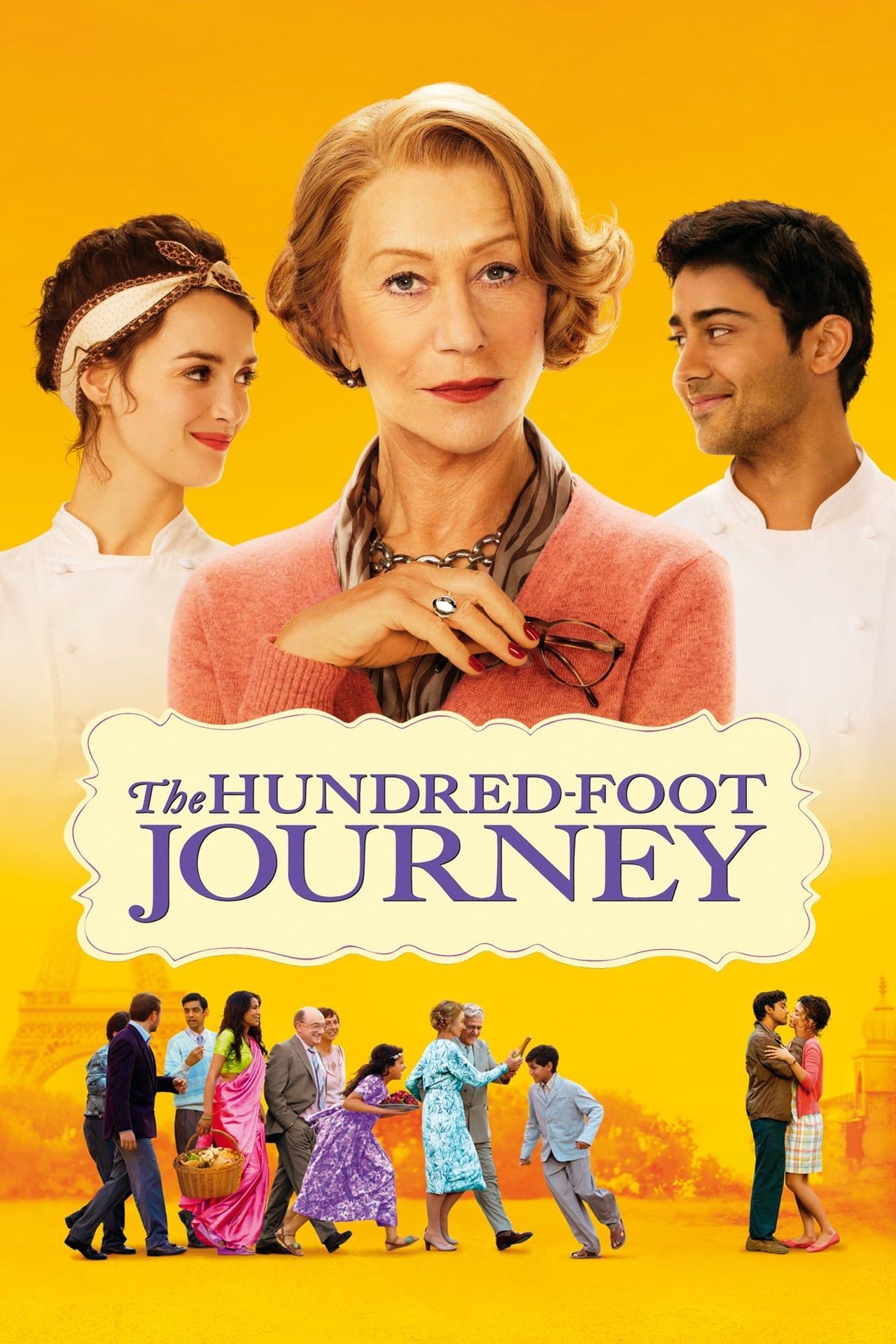
If you haven't seen it yet, let’s be real: you’re missing out on one of the most visually delicious films ever made. It’s been years since The Hundred Foot Journey movie first hit theaters in 2014, but it still feels remarkably fresh. Maybe it’s the way the light hits the hollandaise. Or maybe it’s just Helen Mirren being Helen Mirren. Whatever the "it" factor is, this movie managed to do something most food films fail at—it made the cultural friction feel as real as the spices.
Usually, when Hollywood tries to do "culture clash," it feels forced. You get the stereotypical jokes and the predictable resolution. But here, the distance between a traditional Indian family and a Michelin-starred French restaurant isn't just a metaphor. It’s exactly one hundred feet. That physical gap across a quiet road in Saint-Antonin-Noble-Val becomes the entire world for two hours. Honestly, it's kinda brilliant in its simplicity.
What Actually Happens in The Hundred Foot Journey Movie?
The Kadam family, led by the stubborn but lovable Papa (Om Puri), flees tragedy in India only to find themselves stranded in the south of France. Their van breaks down, which is the ultimate cinematic trope for "life is about to change." But instead of fixing the radiator and moving on, Papa decides to open an Indian restaurant, Maison Mumbai, right across the street from Le Saule Pleureur.
That’s where the trouble starts.
Le Saule Pleureur is a temple of French haute cuisine run by Madame Mallory. She is, for lack of a better word, terrifying. Helen Mirren plays her with this icy precision that makes you wonder if she actually has ice water in her veins. The rivalry isn't just about noise or smells; it’s about heritage. It’s about the "sacred" butter-heavy French sauces versus the "chaotic" spices of Mumbai.
But the real heart of the story is Hassan, played by Manish Dayal. He’s a culinary prodigy. He doesn't just cook; he understands the soul of the ingredient. When he eventually bridges that hundred-foot gap to learn under Madame Mallory, the movie shifts from a neighborhood feud into a deep dive into what it means to find your voice in a foreign land.
Why the Critics Were Split (And Why They Might Be Wrong)
When you look back at the reviews from 2014, it’s a mixed bag. Rotten Tomatoes has it sitting around 67%. Not a disaster, but not a masterpiece either. Some critics, like those at The New York Times, felt the movie was a bit too "syrupy." They called it "cinematic comfort food."
Is it sentimental? Absolutely. Is it predictable? Sorta.
But here’s the thing: sometimes we want a movie that feels like a warm hug and a five-course meal. Lasse Hallström, the director, also did Chocolat, so he knows exactly how to make food look better than it does in real life. He uses these tight, macro shots of breaking eggs and whisking sauces that are basically food porn. If you’re watching this on an empty stomach, you’re making a tactical error. You’ll be craving boeuf bourguignon and chicken tikka masala at the same time, which is a confusing place for your taste buds to be.
The nuance people miss is the technical accuracy. The film was produced by Steven Spielberg and Oprah Winfrey, and they didn't skimp on the details. They brought in legendary chef Floyd Cardoz to consult. Cardoz was the guy who basically put modern Indian cuisine on the map in New York with his restaurant Tabla. He made sure that when Hassan makes an omelet, he’s doing it with the correct technique. He made sure the spices looked authentic, not like some Hollywood version of "curry powder."
The Magic of the Omelet Scene
There’s a specific scene that every fan talks about. It’s the omelet.
In French cooking, the omelet is the ultimate test. It’s simple, but there’s nowhere to hide. If the heat is too high, it browns. If you flip it wrong, it tears. Hassan makes one for Madame Mallory, but he adds his own twist—chili, cilantro, and spices from his mother’s collection.
It’s a turning point. It’s the moment Madame Mallory realizes that her rigid adherence to tradition might be blinding her to genius. The way she tastes that omelet—with one hand shaking—is acting at its finest. It’s a silent admission of defeat and an invitation to a new future.
Beyond the Kitchen: The Reality of the Cast
We have to talk about Om Puri. He passed away in 2017, and The Hundred Foot Journey movie remains one of his most beloved international roles. He brings such a grounded, gritty energy to Papa. He’s not a caricature. He’s a man who lost his wife and his home and is clinging to his family with everything he has. His chemistry with Helen Mirren is the highlight of the film. They are two titans of cinema bickering over parking spaces and classical music.
Manish Dayal also holds his own. It’s hard to play "the genius" without coming off as arrogant, but he brings a vulnerability to Hassan. You see him struggling in the cold, clinical kitchens of Paris later in the film, realizing that fame and Michelin stars don't necessarily taste as good as home.
Fact Check: Is Saint-Antonin-Noble-Val Real?
Yes. 100%.
The village where they filmed is a medieval town in the Tarn-et-Garonne department in southern France. It looks exactly like it does in the movie. The stone bridges, the winding river, the Sunday markets—it’s all there. Travelers actually flock there now just to see the locations. Interestingly, the two restaurants aren't actually across the street from each other in real life. That was some clever location scouting and set building. In reality, the "French" restaurant was a private villa, and the "Indian" restaurant was partially constructed for the film.
The Cultural Impact of the Film
People often group this movie with Chef or Eat Pray Love. But The Hundred Foot Journey movie is doing something slightly different. It’s a movie about the immigrant experience that doesn't focus solely on the trauma. It focuses on the contribution. It shows how the "other" makes the existing culture better.
By the end, Hassan isn't just a French chef; he’s a hybrid. He uses his Indian palate to elevate French techniques. This isn't just a plot point; it’s a reflection of how global gastronomy actually works. Look at the real-world food scene. The most exciting restaurants in London, New York, and Paris right now are fusion concepts. They are the result of people crossing that "hundred-foot" gap.
Common Misconceptions
One thing people get wrong is thinking this is a true story. It's not. It’s based on the novel by Richard C. Morais. While the emotions and the culinary details are grounded in reality, Hassan Kadam is a fictional character. However, many real-life chefs have cited the movie as an inspiration because it captures the high-pressure environment of a Michelin-level kitchen so accurately. The burns, the sweat, the hierarchy—it’s all there.
Another misconception? That it’s just a "chick flick." Honestly, that's a disservice. It’s a movie about ambition, grief, and the brutal business of the restaurant industry. It’s as much a "business movie" as it is a romance. Watching Papa negotiate the price of local pigeons at the market is a masterclass in entrepreneurship.
How to Experience the Movie Today
If you’re planning a rewatch or seeing it for the first time, don't just put it on in the background. This is a sensory experience.
- Watch it in 4K if possible. The cinematography by Linus Sandgren (who later won an Oscar for La La Land) is breathtaking. The colors of the spices—the turmeric yellows and chili reds—are meant to pop.
- Cook something first. Seriously. You will get hungry. Maybe try making a Masala Omelet. It’s the easiest way to bring a piece of the movie into your kitchen.
- Listen to the score. A.R. Rahman, the genius behind Slumdog Millionaire, did the music. It subtly blends Indian sitars with French accordion music. It’s a sonic representation of the movie's theme.
Actionable Takeaways for Movie Lovers
If you loved The Hundred Foot Journey movie, here is how you can dive deeper into that world:
- Read the Book: Richard C. Morais’s novel goes into much more detail about Hassan’s time in Paris. It’s a bit darker and more complex than the film.
- Explore the Soundtrack: A.R. Rahman’s work here is underrated. "Saransha" and "The Hundred Foot Journey Cafe" are standout tracks that work great as dinner party music.
- Learn the "Five Mother Sauces": The movie mentions them for a reason. Béchamel, Velouté, Espagnole, Sauce Tomate, and Hollandaise are the foundation of French cooking. Learning to make even one will change how you cook forever.
- Visit the Region: If you ever find yourself in the South of France, head to Saint-Antonin-Noble-Val. It’s about an hour and fifteen minutes from Toulouse. The Sunday market is a real thing, and it’s every bit as vibrant as the movie portrays.
The movie ends on a note of homecoming. It reminds us that no matter how far we go or how many accolades we collect, the best food is always the stuff that tastes like where we came from. It’s a simple lesson, but in a world that’s constantly moving, it’s one worth remembering.
If you want to understand the "soul" of a dish, you don't look at the recipe. You look at the person holding the spoon. That is the true legacy of this film. It didn't just give us a story; it gave us a new way to look at our dinner plates. No matter how different we think we are, we’re all just a hundred feet away from finding common ground—usually over a really good meal.