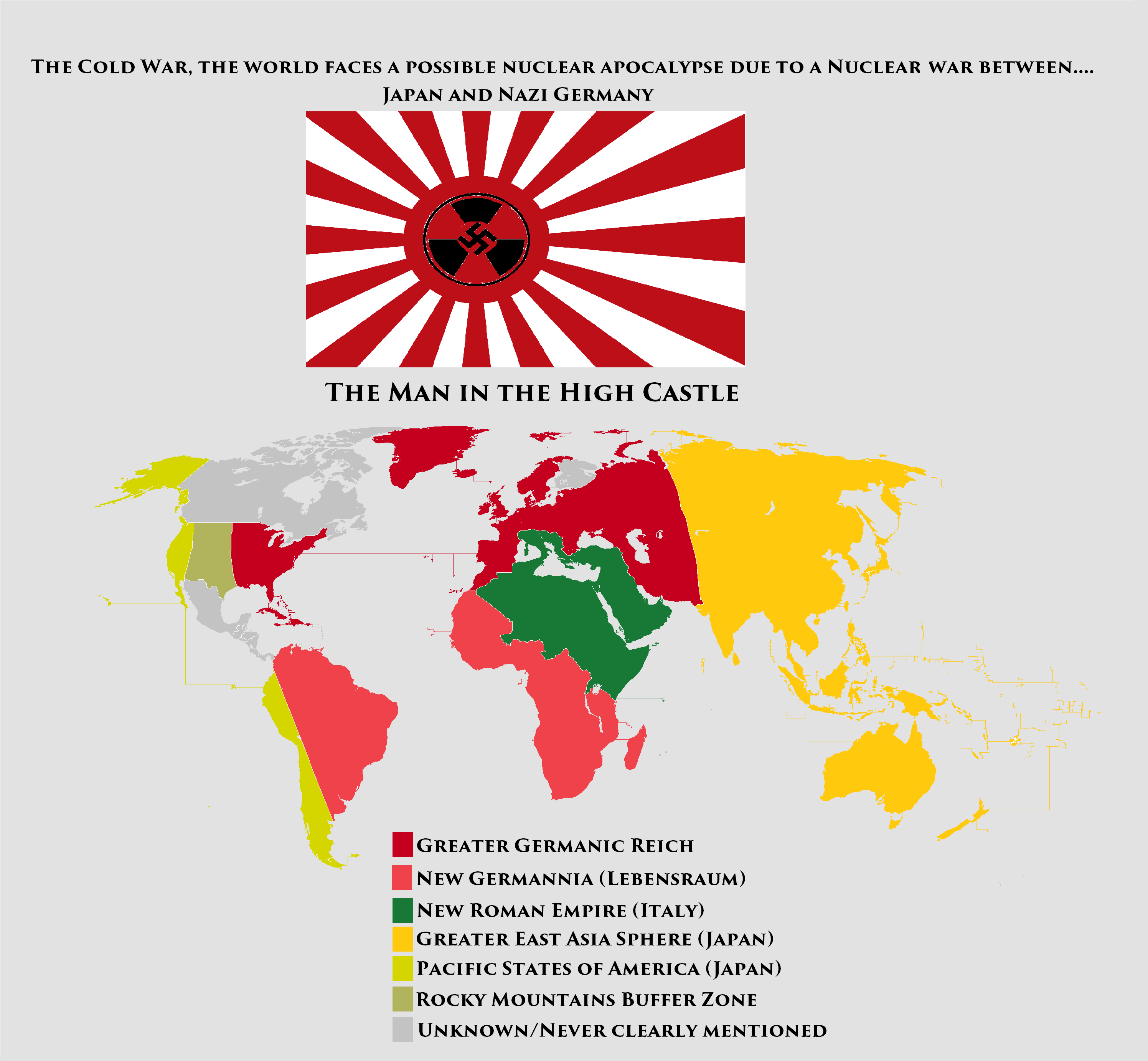
If you look at a map of 1962 North America, it looks familiar. You see the Great Lakes. You see the jagged coastline of Florida. But then you notice the colors are all wrong. There is a deep, bruised red covering the Eastern seaboard and a mustard yellow stretching across the Pacific States. In between? A thin, precarious strip of "Neutral Zone" that looks more like a scar than a border.
The Man in the High Castle map isn't just a piece of set dressing for a high-budget Amazon show or a cool graphic in a Philip K. Dick novel. It's a terrifying visual representation of what happens when history breaks. Honestly, it’s one of the most recognizable maps in "alt-history" fiction, but people constantly get the details wrong. They think it’s just a 50/50 split between Germany and Japan. It’s not. It’s way messier than that, and if you actually look at the geography of the GRR (Greater Nazi Reich) versus the JPS (Japanese Pacific States), you start to see the cracks in the Axis alliance.
The Divided States: Geography of a Nightmare
The world of The Man in the High Castle stems from a single, haunting "what if": What if Giuseppe Zangara hadn't missed, and Franklin D. Roosevelt was assassinated in 1933? Without FDR's New Deal and his later leadership during the war, the U.S. remained isolationist and weak. By the time 1947 rolled around, the Axis powers had won. Washington D.C. was nuked. The surrender was total.
When you study the Man in the High Castle map, the first thing that hits you is the sheer scale of the Greater Nazi Reich. They didn't just take the East Coast. They took everything from the Atlantic all the way to the edge of the Great Plains. We are talking about the "American Reich." New York is the crown jewel, rebranded with swastikas and brutalist architecture that makes the Empire State Building look small.
The Japanese Pacific States, on the other hand, are much smaller. They’ve got the West Coast—basically everything west of the Rocky Mountains. San Francisco is the capital here. It’s a colonial outpost, crowded and foggy, flavored by a mix of 1960s Americana and imperial Japanese culture. But notice the size difference. The Reich is a superpower; the Japanese territory feels like a coastal buffer zone. This creates a massive power imbalance that drives the entire plot of the show and the book.
The Neutral Zone: The Wild West Reborn
Sandwiched between these two titans is the Neutral Zone. It follows the Rocky Mountains, cutting through states like Colorado, Wyoming, and Utah. It’s not a country. It’s a lawless gap.
Think of it as a dumping ground. It’s where the "unwanted" people go—the Jews, the Romani, the political dissidents, and the outcasts who managed to flee the Reich’s ethnic cleansing or the Japanese Empire’s strict social hierarchies. Life here is tough. It’s basically the 1800s but with 1960s technology. There are no real laws, only what you can enforce with a gun.
Canonically, both the Reich and Japan agreed to this buffer to prevent a direct border conflict. They knew that if their soldiers were standing toe-to-toe on a single line, someone would eventually pull a trigger. So, they left the mountains to the outlaws and the refugees. It's a clever geopolitical move, but it's also where the resistance thrives.
Global Borders and the Lebensraum Reality
The Man in the High Castle map doesn't stop at the U.S. borders. If you zoom out, the world is unrecognizable. The Mediterranean Sea? Gone. In the show’s lore (and based on actual Nazi "Atlantropa" plans), the Germans dammed the Strait of Gibraltar and drained the sea to create more farmland. It’s a logistical nightmare that reflects the Reich's obsession with Lebensraum—living space.
Africa is a dark spot on the map. It's essentially been turned into a continent-sized concentration camp and resource extraction site. Most of the indigenous population has been wiped out or enslaved. It’s the most horrific part of the lore that the show often only whispers about because the reality is too grim to depict.
South America is split, much like North America, but with a heavier leaning toward German influence in the South. Meanwhile, Japan controls the "Greater East Asia Co-Prosperity Sphere." This includes China, India, Australia, and the Pacific islands. While the Nazis focus on racial purity and massive engineering projects, the Japanese focus on trade and resource dominance.
Discrepancies Between the Book and the Show
Philip K. Dick’s original 1962 novel and the Amazon series handle the map slightly differently. In the book, the "Neutral Zone" is referred to as the Rocky Mountain States. It’s arguably more "civilized" in the book, functioning more like a weak puppet state than a total anarchy.
The show, however, dialed up the "Wild West" vibes for visual drama. It also introduced the concept of the "Heisenberg Device" (the Nazi atomic bomb) being the reason for the specific border placements. In the show, the borders are frozen in 1962 because of a nuclear stalemate, a "Cold War" between the two victors that mirrors our own history with the USSR and the USA.
Why the Map Matters for SEO and Fans Alike
If you are searching for a Man in the High Castle map, you're probably looking for more than just a wallpaper. You're looking for logic in a world that lacks it. The map is a character. It tells you who has the water, who has the oil, and who is winning the "cold" race for world domination.
The Reich has the industry. They have the "Vantablack" equivalent of 1960s tech—supersonic jets (the Concorde exists here but it’s German) and advanced rockets. The Japanese territory looks more like the world we know, just under a different flag. This visual distinction on the map—the high-tech, sterile East versus the crowded, traditional West—is a masterclass in world-building.
Mapping the Resistance
Where is the High Castle? That’s the big question. On the map, it’s not a literal castle. In the book, it’s a fortified house in the Neutral Zone (specifically in Denver). In the show, it’s a literal warehouse full of films.
The resistance doesn't have a color on the map. They are the "underground." They move between the zones using the "Grasshopper" films as their guide. These films show our world—the one where the Allies won. For the characters, the map they live in is a cage; the map in the films is a dream.
Actionable Insights for Alt-History Buffs
If you're diving deep into the world of The Man in the High Castle, or perhaps you're a writer looking to build your own world, here is how you should analyze this specific map:
- Study the Buffer Zones: Notice how the Neutral Zone isn't just empty space; it’s a strategic necessity. If you’re world-building, always include a "gray area" where your protagonists can breathe.
- Resource Distribution: Look at why the Nazis took the East. It wasn't just proximity to Europe; it was the industrial heartland of the 1940s. Japan took the West for Pacific naval dominance. Geography dictates destiny.
- The "Losing" Superpower: Observe the Japanese Pacific States. They are overextended. Their portion of the Man in the High Castle map is harder to defend and culturally more rebellious. This is a classic trope: the victor who is spread too thin.
- Check the Lore: If you're a collector, look for the "Smith family" maps used in the show's production. They include handwritten notes and tactical markings that aren't visible in the wide shots.
The map is a reminder that borders are rarely about people and almost always about power. It’s a chilling "what if" that stays with you long after the credits roll. Whether you're looking at the Amazon version or the original Dick vision, the geography of this broken America is a lesson in how quickly the world can turn upside down.
To understand the world of the show, you have to look at the edges of the map. That's where the truth usually hides.