You’re sitting in a dark theater, or maybe on your couch with the lights dimmed, and suddenly this... thing sprints out of the shadows of a literal basement pit. It isn't a ghost. It isn't a demon. It is a tall, grey, sagging, and deeply confused woman who just wants to nurse a grown man. Honestly, the Mother from Barbarian is one of the most unsettling things to happen to the horror genre in the last decade. She’s gross. She’s terrifying. But if you look closer at the lore Zach Cregger built into his 2022 hit, she’s also heartbreaking.
The Mother isn't just a monster. She's a byproduct of a very specific, very human evil.
Most horror movies rely on the supernatural to get a rise out of the audience. They use jump scares or ancient curses. Barbarian didn't do that. It gave us a creature born from decades of systemic rot in Detroit and the horrifying actions of a man named Frank. When we talk about the Mother from Barbarian, we’re talking about a character that forces us to look at the consequences of abuse, isolation, and a distorted version of maternal instinct that has gone completely off the rails.
Who Exactly Is the Mother From Barbarian?
Let’s get the facts straight. The Mother is played by Matthew Patrick Davis. Yeah, a man. He’s about 6'8", and the production team used that height to make her look absolutely looming and unnatural. But in the story, she is the offspring of Frank, the "original" owner of the house on Bright Street. Frank was a serial kidnapper and rapist who spent decades snatching women and keeping them in an elaborate tunnel system beneath his basement.
The Mother is the result of generations of inbreeding within those tunnels. She has never seen the sun. She has never had a normal conversation. All she knows is what she saw on the grainy VHS tapes Frank used to play—tapes of breastfeeding and "nurturing" videos.
It’s a bizarre contradiction. She will rip a man’s head apart with her bare hands, but then she’ll try to cradle a stranger and give them a bottle of "milk" that you definitely do not want to drink. That’s why she resonates so much with audiences. She isn’t "evil" in the way Freddy Krueger is evil. She’s a predator, sure, but she’s also a victim of a cycle that started long before she was born.
The Mother represents the ultimate breakdown of the "Final Girl" trope. Usually, the woman survives the monster. In Barbarian, the "monster" is a woman who thinks she’s doing the most natural thing in the world: protecting her baby.
Why the Mother From Barbarian Creeps Us Out More Than Usual
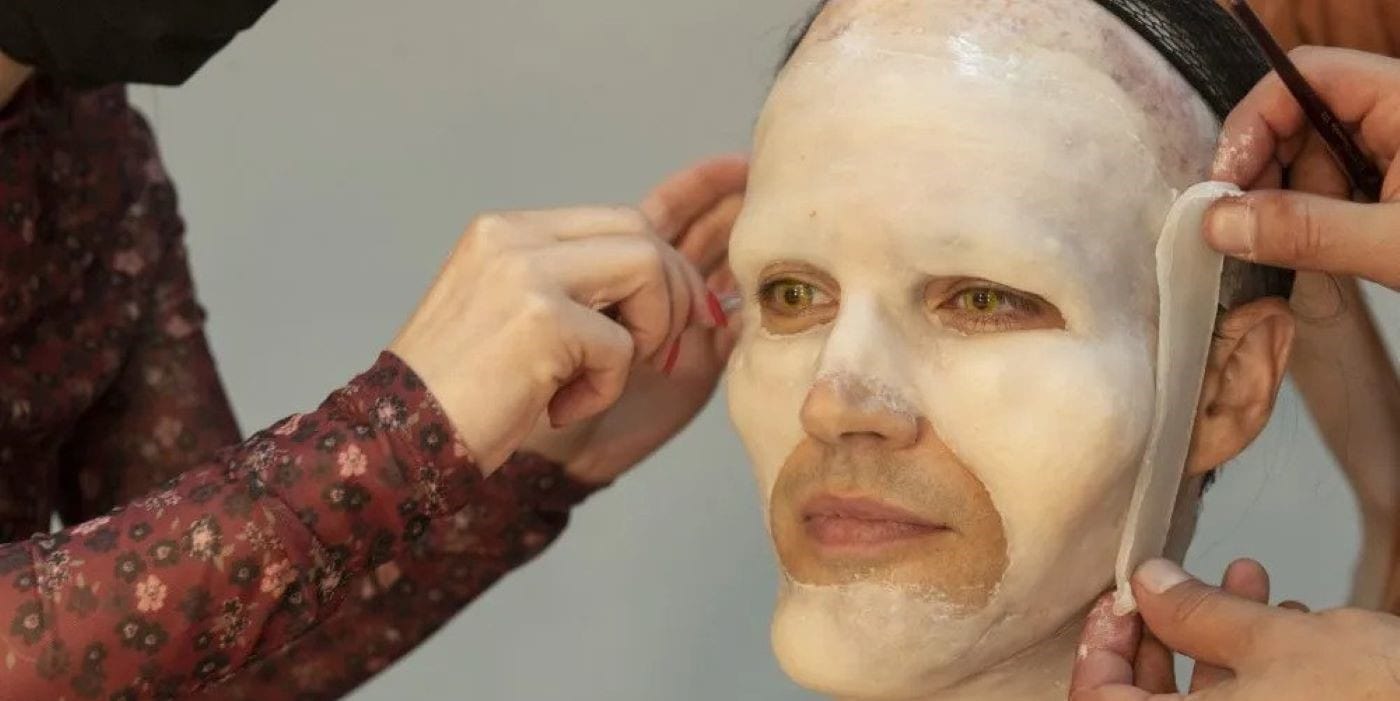
There is a psychological concept called the "Uncanny Valley." Usually, we use it for robots or CGI that looks almost human but not quite. The Mother fits this perfectly. Her movements are jerky and animalistic, yet her face—covered in layers of incredible prosthetic work by the team at Bulldog Pro—still carries a flicker of human recognition.
When Tess (played by Georgina Campbell) first encounters her, the fear isn't just about dying. It’s about the total subversion of what a mother is supposed to be.
The Nurturing Nightmare
The most famous scene involves a baby bottle. It’s disgusting. It’s hard to watch. But it tells you everything you need to know about her character. She has no concept of boundaries or consent. She has been conditioned to believe that "mothering" is the only way to exist. When she sees Justin Long’s character, AJ, she doesn't just see meat. She sees something to care for.
Of course, she cares for it by jumping off a water tower and shattering her own body to protect it, which brings us to the tragedy of her ending.
The Tragic Reality of the Detroit Setting
You can't talk about the Mother from Barbarian without talking about the city of Detroit. The movie uses the urban decay of the Brightmoor neighborhood as a literal breeding ground for horror. Because the neighborhood was abandoned by the police and the government, Frank was able to operate his house of horrors for decades without anyone noticing.
The Mother is a physical manifestation of that neglect. She is what happens when society looks the other way.
If Frank represents the active evil of the world—the predator—then the Mother represents the collateral damage. She is the "trash" that society threw away, quite literally living in the dirt and the dark. This adds a layer of social commentary that most slasher flicks ignore. When Tess eventually has to kill her, it’s not a moment of triumph. It’s a mercy killing.
Behind the Scenes: Creating the Beast
Matthew Patrick Davis deserves a lot of credit for his performance. He spent hours in the makeup chair. He worked with a movement coach to figure out how someone who has never walked on flat, even ground would move.
- Height: The 6'8" frame was emphasized by having Davis walk on all fours or crouch in low-ceiling tunnels.
- Prosthetics: The skin was designed to look translucent and sickly, as if it had never touched Vitamin D.
- The Hair: Matted, thin, and patchy, signifying years of malnutrition.
Interestingly, director Zach Cregger initially worried that the Mother might be "too much." He thought the audience might find her ridiculous rather than scary. But the opposite happened. Her raw, visceral presence grounded the movie’s second half, turning a twisty thriller into a full-blown creature feature.
What Other Horror Monsters Can Learn From Her
Most modern horror villains are too clean. Think of the Conjuring universe or the various Insidious sequels. The monsters are often CGI-heavy and rely on "theatrical" scares. The Mother from Barbarian is different because she is filthy. She is tactile. You can almost smell her through the screen.
She reminds us that the scariest thing isn't a ghost; it's a human being that has been warped into something unrecognizable.
She also flips the script on the "sympathetic monster." Usually, a sympathetic monster is someone like King Kong or Frankenstein's monster—creatures that are misunderstood. The Mother is misunderstood, but she’s also incredibly dangerous. She doesn't have a "noble" side. She just has an instinct. It’s a more honest, more brutal way to handle a character.
Understanding the "Motherhood" Theme
The title Barbarian refers to many things. It refers to the house's location on "Barbary" street (changed to Bright Street in some contexts), but it also refers to the primitive, "barbaric" nature of the Mother’s existence.
Tess survives because she shows a modicum of empathy, whereas AJ dies because he is inherently selfish. The Mother recognizes the difference. She gravitates toward Tess because Tess, in a weird way, acts more like a "mother" than anyone else in the film. She tries to save others. She looks out for the vulnerable.
The Mother’s obsession with the breastfeeding video is a desperate attempt to reclaim a humanity she never actually had. She’s trying to learn how to be a person from a thirty-second clip of a 1980s VHS tape. If that isn't the saddest thing you've ever heard about a horror villain, I don't know what is.
Actionable Insights for Horror Fans
If you’re a fan of the Mother from Barbarian and want to find similar "feral" or "subterranean" horror that hits those same visceral notes, there are a few places you should look.
First, revisit The Descent (2005). The Crawlers in that movie share a similar evolutionary backstory to the Mother—humans who moved underground and changed. However, The Descent lacks the specific maternal tragedy that makes Barbarian unique.
Second, check out the makeup effects work of Greg Nicotero or the early work of Rick Baker. The Mother is a love letter to practical effects. In an era where everything is "fixed in post" with digital tools, seeing a real person in a real suit interacting with actors creates a level of tension you just can't fake.
Finally, pay attention to the sound design next time you watch the film. The wet, slapping sounds of the Mother’s feet and the guttural, non-verbal vocalizations she makes are what truly seal the deal.
How to Process the Ending
When the credits roll on Barbarian, most people are just trying to catch their breath. But the "final girl" moment is actually quite complex. Tess shooting the Mother is the final break in the cycle of abuse. By ending the Mother’s life, Tess isn't just surviving; she’s ending the legacy of Frank.
The Mother was a prisoner. Even when she was "in charge" of the tunnels, she was a prisoner of her own biology and her horrific upbringing. Death was her only exit.
What to Do Next
If you want to dive deeper into the lore, look for interviews with Zach Cregger regarding the "Frank" backstory. There is a lot of cut material that explains how the tunnels were built and how Frank managed to evade the law for so long. It makes the Mother's existence even more terrifying when you realize the sheer scale of the operation she was born into.
- Watch the making-of features: Specifically, look for the prosthetic application process for Matthew Patrick Davis.
- Analyze the geography: Look at how the film uses the "Upper World" and "Lower World" to represent class and safety.
- Compare to "The Hills Have Eyes": See how the Mother fits into the lineage of "mutant" or "inbred" horror tropes and where she breaks the mold.
The Mother from Barbarian isn't going anywhere. She’s already cemented her place in the hall of fame of horror icons. She’s a reminder that the basement is always deeper than you think, and the things living in the dark might just want a hug—even if that hug will crush your ribcage.