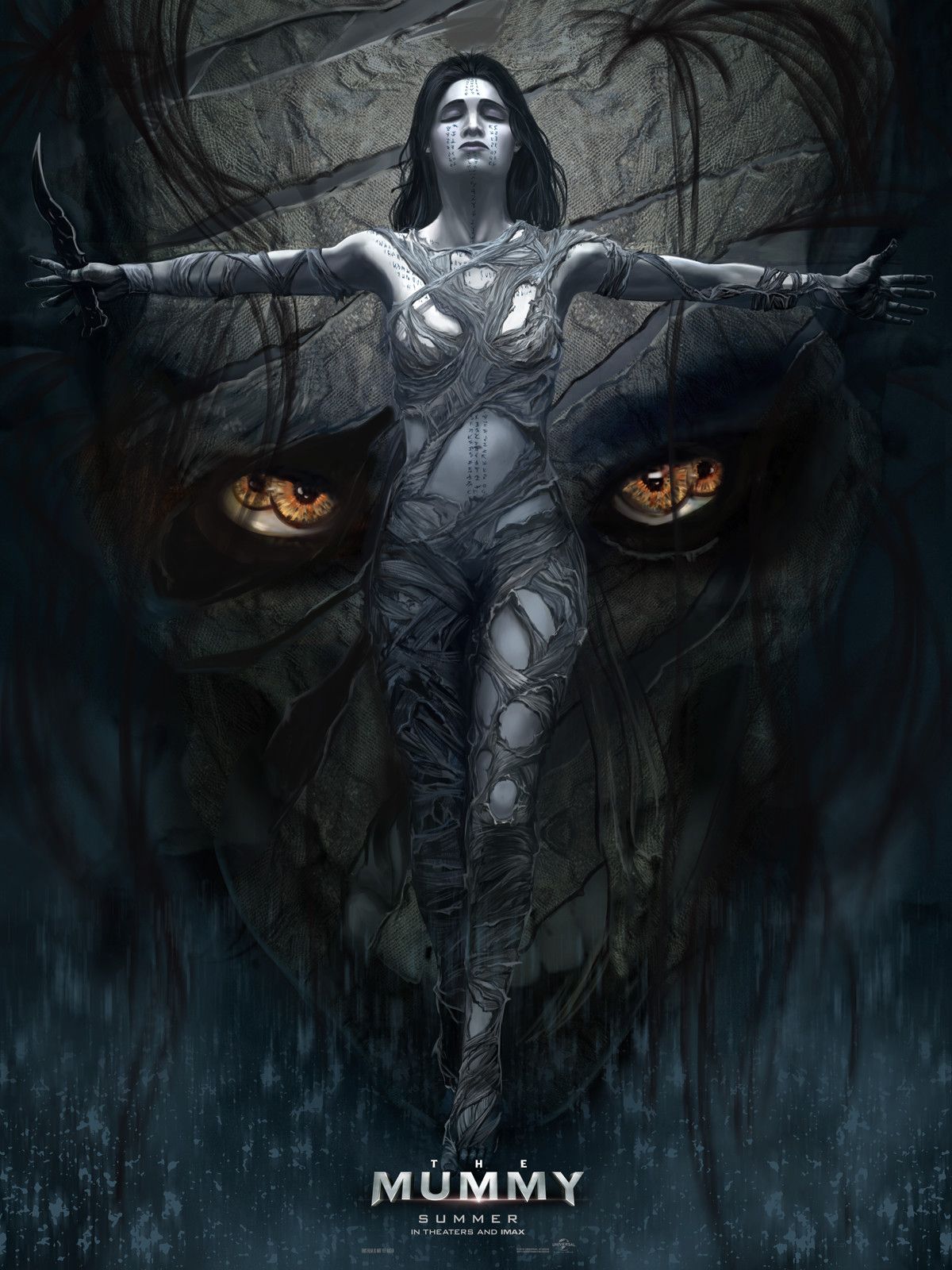
It was supposed to be the start of something massive. Think Avengers, but with bandages, fangs, and bolts in necks. When Universal Pictures dropped The Mummy 2017, they weren't just releasing a summer blockbuster; they were staking a claim on a multi-billion dollar "Dark Universe." They even took that infamous cast photo featuring Tom Cruise, Russell Crowe, Javier Bardem, Johnny Depp, and Sofia Boutella. It looked unstoppable on paper. Then the movie actually came out.
Most people remember the botched trailer—the one where the audio track was missing and all you could hear was Tom Cruise screaming in a plane crash—more than the actual plot. Honestly, it’s a bit of a tragedy. Not because the movie is a misunderstood masterpiece, but because it’s such a fascinating case study in how "franchise fever" can absolutely kill a standalone story.
You’ve got Tom Cruise playing Nick Morton, a guy who is basically Ethan Hunt if he had zero morals and a weird penchant for looting ancient artifacts. He stumbles upon the tomb of Ahmanet, an Egyptian princess who was buried alive for murdering her family. Standard stuff for a Mummy flick. But instead of the swashbuckling charm of the 1999 Brendan Fraser classic, we got a movie that couldn't decide if it wanted to be a horror film, a mission impossible stunt-spectacular, or a two-hour teaser for a sequel that would never happen.
Why The Mummy 2017 didn't stick the landing
The biggest issue with The Mummy 2017 wasn't the acting. Sofia Boutella is actually incredible as Ahmanet. She has this physical presence—a twitchy, predatory grace—that makes her genuinely creepy. The problem was the script's desperate need to explain everything. We spend so much time in "Prodigium," a secret monster-hunting organization led by Russell Crowe’s Dr. Henry Jekyll, that we forget we’re supposed to be watching a movie about a mummy.
It felt rushed. It felt crowded.
Universal wanted Marvel's ten-year success in ten months. They introduced Dr. Jekyll and Mr. Hyde in the first act of the first movie. It’s like if Iron Man had spent forty minutes of his first film explaining who Captain America, Thor, and Black Widow were before he even built the Mark III suit. It bogs down the pacing. By the time the third act rolls around, you’re less interested in the curse and more confused about why there are vampire skulls in the background of Jekyll’s office.
And let’s talk about the "Tom Cruise Effect." Cruise is a powerhouse. He’s arguably the last true movie star. But his presence changed the DNA of what a Mummy movie should be. Usually, the protagonist is the underdog. In this version, Nick Morton is essentially a superhero in training. When the stakes are "Tom Cruise might become a god," the horror elements sort of evaporate. You don't feel scared for him. You just wait to see how he’s going to sprint away from the problem.
The box office numbers vs. the narrative
If you look at the raw data, The Mummy 2017 wasn't a "flop" in the traditional, bankrupting sense. It grossed over $400 million worldwide. In any other context, that’s a win. But when your budget is north of $125 million—plus a marketing spend that likely matched that—and you’re trying to launch a cinematic universe, $400 million is a disaster.
The domestic performance was particularly brutal. It only made about $80 million in the US. Audiences stayed away. Critics were even harsher. On Rotten Tomatoes, it sits at a dismal 15%. People compared it unfavorably to the 1932 Boris Karloff original and the 1999 reboot.
- The 1932 version: Pure atmospheric horror.
- The 1999 version: Romantic adventure with great CGI for its time.
- The 2017 version: A "Dark Universe" commercial.
The disparity between what the studio wanted and what the audience craved was massive. People wanted a scary monster movie or a fun adventure. They got a lore-heavy setup for a franchise that was cancelled almost immediately after the opening weekend.
Alex Kurtzman and the creative struggle
Director Alex Kurtzman has been pretty vocal in recent years about the experience. He’s a talented producer and writer, but The Mummy 2017 was a massive undertaking for someone with limited directing credits at that scale. In various interviews, Kurtzman has referred to the film as his "biggest failure," but also his greatest learning experience. He admitted that the movie didn't represent what he wanted it to be.
There were reports of significant "creative control" issues on set. Variety reported that Cruise had a huge say in the production, from script changes to the editing room. While Cruise’s perfectionism usually results in hits, here it seemed to clash with the tonal requirements of a horror-adjacent film. You can’t really have a "monster" movie where the monster is secondary to the leading man’s character arc.
The ghost of Brendan Fraser
You can't discuss The Mummy 2017 without mentioning the 1999 film. It’s impossible. That movie is a cult classic for a reason. It has a perfect balance of humor, genuine scares, and chemistry between Brendan Fraser and Rachel Weisz.
When the 2017 trailer dropped, the internet immediately started campaigning for Fraser. The "Brenaissance" we see today—with Fraser winning an Oscar for The Whale—partially started as a reaction to how much people disliked the 2017 reboot. It reminded everyone how much they loved Rick O'Connell.
The 2017 film took itself way too seriously. It lacked the "fun" factor. It was gray, gritty, and dour. Even the color palette was washed out. It felt like it was trying to be The Dark Knight when it should have been trying to be Raiders of the Lost Ark.
What was the Dark Universe supposed to be?
For those who don't know, the Dark Universe was a planned series of interconnected films featuring the Universal Monsters. After The Mummy 2017, we were supposed to see:
- Bride of Frankenstein (directed by Bill Condon)
- The Invisible Man (starring Johnny Depp)
- Frankenstein's Monster (starring Javier Bardem)
- The Wolfman
- Dracula
- Creature from the Black Lagoon
After the lackluster reception of the Cruise vehicle, Universal scrapped the "connected" idea. They pivoted hard. This actually led to the 2020 version of The Invisible Man starring Elisabeth Moss, which was fantastic. Why? Because it was a low-budget, character-driven horror movie that didn't care about setting up a sequel. It just wanted to be a good movie.
Technical achievements and the plane crash
Despite the mess, we have to give credit where it's due. The zero-gravity plane crash sequence in The Mummy 2017 is insane. They actually flew a vomit comet (a reduced-gravity aircraft) to film those scenes. Cruise and the crew did 64 takes in weightlessness over two days.
That is dedication. It’s a stunning sequence. You can see the genuine disorientation on the actors' faces. If the rest of the movie had that level of singular focus and practical ingenuity, we might be talking about a very different legacy.
Sofia Boutella’s makeup was also a highlight. The double-pupil look—which she gets once she starts gaining power—was a striking visual choice. It’s a shame these elements were trapped in a narrative that felt like a corporate board meeting.
The legacy of a failed universe
What can we learn from The Mummy 2017? It’s basically the cautionary tale for every studio in Hollywood. It proved that you can't force a "universe." You have to make one good movie first.
The film also highlighted a shift in audience tastes. In 2017, we were reaching "franchise fatigue." We didn't want another "part one of twelve." We wanted a story with a beginning, middle, and end.
If you watch it today, detached from the hype and the "Dark Universe" baggage, it’s an okay action movie. It’s polished. The effects are mostly good. But it’s hollow. It’s a movie made by committees and spreadsheets rather than a singular creative vision. It’s the "uncanny valley" of cinema—it looks like a movie, it sounds like a movie, but it doesn't have a soul.
Moving forward with the Mummy mythos
If you’re a fan of the genre, don't let this one film sour the whole concept. The Mummy is a foundational pillar of horror.
Take these steps if you want to actually enjoy the Mummy lore:
- Watch the 1932 original: It’s slow, but Boris Karloff is haunting. It’s about obsession and reincarnation, not explosions.
- Revisit the 1999 Stephen Sommers version: It holds up remarkably well. The practical effects and sets give it a warmth that the 2017 version lacks.
- Check out the Hammer Horror "Mummy" films: Christopher Lee played the Mummy in 1959. It’s vibrant, bloody, and very British.
- Skip the 2017 sequels (because they don't exist): Instead, watch the 2020 The Invisible Man. It’s the "spiritual" successor that shows what happens when Universal lets directors take risks with these monsters.
The 2017 film is a fascinating relic of a specific time in Hollywood when everyone was chasing the Marvel dragon. It’s a reminder that even the biggest stars and the biggest budgets can’t save a story that doesn't know what it wants to be.
Next time you see it on a streaming service, give it a 20-minute look just for the plane crash. Then, honestly, go watch Brendan Fraser fight some CGI skeletons. You’ll have a much better time.
To truly understand the evolution of the genre, compare the "sand storm" effects between the 1999 and 2017 versions. You'll notice that while the 2017 version is technically more "realistic," the 1999 version has way more personality. That's the movie's problem in a nutshell.
Check out the "making of" features if you can find them. The physical training Sofia Boutella went through is actually more interesting than the movie itself. She’s a world-class dancer and athlete, and she brought a level of physicality that deserved a better script.
Ultimately, the movie serves as a perfect example of what happens when the "business" of show business gets in the way of the "show." It’s a piece of cinema history, just maybe not the kind Universal was hoping for.