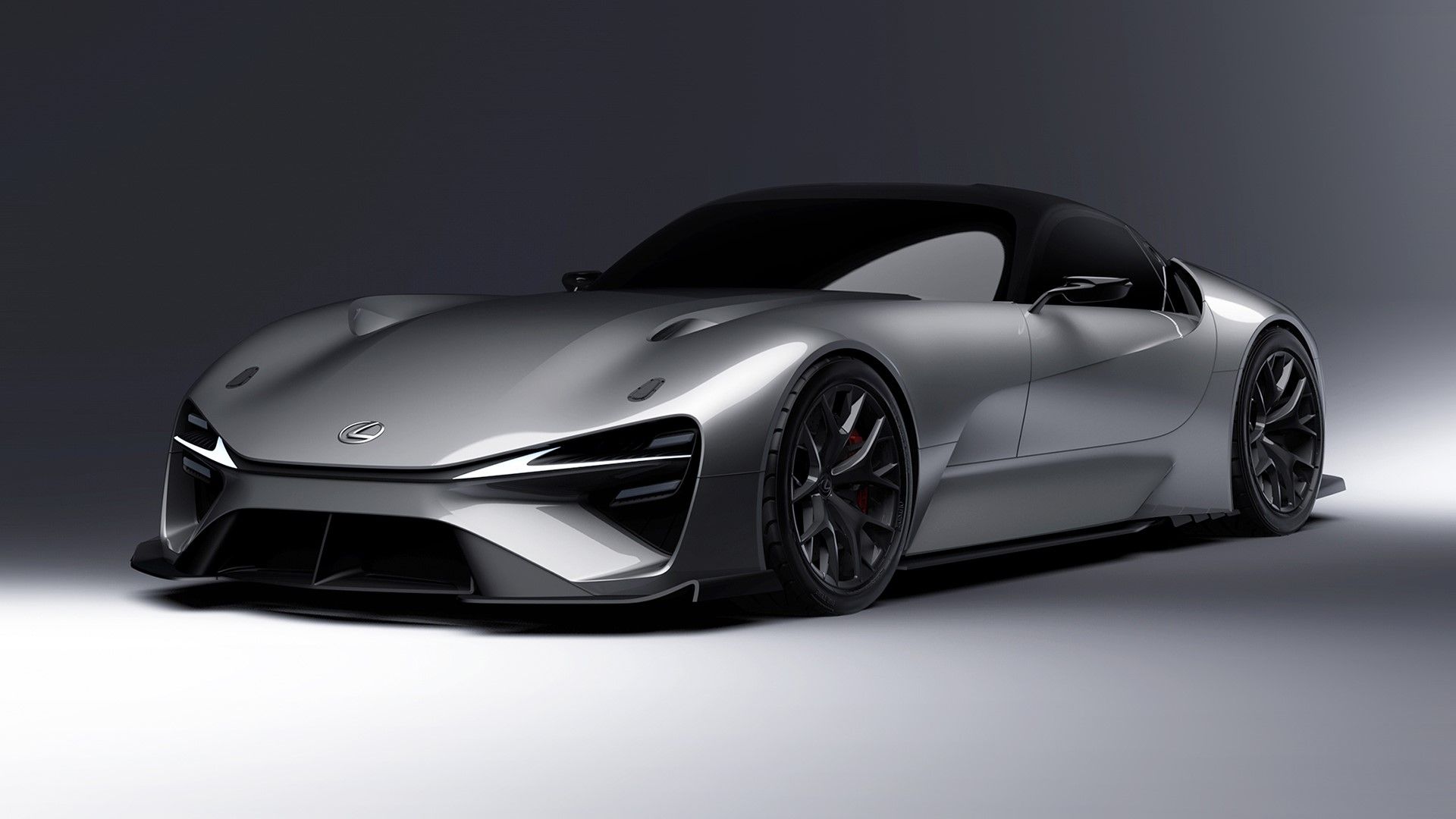
You’ve seen the spy shots. The long, low-slung silhouette tearing around the Nürburgring, looking more like a specialized endurance racer than something you’d park at a local grocery store. Everyone is calling it the "new LFA," but that’s not quite right.
Honestly, the new Lexus sports car—widely expected to be named the LFR—is shaping up to be something much weirder and more ambitious than a simple sequel to the V10 legend. It’s a bridge between two worlds that usually don't talk to each other. On one side, you have the high-octane, eardrum-shattering world of GT3 racing. On the other, the silent, clinical future of electrification. Lexus is trying to sit right in the middle.
Why the Lexus LFR is More Than Just an LFA Sequel
Let’s clear something up. The original LFA was a laboratory on wheels. It took a decade to build, lost the company money on every unit, and sounded like a Formula 1 car from the mid-2000s. The LFR is different. It’s being developed alongside a literal race car, the Toyota GR GT3.
This isn't just marketing fluff.
In December 2025, Toyota Gazoo Racing and Lexus held a world premiere that basically laid the cards on the table. They showed off the GR GT3 and a road-going version that looks suspiciously like what we’ve been calling the LFR.
But here’s where it gets confusing. Lexus also debuted something they are explicitly calling the LFA Concept. It’s a full battery-electric vehicle (BEV).
So, what are you actually going to be able to buy in 2026?
Current evidence points to the LFR launching first. It’s the "spiritual successor" that enthusiasts are actually craving because, unlike the BEV concept, the LFR is almost certainly packing a twin-turbo V8. Specifically, a 4.0-liter unit that might put out north of 700 horsepower when paired with a hybrid system.
The V8 vs. Electric Debate
It’s kinda funny watching the internet argue about this. Half the forums are convinced the next supercar is electric because of the 2021 Sport Concept. The other half saw the exhaust pipes on the Nürburgring mules and felt vindicated.
The reality? Lexus is doing both.
The LFR (the one you see testing) is the internal combustion "hurrah." Takashi Uehara, the president of powertrains at Toyota, basically confirmed a new V8 is in the works. He mentioned it shares DNA with their upcoming 2.0-liter four-cylinder, which sounds like a strange comparison until you realize that doubling a 400-hp four-cylinder gets you a very serious 800-hp V8.
- LFR (Expected 2026/2027): Twin-turbo V8 hybrid.
- LFA Concept (The "Future"): Full electric, potentially with a "manual" transmission simulation.
Lexus is betting that people who spend $250,000 on a car still want to hear something when they mash the pedal.
Pricing and When You Can Actually Get One
Don't expect this to be a bargain.
The Lexus LC 500 is a fantastic grand tourer, but it starts around $100,000. The LFR is a different beast entirely. We’re looking at a price tag that likely starts at **$250,000** and could easily swing toward $500,000 for high-spec versions.
Why so much? Because it’s a "halo" car.
Lexus needs a flagship. Since the LFA went out of production in 2012, they haven't had a true supercar. The LC 500 is beautiful, sure, but it’s not a Ferrari-killer. The LFR is meant to be that. It’s built on an all-aluminum spaceframe designed for the rigors of endurance racing. You’re paying for the R&D of a car that’s meant to win at Le Mans.
Deliveries are rumored to start in mid-2026. If you aren't already on a list at your local dealer, you might be too late for the first wave. Lexus usually keeps these runs limited. Remember, they only made 500 LFAs. While the LFR might see slightly higher production numbers to satisfy GT3 homologation rules, it’s still going to be a rare sight.
What Most People Get Wrong About the Tech
People hear "hybrid" and think of a Prius. Stop doing that.
In the new Lexus sports car, the hybrid system isn't there to help you get 50 miles per gallon. It’s there for torque fill. Turbochargers take a second to spool up. Electric motors are instant. By sandwiching a motor between the engine and the transmission, Lexus can make a turbocharged V8 feel like a massive, naturally aspirated V10.
It’s about the "linear" feel.
Akio Toyoda, often called "Master Driver Morizo," is obsessed with the kaiwa—the conversation between driver and car. He doesn't want a car that just goes fast in a straight line. He wants a car that responds to your thoughts. That’s why the LFR is keeping a combustion engine for now. The tech for an "emotional" EV is getting there, but for a 2026 launch, gas is still the heart of the machine.
Design: Aerodynamics Over Everything
If you look at the Lexus Sport Concept shown at Monterey Car Week, you’ll notice it’s incredibly low. Under 1,200 mm. That’s shorter than a Lamborghini Huracán.
The design isn't just for looks. It’s "reverse-engineered" from the airflow requirements of the GT3 racer. They didn't draw a pretty car and then add wings. They found the most efficient shape for downforce and then wrapped a Lexus body around it.
The result is a long hood, a tiny greenhouse, and a rear end that looks like it belongs on a spaceship. It’s aggressive, but in a very Japanese, minimalist way. No huge wings (unless you get the track-focused trim), just clean lines and massive air intakes.
Actionable Steps for Potential Buyers
If you’re serious about getting into the seat of the next Lexus performance era, you need to act now. This isn't like buying an RX 350.
- Contact a "Lexus Plus" Dealer: Not every Lexus dealership is equipped to handle supercar sales or specialized service. Look for flagship dealers in major metropolitan areas.
- Verify the Allocation Process: Most halo cars are sold via invitation or to previous Lexus LFA/LC 500 owners first. Getting your name on a "gesture of interest" list is the first step.
- Prepare for the V8 vs. BEV Choice: If you want the raw sound, focus on the LFR/GT3-derived model. If you want the cutting-edge tech (and can wait until 2028 or later), keep an eye on the LFA Concept's production timeline.
- Watch the 24 Hours of Daytona: The GT3 version is slated to race in 2026. How it performs on the track will be a direct indicator of how the road car will handle.
The window for high-displacement, internal combustion supercars is closing fast. The LFR might be the last time we see Lexus throw everything they have at a V8. It’s a gamble, but for the people who missed out on the LFA a decade ago, it’s a second chance at owning a piece of history.