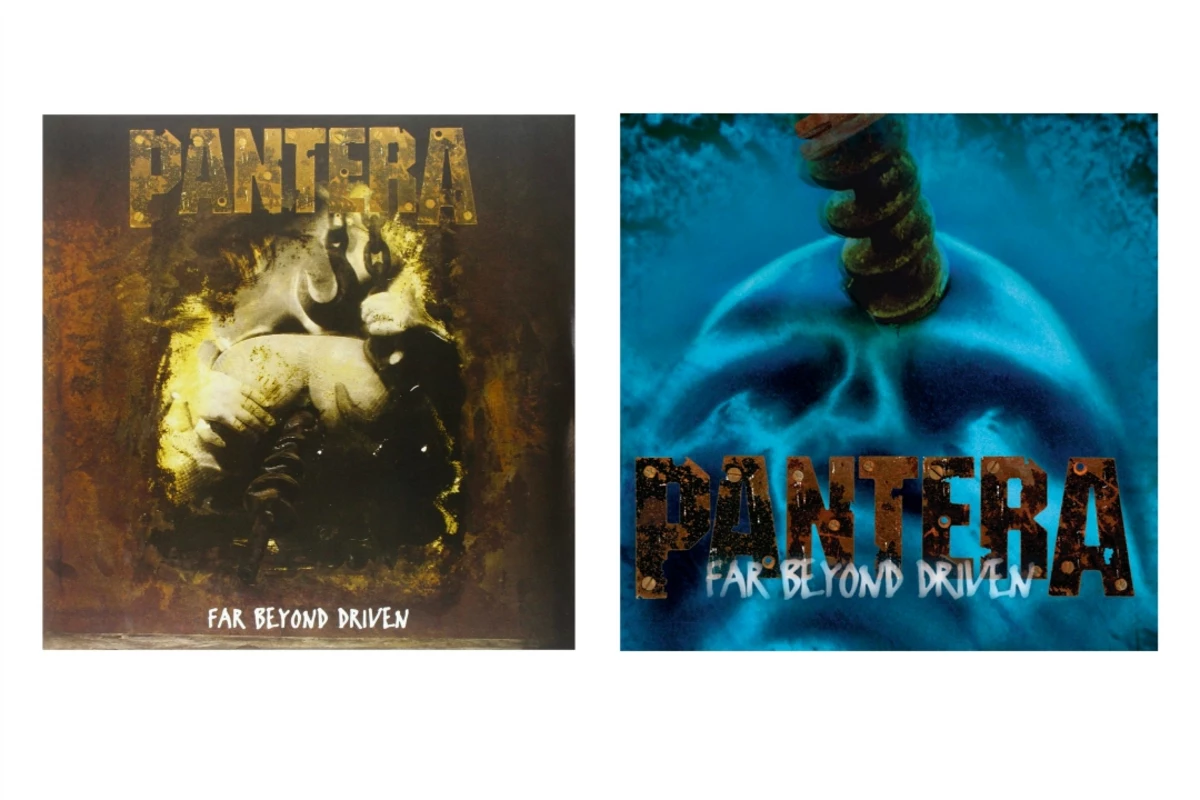
March 1994 was a weird time for heavy music. Grunge was still king, but Pantera was about to do the impossible by hitting Number 1 on the Billboard 200 with an album that sounded like a circular saw hitting a concrete floor. While the riffs on Far Beyond Driven are legendary, the Pantera Far Beyond Driven cover remains one of the most debated, censored, and misunderstood pieces of metal iconography ever conceived.
Honestly, if you bought the CD back in the day, you probably saw a blue-tinted drill bit spiraling into a human skull. It’s iconic. It’s tough. It fits the "Power Groove" brand perfectly. But that wasn't the original plan. Not even close. The actual intended artwork was so graphic that it almost derailed the marketing campaign before it even started, leading to a last-minute scramble that created one of the most famous "banned" covers in music history.
The Graphic Original Concept That Labels Hated
Let’s get into the weeds here. The original Pantera Far Beyond Driven cover didn't feature a skull. It featured a drill bit, sure, but it was being inserted into a much more sensitive area of the human anatomy—specifically, a person's anus.
It was provocative. It was crude. It was exactly the kind of thing Philip Anselmo, Dimebag Darrell, Vinnie Paul, and Rex Brown thought represented their "extreme" shift from the slightly more polished Vulgar Display of Power. They wanted to show that they were pushing further, harder, and more aggressively than anyone else in the mainstream.
Dean Karr was the photographer brought in to handle the shoot. Karr is a legend in the industry, having worked with everyone from Marilyn Manson to Slayer. He’s known for a gritty, high-contrast aesthetic that feels like a fever dream. When the band approached him with the "drill bit" idea, he didn't blink. He just went to work.
The label, EastWest (a subsidiary of Atlantic), had a total meltdown. You have to remember the context of 1994. Big-box retailers like Walmart and Kmart were the primary gatekeepers of music sales. If they refused to carry an album because of the artwork, the record was essentially dead on arrival. The label execs knew they had a potential Number 1 hit on their hands, and they weren't about to let a literal "pain in the ass" ruin their margins.
Switching to the Skull: A Happy Accident?
The band was told in no uncertain terms that the "anal drill" cover was a non-starter for retail. So, they pivoted. The compromise was the skull.
Some fans think the skull is a bit cliché for a metal band, but the way Karr shot it gave it a clinical, almost industrial vibe. The drill bit entering the front of the cranium symbolized the "mental" assault of the music. It worked. It worked so well that most people today don't even realize it was a Plan B.
Interestingly, the original graphic version wasn't completely scrubbed from existence. If you were lucky enough to snag an early vinyl pressing or certain international imports, you got the "explicit" version. It became an instant collector's item. In the early days of eBay and metal message boards, finding an original Pantera Far Beyond Driven cover with the "forbidden" art was a rite of passage for die-hard fans.
The blue-and-metallic color palette of the skull cover also played a huge role in the album's branding. It felt cold. It felt "driven." While Vulgar Display of Power was all about the physical impact of a punch to the face, Far Beyond Driven was about the psychological drilling of addiction, fame, and internal rage.
Why the Art Matched the Sonic Chaos
You can't talk about the cover without talking about the music. This was Pantera at their most uncompromising. Tracks like "Strength Beyond Strength" and "Becoming" were faster and more abrasive than anything they’d done previously.
Vinnie Paul once mentioned in an interview that the band wanted the heaviest record ever to hit Number 1. They achieved that. The Pantera Far Beyond Driven cover—even the "safe" skull version—warned the listener that this wasn't going to be a fun, melodic ride. It was a lobotomy set to 120 decibels.
There's a gritty realism in Dean Karr’s photography that AI-generated art just can't replicate today. He used real props, real lighting, and actual film. The textures on the drill bit look oily and dangerous. The skull doesn't look like a plastic Halloween prop; it looks like a medical specimen. That tangible, "dirty" feeling is why the image still shows up on T-shirts at every metal festival three decades later.
Collectors and Reissues: Where the "Real" Cover Lives Now
If you’re looking for the original artwork today, it’s much easier to find than it was in 1994. Anniversary reissues have embraced the band's original vision.
- The 20th Anniversary Edition: This release finally brought the "banned" art back to the forefront for a wider audience, often tucked inside the booklet or as a reversible sleeve.
- Vinyl Repressings: Many modern 180g vinyl releases use the original drill-in-backside artwork as the main jacket, catering to the "true" fans who want the unfiltered Pantera experience.
- Bootlegs and Merch: You’ll often see "reimagined" versions of the cover at independent record stores, mixing elements of both the skull and the original concept.
It's funny how time changes things. What was once considered "unsellable" by Atlantic Records is now a selling point for collectors. The controversy didn't hurt the band; it added to their mythos.
What Most People Get Wrong About the Artist
A common misconception is that the cover was just a quick Photoshop job or a low-budget effort. In reality, Dean Karr put massive effort into the lighting and the "mechanical" feel of the shoot. Karr has often spoken about how the band was incredibly involved. They weren't just guys who handed off the job to a design firm. They had a specific vision of "industrial-meets-Texas-tough."
Another mistake? Thinking there's only one "banned" version. There are actually several iterations of the graphic art depending on the brightness and cropping used in different regions. Some Australian pressings, for instance, had slight variations in the tint.
Actionable Steps for the Modern Pantera Fan
If you're looking to dive deeper into the history of this era or want to track down a piece of this history, here is how you should handle it:
- Check the Matrix Numbers: If you are hunting for an original 1994 pressing with the graphic art, look for specific catalog numbers (like EastWest 7567-92302-2 for certain European versions). Don't just trust a "rare" tag on a listing.
- Compare the Tint: The original "skull" CD has a very specific dark blue/grey hue. Many modern digital uploads of the Pantera Far Beyond Driven cover are oversaturated or too bright. If you want the authentic vibe, look for the matte-finish physical copies.
- Explore Dean Karr’s Portfolio: To understand why Pantera chose him, look at his work with GWAR or his music video for "Sweet Dreams" by Marilyn Manson. It puts the Far Beyond Driven aesthetic into a broader historical context of 90s counter-culture.
- Listen to the "Planet Caravan" Cover: To truly appreciate the cover's contrast, listen to the final track on the album. The artwork is brutal, but the album ends with a haunting, trippy Black Sabbath cover. The juxtaposition between the "drilling" imagery and the psychedelic ending is what makes the album a masterpiece.
The Pantera Far Beyond Driven cover isn't just a picture of a drill. It's a snapshot of a band at the height of their powers, daring the industry to blink. The fact that we are still talking about a piece of "rejected" art thirty years later proves that Pantera won the war, even if they had to change the battle plan at the last minute.
To get the full experience, go find an original LP, crank "5 Minutes Alone," and look at the textures Karr captured. It’s a reminder that in the 90s, physical media was the only way to truly "see" a band’s soul—even if that soul was as sharp and cold as a tungsten drill bit.