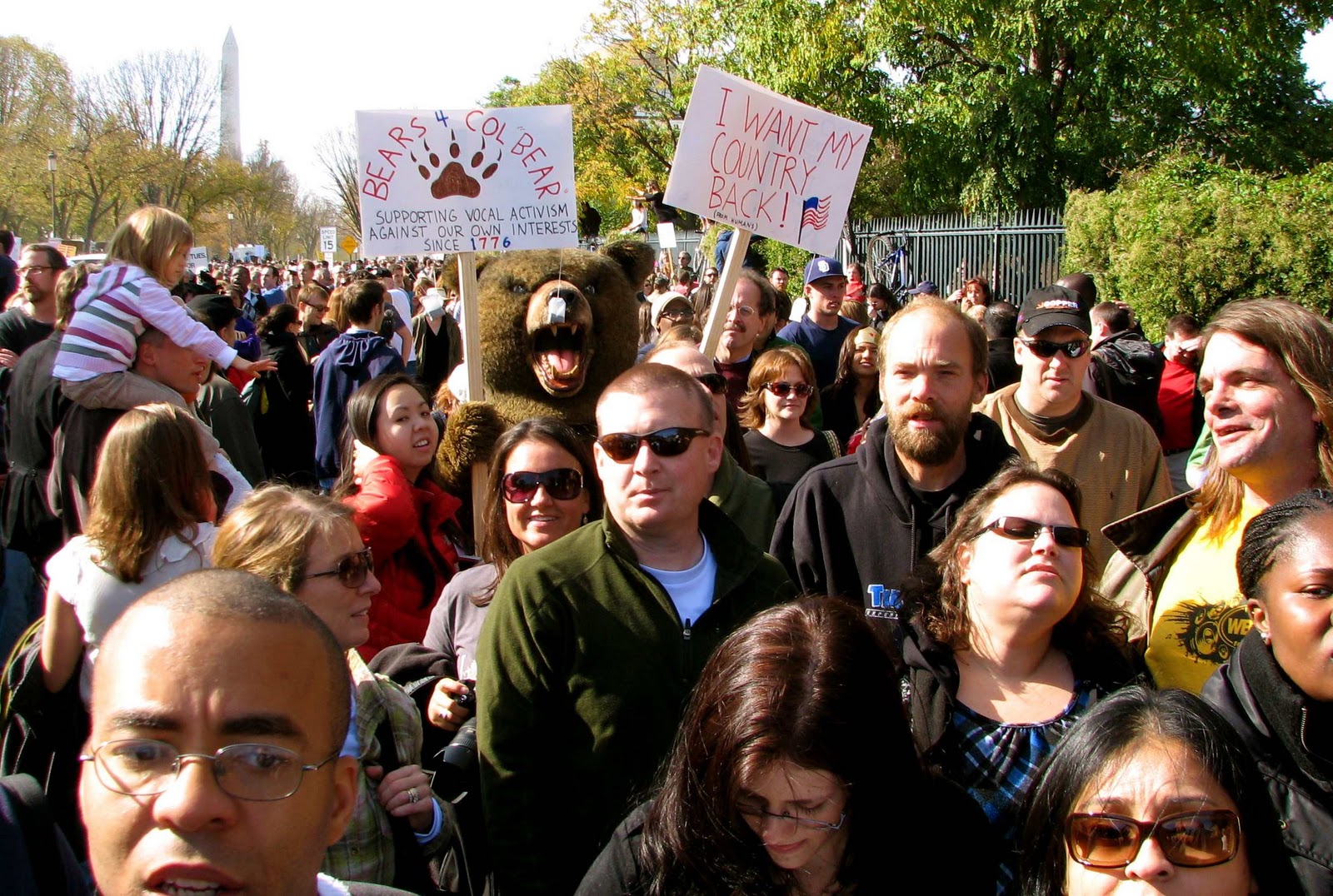
October 30, 2010, was a strange day to be in Washington, D.C. If you were standing on the National Mall, you weren't looking at a sea of angry protesters or a standard political mobilization. Instead, you were looking at a man holding a sign that said "I disagree with you, but I'm pretty sure you're not Hitler."
That was the vibe.
The Rally to Restore Sanity and/or Fear was technically two events smashed into one. Jon Stewart, then the king of The Daily Show, wanted to "restore sanity." Stephen Colbert, playing his hyper-conservative "Colbert Report" persona, wanted to "keep fear alive." It was a satirical response to the rising temperature of American political discourse, specifically aiming its fire at the 24-hour news cycle and the polarized shouting matches that had become the norm. People didn't just show up; they swarmed. While the National Park Service doesn't give official estimates anymore, CBS News commissioned an analysis that put the crowd at about 215,000 people. That is a massive number for something that started as a joke on basic cable.
What the Rally to Restore Sanity and/or Fear Was Really About
Most people remember the funny signs. They remember the Cat Stevens and Yusuf Islam bit, or the "Medal of Reasonableness." But at its core, the Rally to Restore Sanity and/or Fear was an experiment in meta-politics.
At the time, the Tea Party movement was at its peak. Glenn Beck had recently held his "Restoring Honor" rally at the Lincoln Memorial. The media was obsessed with conflict. Stewart’s premise was simple: the loudest voices on the extreme ends of the spectrum were hijacking the conversation, making it seem like the country was on the verge of a civil war. He argued that most Americans actually have "shit to do" and can’t spend all day being outraged.
It’s easy to look back now and think the rally was naive. Looking at the political landscape of 2026, the idea that "lowering the volume" would solve our problems feels like a relic from a simpler time. But in 2010, it was a radical act of moderation.
The Colbert Factor: Keeping Fear Alive
Colbert’s "March to Keep Fear Alive" was the perfect foil. While Stewart played the straight man calling for nuance, Colbert arrived in a chariot, wearing a Captain America-style outfit, arguing that fear is what keeps us safe. It was a masterclass in satire. By leaning into the absurdity of fear-mongering, he exposed how much of the political news at the time relied on scaring people to keep them tuned in.
He even had a "Fear-O-Meter." It was ridiculous.
But the humor had a sharp edge. The rally wasn't just poking fun at politicians; it was poking fun at us—the audience. It questioned why we let the loudest, most extreme voices define our reality. It’s kinda fascinating that even sixteen years later, we are still grappling with the exact same issue, just with different tech and higher stakes.
The Moment the Tone Shifted: Stewart's Closing Speech
For most of the afternoon, the event felt like a giant outdoor comedy festival. There were musical guests like The Roots, Sheryl Crow, and Mavis Staples. There were pre-taped segments and goofy awards. But then, Jon Stewart ended the show with a ten-minute "sermon" that stripped away the irony.
He used a metaphor that a lot of people still quote today: the "merge."
He talked about how Americans work together every single day in the most mundane ways, like cars merging into a tunnel. We don't ask about the political affiliation of the person letting us into the lane. We just move forward. We cooperate because we have to.
"We live now in hard times, not end times."
That was his big takeaway. He criticized the media for being a "magnifying glass" that took every small disagreement and made it look like a world-ending catastrophe. He wasn't saying there are no big problems. He was saying that we can't solve big problems if we are constantly in a state of manufactured panic.
Why Critics Hated It (and Why They Might Have Been Right)
Not everyone was a fan.
A lot of people on the Left were actually pretty pissed off. They felt that by calling for "sanity" and "moderation," Stewart was creates a false equivalence between the two parties. In their view, one side was trying to pass healthcare reform and the other side was questioning where the President was born—they didn't think those two things deserved equal blame for "insanity."
The late Christopher Hitchens wrote a pretty scathing piece about it. He basically called the rally a "tepid" exercise in middle-of-the-roadism.
Even today, political scientists debate if the Rally to Restore Sanity and/or Fear did more harm than good. Did it encourage people to disengage? Did it make "both-sidesism" a virtue? It’s a valid question. If you treat politics like a joke, do you lose the ability to fight for things that actually matter? Honestly, it depends on who you ask. If you were there, you probably felt a sense of community. If you were watching from home as a political strategist, you probably thought it was a wasted opportunity to mobilize a huge group of young voters right before the midterms.
The Legacy of the Rally in the Age of Social Media
It’s wild to think that this happened before Instagram was a big thing. TikTok didn't exist. Twitter was still mostly people talking about what they had for lunch.
The Rally to Restore Sanity and/or Fear was one of the last great "monoculture" events. Back then, The Daily Show had a massive, concentrated influence on a specific demographic. Today, that influence is fragmented across a million different creators and platforms.
But you can see the rally's DNA in how we talk about "toxic" discourse today. The rally was the first major public event to name the problem of the "outrage machine." It didn't fix it—clearly—but it gave people a vocabulary for it.
What most people get wrong about the event:
- It wasn't a protest. It was a "gathering." The distinction matters. Stewart went out of his way to say this wasn't about a specific policy.
- It wasn't a "Daily Show" episode. While the staff produced it, the scale was beyond anything a late-night show had done.
- It didn't "fail." People often point to the 2010 midterms (where Democrats got crushed) as proof the rally did nothing. But Stewart’s goal wasn't to win an election; it was to make a point about the media. In that sense, he succeeded.
How to Apply the "Sanity" Mindset Today
If you’re feeling burnt out by the current political climate, looking back at the 2010 rally offers some surprisingly practical insights. The world is louder now, but the mechanics of outrage haven't changed that much.
Audit your information diet. Stewart’s main target was the 24-hour news cycle. Today, that’s your "For You" page. If everything you see is designed to make you feel "fear" (the Colbert side), you’re being manipulated for engagement.
Look for the "Merge." In your daily life, you probably interact with people you disagree with all the time without realizing it. Recognizing that those people aren't your mortal enemies is the "sanity" part. It doesn't mean you stop caring about your values; it just means you stop letting the "magnifying glass" distort your reality.
Value nuance over slogans. The funniest signs at the rally were the ones that refused to be simple. "I'm not a brain surgeon but I play one on the National Mall." Complexity is the enemy of the outrage machine.
The Rally to Restore Sanity and/or Fear was a snapshot of a moment where we thought we could laugh our way back to a reasonable conversation. We couldn't. But the attempt itself remains one of the most interesting intersections of comedy and political philosophy in American history. It showed that hundreds of thousands of people were desperate for a way to talk to each other without screaming. That desperation hasn't gone away; if anything, it’s only grown.
Actionable Steps for Navigating Political Noise
- Practice "Slow News" Consumption: Instead of reacting to breaking news alerts, wait 24 hours to read a deep-dive analysis. The "fear" usually dissipates once the facts catch up.
- Engage in Localized Action: Stewart’s "Sanity" was about the mundane. Focus on your immediate community—school boards, neighborhood associations—where the "magnifying glass" of national media has less power.
- Use Satire as a Shield, Not a Weapon: Satire, like Colbert’s performance, is meant to expose the absurdity of power. Use it to deconstruct the arguments that are meant to scare you, rather than using it to mock the "other side."
- Identify False Equivalency: Be honest about when "both sides" are actually at fault and when one side is clearly the outlier. True sanity requires the ability to distinguish between a "disagreement" and a "threat."