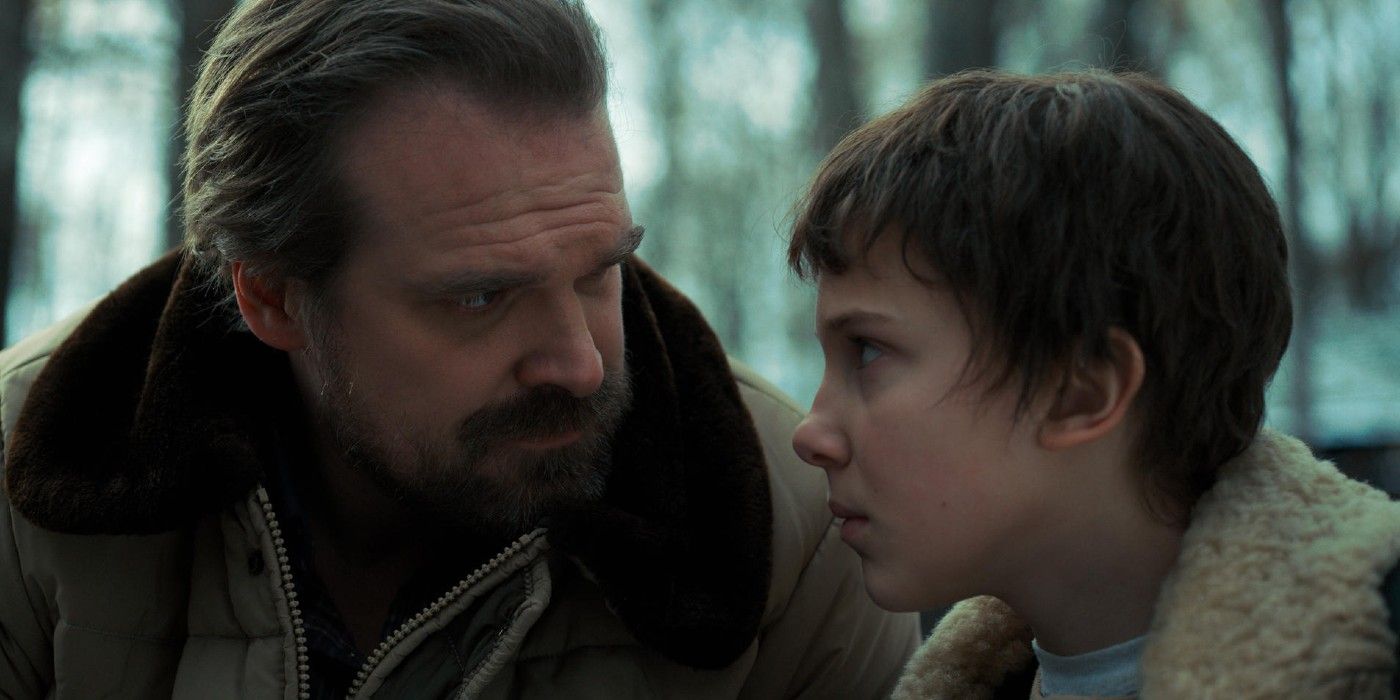
Jim Hopper and Eleven. It’s the heart of the show. Honestly, without them, Stranger Things is just a bunch of kids on bikes running away from a CGI monster. When the Duffer Brothers first introduced us to the cigarette-smoking, pill-popping Chief of Police and the traumatized lab escapee, nobody expected them to become the show's emotional bedrock. It’s a messy, loud, and sometimes frustrating bond. It feels real.
Think back to Season 1. They barely interacted. Hopper was busy hunting for Will Byers, and Eleven was hiding in Mike’s basement eating Eggos. But then Season 2 happened. The cabin in the woods changed everything. We saw two broken people trying to build a life out of scrap wood and TV dinners. It wasn't pretty. They yelled. Eleven blew out the windows with her mind. Hopper took away her TV privileges. It was peak "grumpy dad" energy meets "superpowered teenager" angst.
What People Get Wrong About the Stranger Things Hopper and Eleven Connection
A lot of fans look at their relationship as a simple replacement for what they lost. Hopper lost Sara; Eleven lost her childhood and any semblance of a real father figure in "Papa" Brenner. But calling it a simple "replacement" is a bit of a disservice to the actual writing. It’s deeper.
Hopper wasn't just looking for a new daughter. He was looking for a reason to not be a total wreck. Eleven wasn't just looking for a protector; she was looking for a person who wouldn't experiment on her. It’s a partnership of necessity that turned into a soul-deep familial bond. David Harbour has mentioned in several interviews that Hopper’s arc is fundamentally about his "resurrection" as a human being through Eleven. He starts the series essentially dead inside. By the time he’s writing that "three inches" speech in Season 3, he’s a man who has rediscovered what it feels like to have a heart that can be broken.
The Evolution of the Cabin Years
Living in that cabin in Mirkwood wasn't some idyllic forest retreat. It was basically house arrest for a girl who just wanted to see her friends. Hopper was terrified. He was scared that if she stepped outside, the government would snatch her back or the world would end. Or both.
This led to some of the most authentic conflict in the whole series. You remember the fight in Season 2, Episode 4? "Punks" and "bitchin’"? It’s iconic because it’s so grounded. Even with the telekinesis, the core of the argument is something every parent and teenager has gone through: the desperate need for independence versus the suffocating desire to protect. Hopper lied to her about when she could see Mike. He was wrong. He knew he was wrong. But he did it because he couldn't lose another daughter. That desperation is what makes the Stranger Things Hopper and Eleven story arc so gut-wrenching.
The Season 3 Friction and the "Three Inches" Rule
Season 3 was polarizing for a lot of fans. Some felt Hopper became too much of a "caricature" of a jealous dad. He was sweaty, he was angry, and he was constantly yelling at Mike. But if you look at it from his perspective, he finally had a family, and it was slipping through his fingers because of puberty and 7-Eleven Slurpees.
The "three inches" rule became a meme, but it’s actually a pretty tragic symbol of Hopper’s inability to let go. He wanted to freeze time. He wanted Eleven to stay the little girl in the overalls forever.
- He struggled with the "dad talk."
- He used Joyce to try and articulate feelings he didn't understand.
- He eventually realized that change is the "one thing" he can't stop.
Then came the Starcourt Mall. The letter he wrote—the one Eleven reads at the end of the season—is arguably the best piece of writing in the series. It wasn't just a goodbye; it was an admission of failure and a blessing for her to keep growing. When Eleven says "half-way happy" in Season 4, she's carrying that letter with her. It’s her North Star.
The Trauma Bond and Dr. Brenner
We have to talk about the contrast between Hopper and Martin Brenner. Brenner called himself "Papa," but he was a jailer. He used Eleven’s gifts for Cold War espionage. Hopper, conversely, tried to hide those gifts. He wanted her to be ordinary.
In Season 4, when Eleven is back in the NINA project, her memories of Hopper are what keep her tethered to her humanity. While Brenner tries to convince her she’s a monster, her experiences with Hopper—the waffles, the cleaning of the cabin, the dancing to Jim Croce—prove she’s a person. This is a crucial distinction. Hopper gave her an identity outside of being "011." He gave her the name Jane Hopper. That’s not just paperwork; it’s a soul.
The Russia Reunion
The reunion in the Season 4 finale was short. It was barely a few minutes of screen time. But the way Hopper looked at her—shaved head, emaciated from the gulag—and the way she just folded into him? That’s years of character development paying off in a single hug. They didn't need a big monologue. They just needed to know the other was alive.
It’s interesting to note that Millie Bobby Brown and David Harbour have a genuine bond off-screen too. Harbour has often spoken about feeling a "paternal instinct" toward Millie as she navigated the insane fame that came with the show. That chemistry isn't something you can fake with a script. It’s why the Stranger Things Hopper and Eleven scenes always feel like they have more weight than the rest of the show.
What This Means for Season 5
As we head into the final season, the stakes for this duo are higher than ever. Vecna is still out there. Hawkins is literally splitting open. But for Hopper and Eleven, the goal has shifted. It’s no longer about hiding in a cabin. It’s about fighting for a world where they can actually live together without a ticking clock.
There are a few things we should expect to see:
- Hopper as a General: He’s going to be leading the human resistance, but his priority will always be Eleven’s safety, which will lead to more friction.
- Eleven’s Independence: She’s not a kid anymore. She’s a young woman who has survived a lab, the Upside Down, and losing her powers. Hopper has to treat her like a peer, not just a child.
- The Joyce Factor: How does Eleven fit into a world where Hopper and Joyce are finally "official"? This is a new family dynamic that hasn't been fully explored.
Practical Takeaways for Fans
If you’re rewatching the series or analyzing the character beats, pay attention to the silence. The best moments between these two aren't the big speeches. They are the small nods, the shared looks, and the way they both carry the weight of their past losses.
- Watch the "You’re Like Me" scene in Season 2 again. It’s the moment Hopper realizes Eleven isn't a project; she's his daughter.
- Track the use of the blue hair tie. It belonged to Hopper’s daughter Sara. He wore it on his wrist for years. Then he gave it to Eleven. She wore it to the Snow Ball. It’s the ultimate hand-off of love and grief.
- Observe their body language. In Season 1, Hopper is tense and closed off. By Season 4, despite being in a Russian prison, his thoughts are entirely externalized toward Eleven’s survival.
The core of Stranger Things isn't the Demogorgon. It’s the fact that a broken cop and a broken girl found a way to be a family in the middle of the apocalypse. That’s why people still care. That’s why the show works.
To really understand the show's endgame, you have to look at how far they've come. They've moved from "don't open the door" to "keep the door open three inches," and finally to "I'll find my way back to you." It's a journey of letting go and holding on at the same time. As the final episodes approach, the survival of Hawkins might depend on Eleven's powers, but her survival depends on the humanity Hopper helped her find.
Keep an eye on the official Netflix social channels for Season 5 production updates. The filming process has been long, but the behind-the-scenes photos of Harbour and Brown on set suggest that their final arc will be the emotional centerpiece of the series finale. Focus on the character-driven episodes rather than just the action set pieces; that’s where the real story lives.