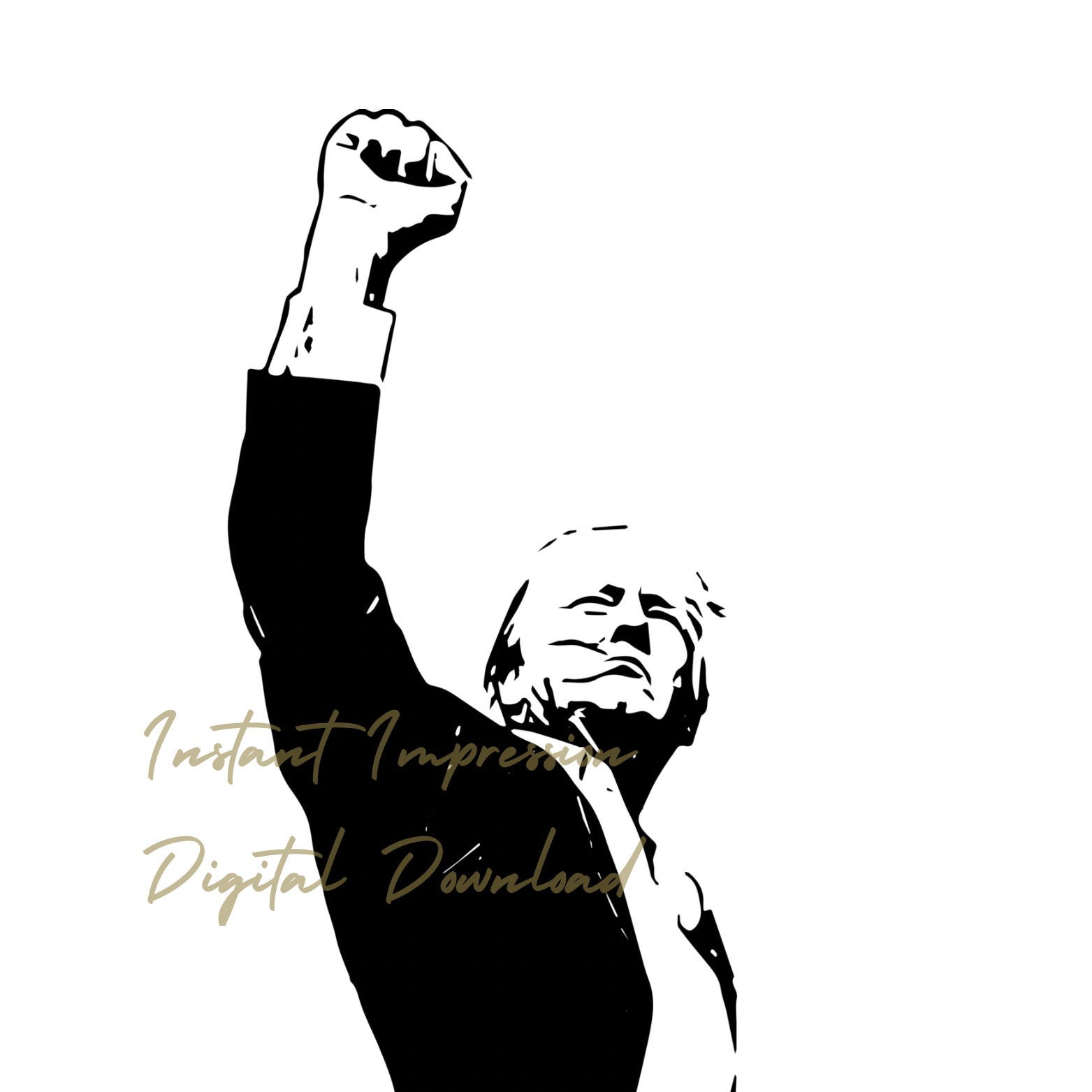
Honestly, we’ve all seen it a thousand times by now. That raw, chaotic frame from a sweltering July afternoon in Butler, Pennsylvania. Donald Trump, face streaked with blood, arm thrust upward, while a huddle of Secret Service agents tries to pull him into the safety of an armored SUV. It’s the trump fist pump photo, and whether you love the guy or can't stand him, you have to admit: the image is a masterpiece of timing and instinct. It’s one of those rare moments where history and art collide so violently that the world just kind of stops for a second.
July 13, 2024. It was supposed to be just another rally. Then the pops happened.
The Chaos Behind the Lens
Evan Vucci, the Associated Press chief photographer who took the shot, didn't have time to think about "iconic" status. He’s a veteran. He’s covered wars in Iraq and Afghanistan. When the gunfire started, his brain didn’t go into "panic" mode; it went into "work" mode. While everyone else was hitting the deck—rightfully so—Vucci ran toward the stage.
He knew right away it was gunfire. In interviews later, he mentioned how he was just trying to manage his composition. "Slow down, slow down. Compose, compose," he kept telling himself. That’s wild, right? Most of us would be looking for the nearest concrete wall, but he was worried about the light and making sure he didn't cut off Trump's head in the frame. He switched from his long lens to a wide-angle lens as he moved closer, anticipating where the agents would move the former president.
Breaking Down the Frame
Why does this specific trump fist pump photo work so well? Critics and art historians have spent months dissecting it. It’s not just "a guy with his hand up." It’s the geometry.
- The Triangle: The Secret Service agents form a base, a literal human shield, with Trump at the apex. It creates a sense of stability in a moment that was anything but stable.
- The Colors: You’ve got the deep blue of the Pennsylvania sky, the red of the MAGA hat in his hand, the red stripes of the flag, and—most viscerally—the red of the blood on his cheek. It’s a patriotic palette that looks almost staged, even though it was totally spontaneous.
- The Gaze: One of the agents, Sean Curran, is looking directly at the camera. It’s a piercing look that breaks the "fourth wall," pulling the viewer into the danger.
It’s been compared to Raising the Flag on Iwo Jima or Liberty Leading the People. That’s heavy company for a digital file sent via a Wi-Fi hotspot in a field of grass and dirt.
What Really Happened in Those Seconds?
The timeline is a blur for most people who watched it live on TV, but for the photographers in the "buffer," it was a series of rapid-fire technical decisions. Doug Mills from the New York Times was there too. He actually caught a bullet in flight—a literal streak of lead in the air—because he was shooting at a staggering 1/8000th of a second.
But Vucci’s shot is the one that stayed. It’s the one that became a shirt, a poster, and eventually, a portrait hanging in the White House.
Trump was on the ground for about a minute. When he stood up, he wasn't just letting the agents lead him away. He realized the crowd was still there. He realized they were terrified. He said later to the New York Post that he wanted to let them know he was okay. "Fight! Fight! Fight!" he mouthed.
It was a display of pure media instinct. Even with a piece of his ear missing, he knew the power of the visual.
The Viral Aftermath and "Post-Truth"
We live in a weird time. Within minutes, the trump fist pump photo wasn't just news; it was a meme. It was a fundraising tool. It was "proof" of whatever narrative people already believed. For supporters, it was a symbol of indomitable strength. For critics, it was a complicated image to process—an undeniable moment of history that they knew would be used as political fuel.
Art critic Jonathan Jones noted that the image has a "religious suggestiveness." It’s a bit uncanny. How does a scene that messy turn out that perfect? It almost feels like a Renaissance painting where every limb is exactly where it needs to be to tell a story of sacrifice and defiance.
Facts vs. Folklore
There was a lot of chatter online about the photo being "staged" because it looked too good. That's basically been debunked by the sheer volume of video evidence and the testimony of the photographers who were literally in the line of fire. These guys (Vucci, Mills, Anna Moneymaker) are Pulitzer winners for a reason. They don't just "take" photos; they see the frame before it happens.
The Lasting Legacy of the Fist Pump
By early 2025, the image had moved from the front pages of newspapers to the walls of the White House. A painting based on Vucci’s photo, created by artist Marc Lipp, replaced a portrait of Barack Obama in the State Floor. It was a gift from Andrew Pollack, a school safety advocate.
Whether you think the photo represents a turning point in American democracy or just a very lucky shot by a very brave photographer, you can’t look away from it. It changed the 2024 election cycle instantly. It turned a moment of potential tragedy into a symbol of resilience that resonated far beyond the borders of Butler.
How to look at the photo today:
- Check the metadata: If you’re a photography nerd, look into the Sony gear Vucci used. His ability to transmit those files instantly is why the world saw the image while the motorcade was still leaving the site.
- Compare the angles: Look at the shots taken by Anna Moneymaker from the ground level. They provide a much more "vulnerable" perspective of the same event, showing how much a single foot of camera height can change the "vibe" of a historical moment.
- Study the composition: Look for the "Golden Ratio." It’s almost spooky how well the elements align.
The trump fist pump photo reminds us that even in the age of 4K video and AI-generated everything, a single still image captured by a human being with a clear eye still holds more power than anything else. It captures a second that didn't just pass—it froze.
To really understand the impact, go back and watch the raw footage of the rally. Compare the screaming, the confusion, and the dust to the silence and "perfection" of Vucci’s frame. It’s the best lesson you’ll ever get on why photojournalism matters.
Next Steps for You:
Check out the Pulitzer Prize archives for 2024 and 2025 to see the full "Breaking News" galleries from that day. Seeing the sequence of shots—from the moment Trump touches his ear to the moment he enters the vehicle—gives you a much deeper appreciation for the split-second decision-making involved in iconic photography.