February 15, 1898. Havana Harbor was quiet, or at least as quiet as a colonial port under the shadow of a rebellion can be. Then, at 9:40 PM, the forward section of the USS Maine exploded, tearing the ship into a jagged mess of steel and fire. Two hundred and sixty-six sailors died. Most of them never even woke up.
It’s one of those moments that basically functions as a "before and after" for American history. Before the blast, the United States was a regional power minding its own business—mostly. After? We were an empire. But the thing is, the story we were told in school about the Spanish-American War is kinda messy. It’s a mix of genuine tragedy, terrible journalism, and a hundred-year-long scientific mystery that wasn't actually "solved" until the 1970s. Or was it?
Honestly, the tragedy was a perfect storm. You had a beautiful, brand-new battleship sitting in the middle of a literal powder keg. Cuba was fighting for independence from Spain. The U.S. was "protecting interests." Then the ship goes boom, and suddenly, "Remember the Maine, to hell with Spain!" is the only thing anyone is shouting.
The Night the USS Maine Exploded
Imagine the scene. The Maine had been in Havana for three weeks. It was a "friendly" visit, but everyone knew it was a flex. Captain Charles Sigsbee was sitting in his cabin writing a letter when the floor basically turned into a volcano.
The explosion was so massive it lifted the ship out of the water. Debris rained down on the city. Sigsbee survived, miraculously, and his first instinct was actually pretty calm. He sent a telegram asking people to "suspend judgment" until an investigation happened. But the American press? They didn't have time for judgment. They had papers to sell.
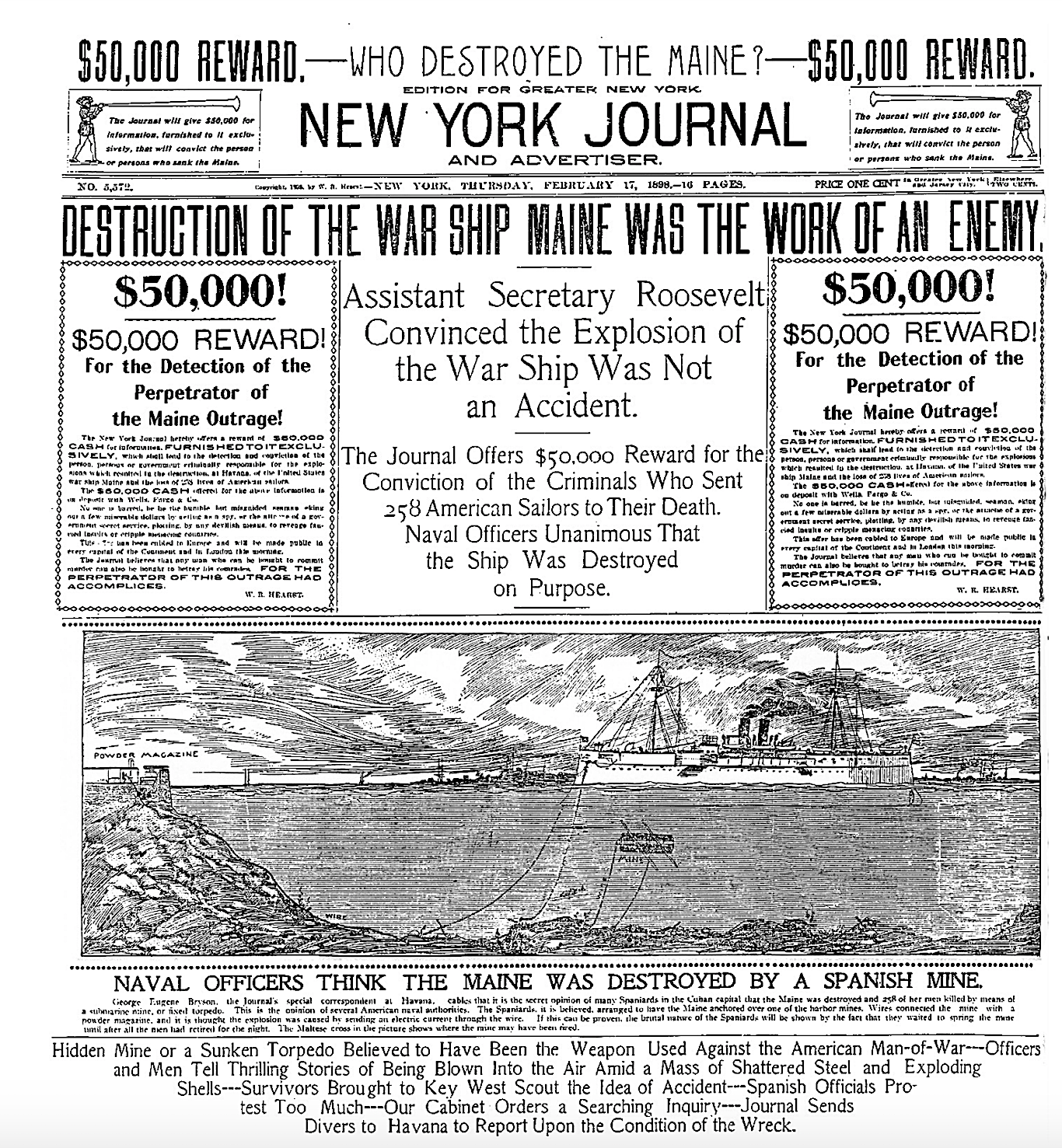
William Randolph Hearst and Joseph Pulitzer—the kings of "yellow journalism"—went absolutely wild. They didn't wait for a diver to check the hull. They just printed diagrams of Spanish mines attached to the ship. It was fake news before we had a catchy name for it.
Why the Location Mattered
Havana wasn't just any port. It was the epicenter of a brutal colonial war. Spain was desperate to keep Cuba. The Cuban revolutionaries were desperate to get the U.S. involved. This put the Maine in the crosshairs of a massive political game. If the USS Maine exploded because of a mine, it was an act of war. If it was an accident? Well, that’s just a tragedy.
The Navy convened a Court of Inquiry almost immediately. In 1898, they looked at the bent steel and decided an external mine had set off the ship's magazines. That was all President William McKinley needed. By April, we were at war.
The Great Mine vs. Coal Bunker Debate
For decades, the "Spanish Mine" theory was the gospel truth. It justified a war that gave the U.S. control of the Philippines, Guam, and Puerto Rico. But as the years went by, people started looking at the physics of the blast again.
Here is the thing about 19th-century battleships: they were kind of floating death traps.
The Maine used bituminous coal. This stuff is notoriously prone to "spontaneous combustion." If the coal bunker—which happened to be right next to the gunpowder magazine—got too hot, it could start a slow-smoldering fire. If that fire touched the bulkhead of the magazine?
Kaboom.
Admiral Rickover’s 1976 Revelation
In the 1970s, Admiral Hyman Rickover (the guy basically responsible for the nuclear Navy) got obsessed with the case. He hired experts to look at the photos and the wreckage. Their verdict? It was almost certainly an internal fire. The way the plates were bent suggested the force came from the inside out, not the outside in.
- The Coal Theory: Smoldering coal in bunker A-16 heated up the partition.
- The heat ignited the 6-inch and 10-inch shell reserves.
- The Mine Theory: A small naval mine was detonated under the ship.
- This triggered a "sympathetic" explosion of the magazines.
National Geographic did another study in 1998 using computer modeling. They argued that a mine could have caused the inward bending seen in some of the wreckage, but it wasn't definitive. It’s one of those historical cold cases that refuses to stay closed.
The Media’s Role in Starting a War
We can't talk about the USS Maine exploded without talking about the "Yellow Press." Hearst famously supposedly told his illustrator, "You furnish the pictures, and I'll furnish the war." Whether he actually said that is debated by historians like W. Joseph Campbell, but the sentiment was definitely there.
The New York Journal offered a $50,000 reward for the "perpetrator." They ran headlines that looked like movie posters. It was sensationalism at its peak. This forced McKinley’s hand. He didn't really want a war, but the public was screaming for blood.
The reality is that Spain had almost zero motive to blow up the ship. They knew they couldn't beat the U.S. in a fight. Why would they poke the bear? The Cuban rebels had more of a motive—they wanted the U.S. to jump in—but they didn't really have the tech to pull off a sophisticated underwater mine attack in a guarded harbor.
Looking at the Wreckage Today
The Maine didn't stay in Havana Harbor forever. It was a hazard to navigation. In 1911, the Army Corps of Engineers built a massive cofferdam around the wreck. They pumped out the water, looked at the mud-caked remains, and did a second investigation.
They found even more evidence of inward-bent plates, which kept the "mine" theory alive for a few more decades. After they were done, they patched up the hull, towed the remains out to sea, and sank her with full military honors. She rests now in deep water off the coast of Cuba.
What's left are the artifacts spread across the U.S. You can see the mast at Arlington National Cemetery. There are bits of the ship in parks from Maine (the state) to California. It’s a scattered memorial to a moment that defined the "American Century."
Facts vs. Myths: A Quick Reality Check
People love a good conspiracy, but let's stick to what we actually know.
The Spanish didn't hate the American sailors. In fact, Spanish officials and sailors from the cruiser Alfonso XII were the ones who rushed into the water to save the survivors. They even held a massive, solemn funeral for the victims in Havana. That’s not usually how people act after they’ve just murdered 260 people.
Also, the "mine" theory usually assumes a high level of technology that just didn't exist for the average person in 1898. To blow up a battleship without being seen, you need a command-detonated mine or a very lucky contact mine. Neither was easy to plant in a busy harbor.
Why We Should Still Care
The fact that the USS Maine exploded is more than just a trivia point. It's a lesson in how a single event—interpreted through a lens of bias and excitement—can change the trajectory of the world.
Without the Maine, we might not have had the Spanish-American War. Without that war, the U.S. might not have become a global superpower with territories in the Pacific. The map of the world looks the way it does because of a coal fire or a rogue mine in 1898.
It also serves as a warning about "hurry-up" journalism. When everyone is rushing to be the first to blame someone, the truth usually gets buried in the wreckage.
Actionable Insights for History Buffs
If you want to dive deeper into this or see the history for yourself, here is how you can actually engage with the story of the USS Maine:
- Visit the Mast: If you are in D.C., go to Arlington National Cemetery. Seeing the actual mast of the ship puts the scale of the tragedy into perspective. It's huge.
- Read the Original Sources: Look up the Library of Congress digital archives. Seeing the actual front pages of the New York Journal from February 1898 shows you exactly how the public was manipulated.
- Check out the Rickover Report: For the tech-minded, the 1976 report How the Battleship Maine Was Destroyed is a masterclass in forensic engineering.
- Explore Local Memorials: There are "Maine" memorials in almost every major U.S. city. Check your local parks; there's often a brass plaque or a small piece of the ship nearby that you've probably walked past a hundred times.
The mystery of the Maine might never be 100% "proven" to everyone's satisfaction. Some people will always believe in the Spanish mine. Others are convinced it was a tragic accident. Regardless of the cause, the result was the same: a new era for America and a reminder that history is often written in the smoke of things we don't fully understand.
Next Steps for Research
To get the most accurate picture of the event, compare the 1898 naval report with the 1998 National Geographic computer models. This shows how forensic technology changed our understanding of the exact same piece of bent steel over the course of a century. You can also research the "Reconcentration" camps in Cuba at the time to understand the humanitarian crisis that made the U.S. public so eager to believe the worst about Spain.