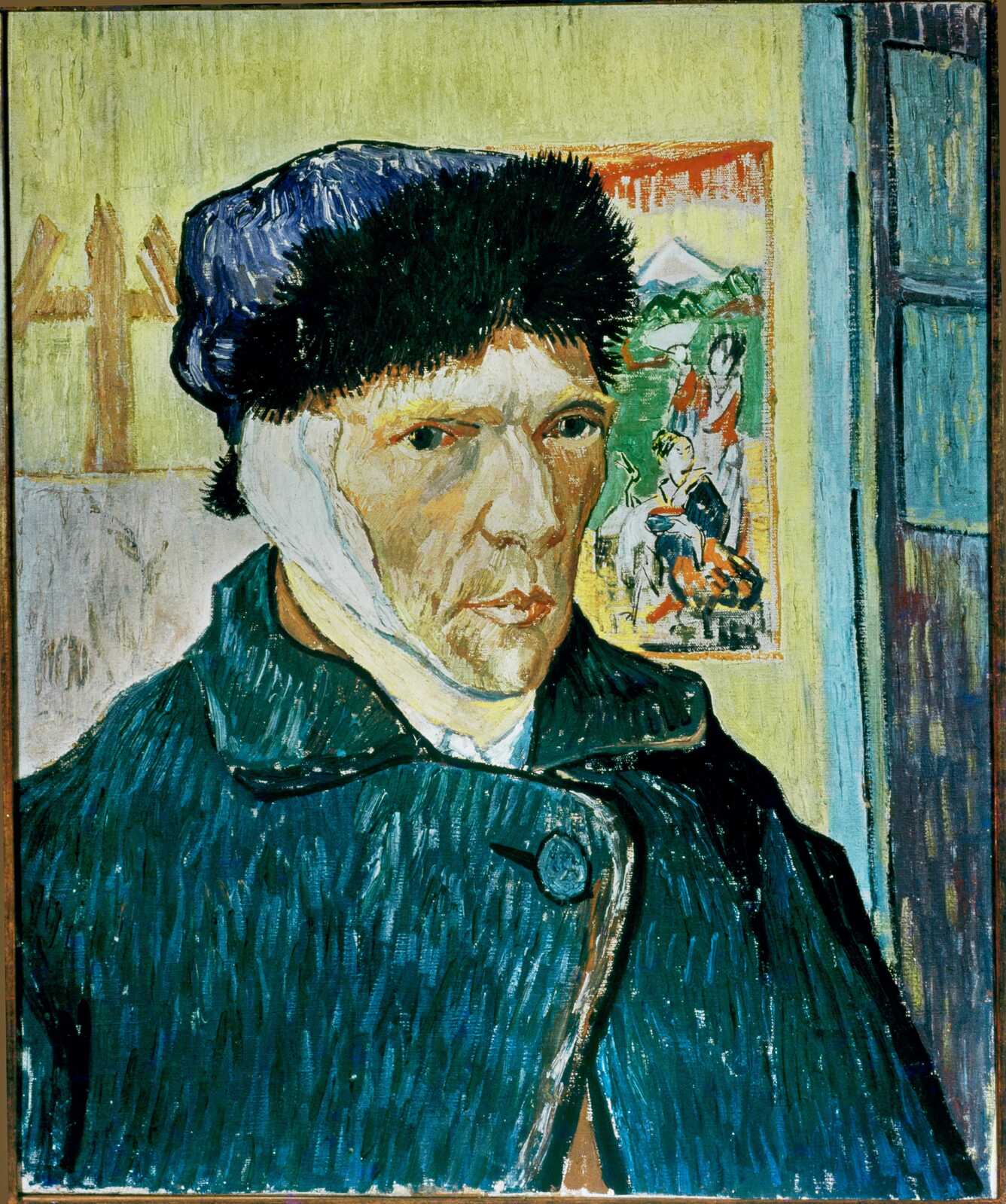
You’ve seen the face. It’s haunting, really. That steady, unblinking gaze of a man who just hacked off a piece of his own head and decided to paint the aftermath. Honestly, the Van Gogh self portrait with a bandaged ear isn’t just a painting; it’s a crime scene and a medical record wrapped in a masterpiece. It sits there in the Courtauld Gallery in London, looking back at you with a clarity that feels almost uncomfortable.
He looks calm. That’s the weird part.
Vincent van Gogh wasn't a stranger to chaos, but this specific moment in January 1889 marks a turning point that people still argue about in art history circles and psychiatric wards alike. Most people think he was just "crazy." It's a lazy label. When you look at the brushwork in the Van Gogh self portrait with a bandaged ear, you aren't seeing the work of a man who lost his mind. You’re seeing the work of a man trying desperately to find it again. He’s wearing a heavy winter coat. He’s in his studio. He’s holding it together.
The Night Everything Fell Apart
To understand why this painting exists, you have to look at the roommates from hell. In 1888, Vincent moved to Arles in the south of France. He had this dream of a "Studio of the South," a commune where artists could live and work together. He finally convinced Paul Gauguin to join him. It was a disaster.
They fought constantly. Gauguin was arrogant and precise; Vincent was emotional and impulsive. By December 23, 1888, the tension snapped. The traditional story says Vincent chased Gauguin with a razor, Gauguin fled to a hotel, and Vincent went home and sliced off his lower left ear. He then wrapped the ear in newspaper, walked to a local brothel, and handed it to a woman named Rachel.
Imagine being Rachel.
But there’s a persistent theory among some historians, like Hans Kaufmann and Rita Wildegans, that Gauguin—an expert fencer—actually lopped the ear off during a fight and they both agreed to a "code of silence" to keep Gauguin out of jail. Whether it was self-mutilation or a duel gone wrong, the result was the same. Vincent ended up in the hospital, and Gauguin hopped the next train to Paris.
Decoding the Van Gogh Self Portrait with a Bandaged Ear
When Vincent got back to his "Yellow House," he didn't hide. He painted. He actually painted two versions of this scene. The one we’re talking about is the one with the Japanese print in the background.
Look at the composition.
He’s wearing a green coat and a fur cap. The bandage is thick, stark white against his pale skin. Here is a fun fact that catches people out: in the Van Gogh self portrait with a bandaged ear, the bandage is on his right side. But we know from medical records that he actually cut his left ear. Why the flip? Simple. He was looking in a mirror. He painted exactly what he saw, a literal reflection of his trauma.
The background is just as important as the face. To the right, there’s a Japanese woodblock print. Vincent was obsessed with Japanese art. He thought it represented a sort of purity and calmness that Western art lacked. Placing it there wasn't an accident. It was a visual anchor. It says, "I am still an artist. I am still connected to the things I love."
The colors are jarring. Oranges and reds clashing with that sickly green of his coat. It shouldn't work, but it does. It creates a vibration. It feels like a high-pitched hum.
The Medical Mystery
What was actually wrong with him? Over the years, doctors have diagnosed everything from temporal lobe epilepsy to bipolar disorder to sunstroke. Some even suggest he had Ménière's disease, an inner ear disorder that causes intense vertigo and ringing. If your ear is ringing so loudly you can't think, maybe you'd try to cut it out too.
In 2016, a researcher named Bernadette Murphy found a drawing by the doctor who treated Vincent, Dr. Felix Rey. The sketch shows that he didn't just nick the lobe. He took almost the whole thing. This makes the Van Gogh self portrait with a bandaged ear even more impressive. He was in immense physical pain while blending those pigments.
Why This Painting Still Hits Hard
We live in an era of "curated" lives. We filter our photos and hide our struggles. Vincent did the opposite. He put his failure, his breakdown, and his physical deformity right in the center of the frame.
It's an act of radical honesty.
The painting functions as a sort of "proof of life." He sent it to his brother, Theo, basically saying, "Look, I'm okay. I'm painting again. See? I can handle the brush." But the eyes tell a different story. They look tired. They look like they’ve seen the bottom of the pit and aren't sure if they've climbed all the way out yet.
There's a specific technique he uses here called impasto. The paint is thick. You can see the ridges. You can see the speed of his hand. It’s not a smooth, academic portrait. It’s tactile. If you ran your fingers over it (don't, the museum guards will tackle you), you’d feel the topography of his recovery.
Misconceptions That Need to Die
- He was "insane" while painting it. No. You can't execute a composition this complex while in the middle of a psychotic break. This was painted in a period of lucidity. It was a conscious choice to document his condition.
- He cut off his whole ear for a girl. It's more complicated. The "Rachel" at the brothel was likely a maid or a regular acquaintance, and the act was more about a total mental collapse than a romantic gesture.
- The painting was a cry for help. It was more of a status report. Vincent was terrified of being sent to an asylum permanently. Painting this was his way of proving he was "functional" enough to remain an independent artist.
Seeing the Work in Person
If you ever get to the Courtauld Gallery, don't just look at the bandage. Look at the eyes. They aren't the eyes of a victim. They are the eyes of an observer. Vincent is observing himself as if he were a vase of sunflowers or a chair. He is applying the same objective intensity to his own suffering that he applied to a landscape.
It’s also surprisingly small. It’s roughly 60 by 49 centimeters. In a world of giant billboards and massive screens, this tiny rectangle of canvas carries more emotional weight than almost anything else in the room.
The Van Gogh self portrait with a bandaged ear remains the definitive image of the "tortured artist," but that's a bit of a cliché. It’s better to think of it as a painting about resilience. About the fact that even when the world—and your own mind—is screaming, you can still pick up a brush and make something beautiful.
How to Appreciate Van Gogh Like an Expert
If you want to go deeper than just staring at the canvas, start looking at the letters. Vincent wrote hundreds of letters to Theo. They are the "user manual" for his paintings. In the weeks following the ear incident, his letters shift. They become more focused on the practicalities of paint and canvas, as if he's clinging to the technical details to keep the darkness at bay.
When you look at the Van Gogh self portrait with a bandaged ear, you’re looking at a survival strategy.
- Check the brushstrokes: Notice how they follow the contour of his face. They don't just fill in space; they build the form.
- Compare the versions: Look up the version without the Japanese print (the one in Chicago). It's bleaker. It’s darker. It shows a different stage of his mental state.
- Ignore the "Crazy Vincent" myth: Focus on the skill. Look at how he balances the intense orange of the background against the blue of his cap. That’s not madness; that’s color theory.
The real power of this work isn't the gore or the drama of the missing ear. It's the fact that he's still there, looking back at us, refusing to be defined only by his worst night. He’s an artist first, a patient second. That’s why we’re still talking about it over 130 years later.
To truly understand this period, your next step should be reading the letters from January 1889. They provide the raw, unedited internal monologue that matches the external vulnerability of the portrait. Visit the Van Gogh Museum's digital archives to see the correspondence between Vincent and Theo during the weeks he was working on these self-portraits. It changes everything you think you know about his "madness."
---