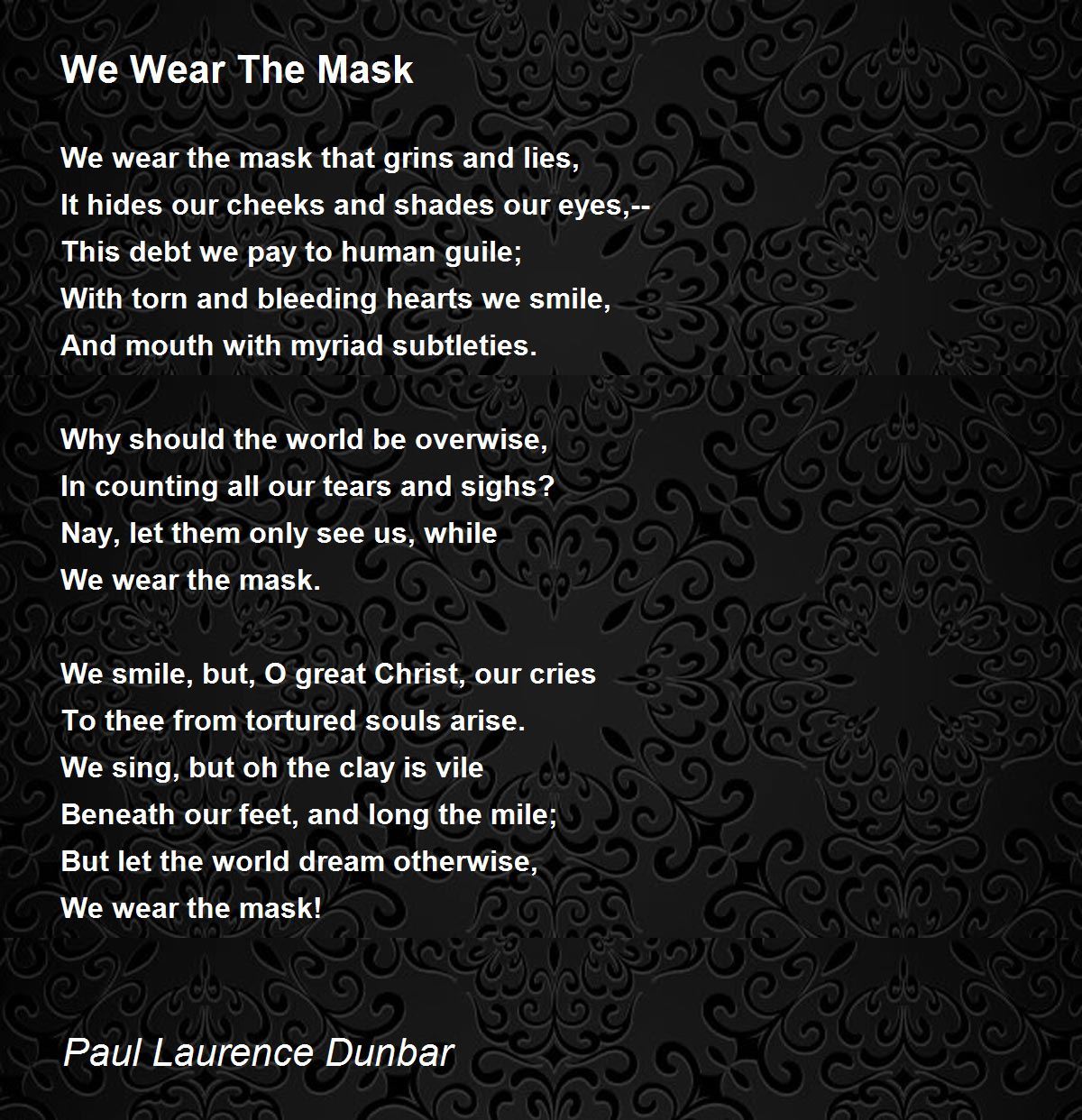
You know that feeling when you're at a party or a work meeting, and you’re smiling, nodding, and acting like everything is totally fine, but inside you’re basically screaming? That's the universal human experience. But for Paul Laurence Dunbar, writing in 1895, that "mask" wasn't just about social awkwardness or being polite. It was a matter of survival. We Wear the Mask by Paul Laurence Dunbar is probably one of the most famous poems in American history, and honestly, it’s because it captures a specific kind of pain that hasn't really gone away. It talks about the "debt we pay to human guile." That’s a heavy way to start a conversation, right?
Dunbar was the son of formerly enslaved parents. Think about that for a second. He was writing during the Jim Crow era, a time when being authentically Black in public could literally get you killed. So, when he talks about wearing a mask that "grins and lies," he isn’t being metaphorical in a flowery, "I’m a sad poet" kind of way. He’s being literal. He’s describing the psychological armor required to navigate a world that wants to see you fail.
The Brutal Reality Behind the Rhyme
It’s easy to look at the poem’s structure—it’s a rondeau, by the way—and think it’s just a catchy bit of verse. A rondeau is a specific form with fifteen lines, two rhymes, and a refrain. It’s tight. It’s controlled. And that’s exactly the point. The poem’s rigid structure mirrors the rigid control Black Americans had to exert over their own emotions.
Imagine having to hide "torn and bleeding hearts." Dunbar uses these visceral images to contrast with the "mouth with myriad subtleties." It’s basically the 19th-century version of "code-switching," but with much higher stakes. When you read the line "Why should the world be over-wise, / In counting all our tears and sighs?" you can feel the defiance. It’s like he’s saying, You don’t get to see our pain. You haven’t earned the right to our vulnerability.
Most people don't realize that Dunbar was actually criticized by some of his contemporaries for writing in "plantation dialect" in his other works. They thought he was playing into stereotypes. But We Wear the Mask by Paul Laurence Dunbar is written in standard English. It’s sophisticated. It’s sharp. It proves that Dunbar wasn't just a "folk" poet; he was a master of the craft who chose his words with surgical precision. He was wearing a mask even in his professional career, giving the white public the "dialect" they wanted while hiding his deeper, more complex thoughts in poems like this one.
Why the Mask Never Truly Came Off
Let’s be real. Even in 2026, the mask is still a thing. We see it in "professionalism" standards that penalize people for their natural hair or cultural speech patterns. We see it in the way people of color often feel they have to be twice as good to get half as much credit. Sociologist W.E.B. Du Bois called this "double consciousness" just a few years after Dunbar published this poem. It’s the sense of always looking at one’s self through the eyes of others.
Dunbar captures this perfectly when he mentions "the clay is vile / Beneath our feet." Life is hard, the ground is rough, and the journey is exhausting. Yet, the world only sees the smile.
What People Get Wrong About the Poem
A lot of students are taught that this poem is just about "sadness." That’s a total oversimplification. Honestly, it’s more about power. By wearing the mask, the speaker is actually withholding something from the world. There’s a secret strength in not letting your oppressor see how much they’ve hurt you. It’s a form of emotional gatekeeping.
- It’s not just about hiding. It’s about protection.
- It’s not a sign of weakness. It’s a survival strategy.
- The "We" matters. This isn't an "I" poem. It's a collective "We." It’s about a shared community experience of trauma and resilience.
Dunbar mentions "Great Christ," which is the only time he shifts the focus away from the "world." It’s a plea to a higher power because the earthly powers—the people walking around counting the tears—aren't trustworthy. It’s a deeply spiritual moment in an otherwise very social poem.
The Technical Brilliance of the "Grin"
Notice how he uses the word "grin" instead of "smile." A grin can be predatory. A grin can be fake. A smile usually implies genuine warmth, but a "grin" feels forced. It’s a mask that’s stretched thin. Dunbar’s choice of "myriad subtleties" is another genius move. It suggests that the mask isn't just one face; it’s a complex performance that changes depending on who is watching.
If you’ve ever worked a retail job or a corporate gig where you had to put on your "customer service voice" while someone was being a total jerk to you, you’ve worn a version of this mask. Now, multiply that by a thousand and add the weight of systemic racism. That’s the atmosphere Dunbar is breathing.
How to Actually Engage with Dunbar’s Work
If you really want to understand We Wear the Mask by Paul Laurence Dunbar, you can’t just read it once and move on. You have to look at the context of the 1890s—the "nadir" of American race relations. This was the era of Plessy v. Ferguson. This was the era where the promises of Reconstruction were being systematically dismantled.
Actionable Insights for Readers and Educators
If you’re a student, a teacher, or just someone who loves literature, here is how you can actually apply the themes of this poem to the real world:
- Audit Your Own Masks: We all have them. Take a moment to think about which "masks" you wear to survive and which ones you wear to fit in. Is there a difference? For Dunbar, the mask was a necessity. For many of us today, it might be a habit.
- Research the "Nadir" Period: To truly get the poem, you have to understand the violence of the 1890s. Look into the work of Ida B. Wells, who was a contemporary of Dunbar. It puts the "torn and bleeding hearts" into a much grimmer perspective.
- Compare with Modern Literature: Read this alongside Maya Angelou’s The Mask or even watch a film like Get Out. The "Sunken Place" is essentially a modern horror riff on Dunbar’s mask.
- Analyze the Meter: Try reading the poem aloud. Notice how the rhythm is almost bouncy (iambic tetrameter), which contrasts horribly with the dark subject matter. That’s intentional. The poem itself wears a mask of regular, pleasant rhythm while talking about torture.
Dunbar died young—he was only 33. He struggled with tuberculosis and, frankly, the weight of being a Black celebrity in a world that didn't truly respect his humanity. When he writes "We wear the mask," he’s giving us a piece of his soul while simultaneously telling us we’ll never truly see it. It’s a paradox that makes this poem one of the most haunting pieces of literature ever written.
Next Steps for Deepening Your Understanding:
To fully grasp the impact of Dunbar's work, your next move should be to read his poem "Sympathy." It’s where the famous line "I know why the caged bird sings" comes from. While We Wear the Mask focuses on the outward performance, "Sympathy" focuses on the internal longing for freedom. Reading them together gives you the full picture of Dunbar’s genius. You should also look for recordings of his work being read by actors like LeVar Burton or Danny Glover; hearing the cadence of the "myriad subtleties" makes the "grin" feel much more real. Finally, check out the Paul Laurence Dunbar House in Dayton, Ohio—it’s a National Historic Landmark and offers a massive amount of context into his daily life and the physical space where he crafted these words.