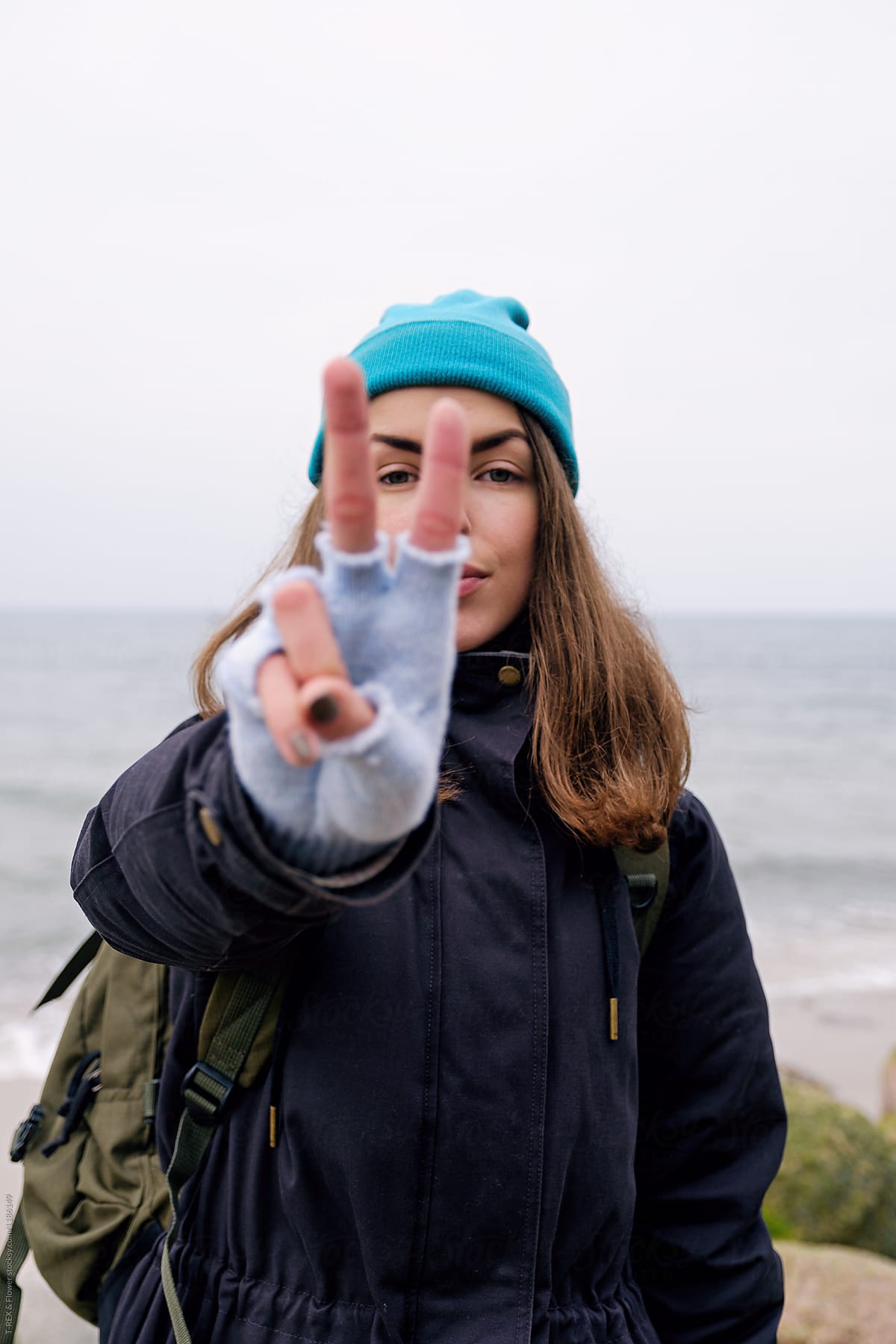
You're at a loud bar. You catch the bartender's eye and hold up two fingers. Simple, right? You want two drinks. But if you’re in a pub in East London and your palm is facing toward you while you do it, you might just get kicked out instead of getting a pint. Context is everything. Gestures are basically a silent language, and the "two-finger" sign is probably the most schizophrenic one in the world.
It's a peace sign. It's a victory mark. It's a gross insult. It’s a way to tell someone to "shove it."
Honestly, it’s kind of wild how a slight rotation of the wrist can be the difference between a hippie vibe and a bar fight. Most people think they know what it means, but they’re usually only seeing it through their own cultural lens. If you’ve ever wondered why some people get offended by a simple "V" or why politicians are so careful about how they wave, you’ve gotta look at the history, which is messier than you’d think.
The Peace Sign vs. The V-Sign: It's All in the Palm
The most common version we see in the States and across most of social media is the palm-forward V-sign. This is the universal shorthand for peace. It’s what you see in every Japanese tourist photo and every 1960s protest archival clip. But let's get specific. When the palm faces out, it’s generally positive.
Winston Churchill is the guy who really cemented this in the global psyche. During World War II, he used the "V for Victory" sign to boost morale. It was a defiant middle finger to the Axis powers, except it used two fingers. But here's a fun bit of trivia: at the very beginning, Churchill actually used to do it with his palm facing inward. His staff had to pull him aside and tell him that, to the working class, he was essentially telling the public to go screw themselves. He quickly flipped his hand around.
In the UK, Ireland, Australia, and New Zealand, the "two-fingered salute" (palm inward) is the equivalent of the middle finger. It’s aggressive. It’s "flipping the bird" but with a bonus finger. If you do this in a "tough" neighborhood in Manchester, you’re looking for trouble.
That Myth About Agincourt
You've probably heard the story about the Battle of Agincourt in 1415. The legend goes that the French threatened to cut off the index and middle fingers of captured English longbowmen so they could never pull a bowstring again. When the English won, they supposedly held up those two fingers to show they were still intact.
It’s a great story. It feels true. But most historians, including Anne Curry, who literally wrote the book The Battle of Agincourt: Sources and Interpretations, say there’s zero contemporary evidence for it. It’s a back-formation—a myth we made up later to explain why we find the gesture so insulting. The reality is probably just that gestures evolve naturally out of a desire to be rude, and the V-shape happens to be a pretty effective way to mimic certain... anatomical or suggestive shapes.
Cultural Nuances You Might Miss
In East Asia, specifically Japan, China, and South Korea, holding up two fingers in a photo is almost a reflex. It doesn't mean "peace" in a political sense anymore; it’s just a "kawaii" or cute aesthetic. It allegedly started getting popular in the 1970s, partly due to Janet Lynn, an American figure skater who fell during the 1972 Sapporo Olympics but kept smiling and became a Japanese sweetheart. She frequently used the peace sign, and the media picked it up. Now, it’s just how you pose for a selfie.
But let’s talk about the Middle East. In some Mediterranean and Middle Eastern cultures, gestures are much more "high-stakes." While the V-sign is understood globally as "victory" due to Western media, you have to be careful with how long you hold it or the direction of the hand, as it can be misinterpreted as a curse or a specific insult regarding someone's virility.
Then there's the "bunny ears" prank. You know the one. You stand behind a friend and put two fingers up behind their head. In the West, it’s a harmless joke. In parts of Italy or Spain, this can be interpreted as "cuckold" ears (cornuto). You’re basically signaling that the person’s partner is cheating on them. Maybe don't do that at a destination wedding in Rome.
The "Two Fingers" in Numbers and Sports
Sometimes, it’s just math. In many parts of Europe, if you want to order two of something, you don’t hold up your index and middle finger. You hold up your thumb and your index finger. If you hold up two fingers like a V-sign to a waiter in Germany, they’ll understand you, but you’re marking yourself as a foreigner immediately.
In sports, two fingers have a functional language all their own:
- Baseball: A catcher might flash two fingers to a pitcher to signal a curveball.
- Cricket: Umpires use various signals, though the two fingers aren't a primary "out" signal (that’s the single index finger), they are used in coaching and sideline communication for specific run counts.
- Cycling: Riders often use two fingers pointed down toward the ground to warn those behind them of a hazard like a pothole or glass.
Why Does This Even Matter?
We live in a digital world where emojis have replaced physical gestures, but the ✌️ emoji still carries all this baggage. If you're texting a friend in London and you use that emoji, they know you mean "peace" or "goodbye." But if you were to take a photo of yourself doing it "the wrong way" and post it, you might get some very confused or angry comments from across the pond.
It’s about situational awareness. The meaning of two fingers isn't stored in the fingers themselves; it’s stored in the brain of the person looking at them.
Understanding these subtle shifts in meaning makes you a better traveler and a more empathetic human. It’s a reminder that what we think is "obvious" is actually just a local habit. A gesture is just a tool. Use it right, and you connect with people. Use it wrong, and you’re the American tourist wondering why everyone is scowling at you.
How to Get It Right Every Time
If you want to avoid an international incident or just a really awkward dinner conversation, follow these basic rules of thumb. Or fingers.
Check the Palm
If you want to be friendly, keep that palm facing the world. Showing the back of your hand while making a V is a gamble you probably don't want to take in any country that was formerly part of the British Empire.
Watch the "V" vs. "Two"
If you're just counting, try to use your thumb and index finger in Western Europe. It’s the "Inglourious Basterds" rule—remember the scene in the tavern where the spy gives himself away by ordering drinks the wrong way? It’s a real thing.
Read the Room
In a professional setting, stick to verbal communication. Gestures are informal and prone to being misread. Even a "thumbs up" can be offensive in parts of West Africa or Iran. Two fingers are even more volatile.
Research Before You Land
Before traveling to a new country, spend five minutes on a site like Culture Atlas. It’ll tell you the specific "no-go" gestures for that region. It’s the easiest way to show respect without saying a single word.
Correct the Myth
Next time someone tells you the Agincourt story, you can be that person who politely lets them know it’s a folk tale. It’s a great way to start a conversation about how language and culture actually evolve—through usage and habit, not just ancient wars.
Ultimately, the two-finger gesture is a perfect example of how human communication is 90% context and 10% action. We see what we expect to see. So, next time you go to flash a peace sign, just take a half-second to make sure your palm is pointing the right way. Your social life might depend on it.