Wolves don't care about your borders. They really don't. A gray wolf in the Alps might wake up in Italy and fall asleep in France, completely oblivious to the geopolitical implications of its commute. When we talk about the range of the wolf, we’re usually talking about one of two things: where they used to be and where they’re stubbornly trying to go back to. It’s a messy, fascinating map that covers almost the entire Northern Hemisphere, or at least it did before we started building parking lots everywhere.
The gray wolf (Canis lupus) is basically the ultimate generalist. They can handle the bone-chilling 40-below winds of the High Arctic and the dry, scrubby heat of the Arabian Peninsula. You’ve probably heard people say wolves only live in the "deep wilderness." Honestly? That’s kind of a myth we tell ourselves to feel better about how much space we’ve taken. They don't need pristine forests. They just need food and for people not to shoot them.
The Massive Historical Footprint
Historically, the range of the wolf was the most extensive of any land mammal besides humans. Think about that. From the tip of Mexico all the way to the edges of Greenland, and from Western Europe across the vastness of Siberia to the islands of Japan. They were everywhere. In North America, they occupied almost every square inch of the continent.
But then things got ugly.
By the mid-20th century, the range of the wolf in the lower 48 United States had basically collapsed into a tiny corner of northeastern Minnesota and Isle Royale in Lake Michigan. That’s it. We spent decades treating them like monsters, using bounties and poison to scrub them off the map. It worked. For a while, the "range" was more of a "remnant." Europe wasn't any better. By the 1920s, wolves were extinct in Scotland, much of Germany, and most of Scandinavia. They were pushed into the rugged mountains of Italy, Spain, and the deepest parts of the Carpathian Mountains.
The Great Comeback (and the Geography of it)
Things started to change in the 70s and 90s. The reintroduction of wolves to Yellowstone National Park in 1995 is the story everyone knows, but it’s just one piece of the puzzle. While the 31 wolves brought from Canada to Wyoming got all the press, a quiet, natural expansion was happening elsewhere.
In Europe, it's been even more dramatic.
Italian wolves started wandering. They moved north out of the Apennine Mountains, crossed the Alps, and suddenly, they were in Switzerland. Then Germany. Then the Netherlands. In 2023, a wolf was even spotted in Belgium for the first time in over a century. This isn't just "nature returning"—it's a massive shift in the range of the wolf that challenges how we think about land use. They are living in managed forests and near suburbs. They’re eating deer in places where people walk their dogs.
Why the Range Expands
Wolves are built for travel. A young wolf looking for a mate—a "disperser"—can easily cover 500 miles in a few months. One famous wolf, OR-7, trekked over 1,000 miles from northeastern Oregon into California, single-handedly expanding the known range of the wolf in that state.
They move because they have to.
If a pack gets too big, the youngsters get kicked out. It's the biological version of "get a job and move out of the basement." These dispersers are the pioneers. They find the gaps. They find the places where the deer are overpopulated and the humans are scarce (or at least tolerant).
The Reality of the "Three Wolf Species"
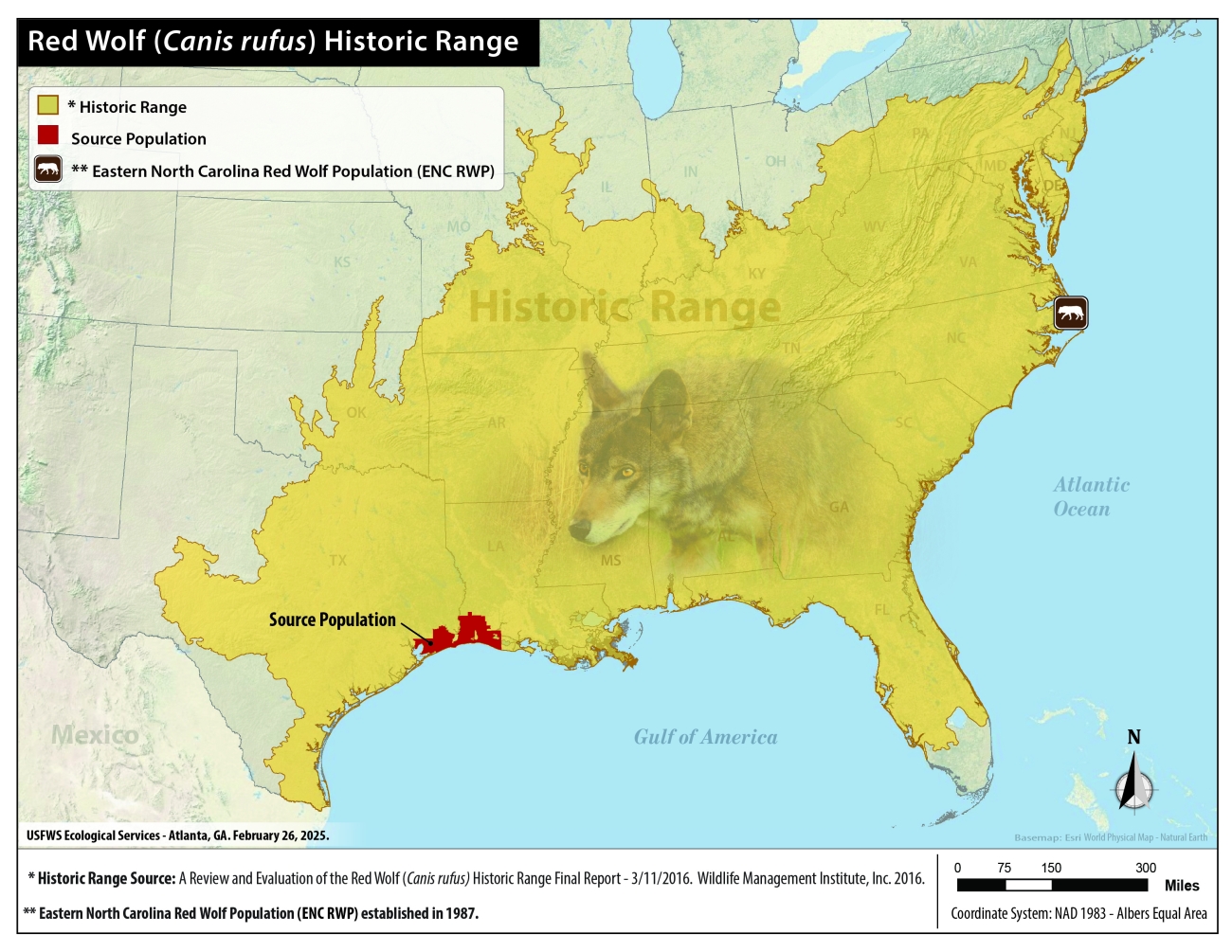
When people search for the range of the wolf, they often forget there’s more than one type. The Red Wolf (Canis rufus) is a tragic outlier. Their range is currently limited to a tiny, managed experimental area in eastern North Carolina. That’s it. One of the rarest mammals on Earth, living on a peninsula.
Then there’s the Ethiopian Wolf (Canis simensis). They don't look like your typical "Big Bad Wolf." They’re lanky, red, and live only in the high-altitude grasslands of the Ethiopian Highlands. Their range is fragmented into a few "islands" of habitat above 10,000 feet. If the climate warms or farmers move higher up the mountain, that range disappears. It’s a fragile existence compared to the rugged versatility of the Gray Wolf.
Understanding Habitat Suitability
What makes a "good" range? It isn't just trees. Biologists like Dr. David Mech, who has studied wolves for over 60 years, emphasize that food density is the primary driver. If there are elk, moose, or deer, wolves will try to be there.
- Corridors: Wolves need paths. Roads are the biggest killers, not just because of roadkill, but because they fragment the range.
- Human Tolerance: This is the big one. The range of the wolf is currently limited more by social science than biological science. If people in a region won't tolerate wolves near their livestock, the range stops at the fence line.
- Density: A pack usually needs anywhere from 50 to 1,000 square miles depending on how much prey is available. In the lush Great Lakes region, territories are smaller. In the barren Arctic, they are massive.
The "Invisible" Ranges
There are places you wouldn't expect. Did you know there are wolves in the deserts of Israel? The Arabian wolf is a subspecies that survives in some of the harshest landscapes on the planet. They are smaller, with shorter fur, but they are undeniably wolves. Their range is a testament to the species' adaptability.
Then you have the Himalayan wolf. Recent genetic studies suggest these might be an even older lineage than the standard Gray Wolf. They live in the shadows of Everest, navigating the thin air and rocky crags where few other predators can compete.
The Conflict at the Edge
As the range of the wolf expands, the "edge" moves. This is where the friction happens. In places like Wisconsin or the French Alps, the edge of the wolf’s range is a battleground of policy and philosophy.
Farmers see their livelihoods threatened.
Conservationists see a missing ecological piece being slotted back into place.
The range isn't just a line on a map; it's a moving frontier. When wolves moved back into the Czech Republic from Poland, it forced a whole new generation of shepherds to learn how to use livestock guardian dogs. The range of the wolf carries a "cultural baggage" that other animals, like bears or mountain lions, don't seem to trigger as intensely.
What Most People Get Wrong
People think wolves need "wilderness." They don't. Wolves have been found living surprisingly close to Berlin and Rome. As long as there is a patch of woods to hide in during the day and something to eat at night, they’re good. We often confuse "where wolves are" with "where wolves are allowed to be."
Another misconception is that the range is static. It’s not. It’s breathing. It expands in years with high pup survival and shrinks when disease—like mange or distemper—hits a population. It’s a dynamic, living boundary.
Actionable Steps for the Amateur Tracker or Enthusiast
If you’re interested in following the shifting range of the wolf, you don't have to be a scientist. There are ways to engage with this data directly.
- Check State Management Reports: In the U.S., states like Washington, Oregon, and Montana publish annual reports. These aren't just dry PDFs; they include maps showing exactly where new packs are forming. It’s the most accurate way to see the range shifting in real-time.
- Use Citizen Science Tools: Apps like iNaturalist or the Voyagers Wolf Project (focused on Minnesota) allow you to see where sightings are occurring. Just remember to be ethical—never post the exact coordinates of a den site.
- Support Habitat Connectivity: The range can only expand if there are "bridges." Support organizations like the Yellowstone to Yukon Conservation Initiative (Y2Y) that work to keep migration corridors open.
- Volunteer for Range Riders: In the American West, some NGOs use "range riders" to monitor wolf movement near cattle. It’s a practical way to help wolves and humans share the same range without conflict.
- Look Locally: If you live in the Northern Tier of the U.S. or anywhere in Europe, look up the "Wolf Distribution Map" for your specific region. You might be surprised to find that the range of the wolf is a lot closer to your backyard than it was ten years ago.
The map of the wolf is still being written. It’s a story of a species that refused to go extinct, pushing back against the boundaries we drew for them. Whether they continue to reclaim their old haunts depends entirely on our willingness to share the landscape.