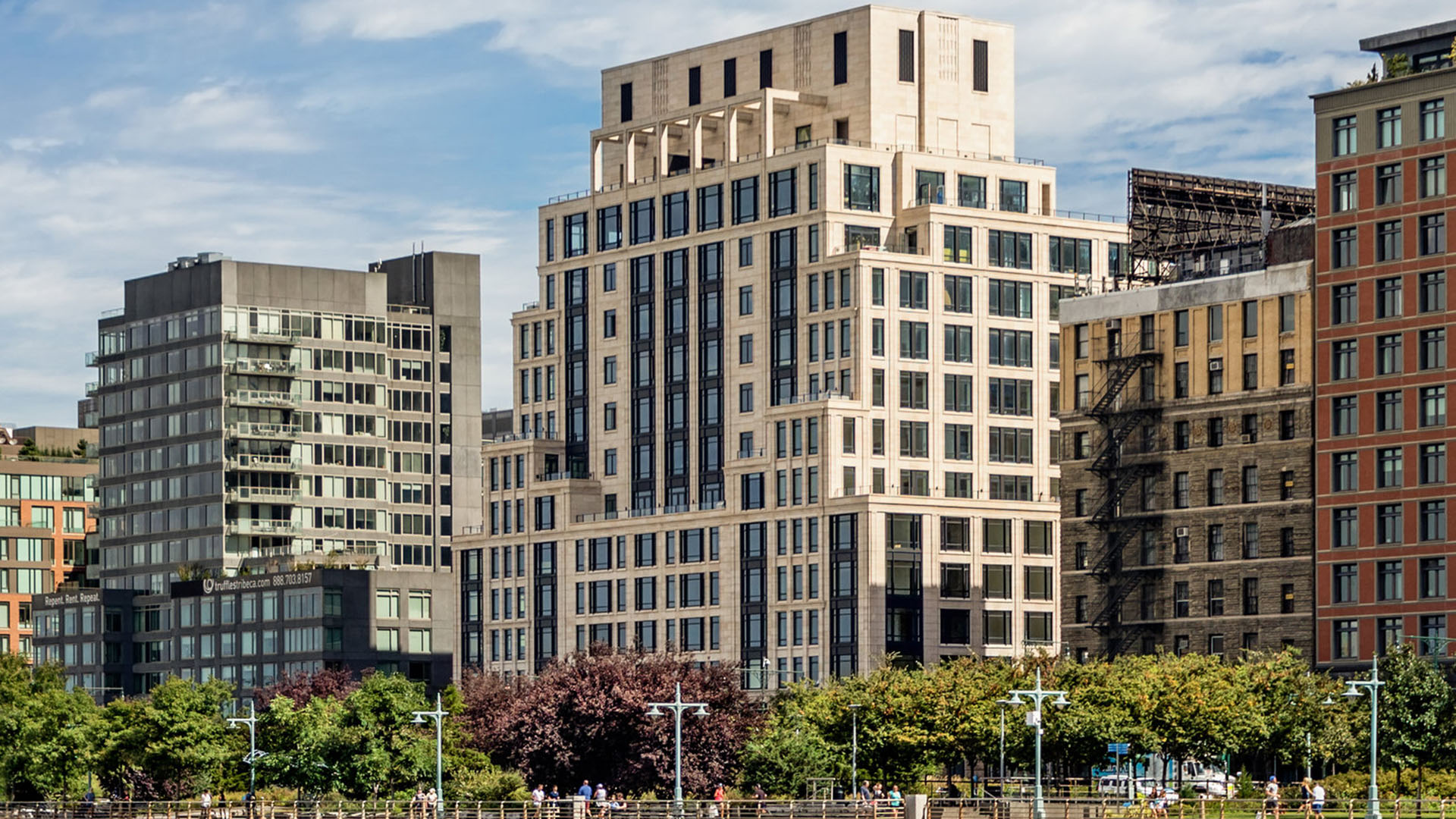
New York real estate is usually a game of "who can build the glassiest tower." You see them everywhere. They're shiny, they’re cold, and honestly, they all look kind of the same after a while. But then there’s 70 Vestry Street.
It’s different.
If you’ve ever walked along the West Side Highway as the sun starts to dip, you’ve probably noticed that warm, buttery glow coming off the limestone. That’s Beaumaniere French limestone, by the way. It wasn't cheap. Robert A.M. Stern—the architect who basically defined modern "old money" New York—decided to wrap this building in it because he wanted it to look like it had been there for a century, even though it only finished up around 2018.
People call it the "billionaire's sandbox." That sounds like marketing fluff, but in this case, it’s actually pretty accurate. When you have Tom Brady and Gisele Bündchen (back when they were a thing), Lewis Hamilton, and Stephen Ross all buying units in the same hallway, you aren't just looking at a condo. You're looking at a fortress for the ultra-visible.
The Robert A.M. Stern Factor at 70 Vestry Street
Robert A.M. Stern is a bit of a legend. He’s the guy behind 15 Central Park West, which is arguably the most successful residential building in the history of the city. He doesn't do glass boxes. He does "Pre-war style with 21st-century plumbing."
At 70 Vestry Street, he leaned into the industrial history of Tribeca but kept it incredibly refined. Most of the new builds in the neighborhood try to be "gritty-chic" with exposed brick and rusted metal. This building went the other way. It’s elegant. It’s understated. It’s got these cascading terraces that make it look like a wedding cake made of stone.
The 14-story structure is relatively low-profile compared to the skyscrapers in Hudson Yards. That's intentional. In Tribeca, height isn't the flex. Privacy is.
Privacy is the real luxury here
Think about how most celebrities get into their homes in NYC. They hop out of a black SUV, dodge a guy with a long lens, and dash through a lobby. Not here. 70 Vestry Street has a gated porte-cochère. It’s a cobblestone driveway that lets you pull your car entirely off the street and into a private courtyard.
You disappear. One second you're on a busy Manhattan street, the next you're inside a serene, leafy sanctuary where no one can see you. For someone like Lewis Hamilton, that's worth the $40 million price tag alone.
Most people don't realize that the building also features an automated parking system. You don't even have to deal with a valet if you don't want to. You just pull in, and the tech handles the rest. It’s weirdly quiet for a building right on the water.
What it’s actually like inside
The interiors were handled by Daniel Romualdez. If you aren't a design nerd, Romualdez is the guy who does homes for Aerin Lauder and Tory Burch. He doesn't do "minimalist." He does "layered."
We’re talking about rift-sawn oak floors.
Marble everywhere.
Sub-Zero and Miele appliances that are integrated so well you can barely find the fridge.
There are only 46 residences in the whole building. That’s tiny. Most modern developments try to cram 200 units into a space this size to maximize profit, but Related Companies (the developer) went for scale and breathing room. Some of these apartments are massive, sprawling across 5,000 or 7,000 square feet. In Manhattan, that’s basically a suburban mansion stacked vertically.
The views are mostly unobstructed looking over the Hudson River. You get those legendary sunsets. Because the building is set back slightly from the street, you don't get the same level of traffic noise you’d expect.
The amenities aren't just for show
Every building claims to have a "world-class spa." Usually, that means a treadmill in a basement.
At 70 Vestry Street, the amenity suite is over 12,000 square feet. It includes:
- An 82-foot swimming pool (which is huge for a boutique building).
- A separate cold plunge pool for the "biohacking" crowd.
- A squash court because, well, it's Tribeca.
- A yoga studio and a fitness center designed by The Wright Fit.
Honestly, the most impressive part is the residents' lounge. It’s got a dining room and a library. It feels more like a private social club than a condo common area. If you live here, you never really have to leave the building to entertain guests.
Why the location is a double-edged sword
Let’s be real: living right on the West Side Highway has its downsides. Even with the triple-paned windows at 70 Vestry Street, you are still on a major artery of the city.
However, the trade-off is that you are literally across the street from Hudson River Park. You have Pier 25 and Pier 26 right there. For families, this is the jackpot. You’ve got mini-golf, volleyball courts, and those long paths for running or biking.
Then there’s the Tribeca vibe. You’re a five-minute walk from Bubby’s or The Odeon. You’re in the heart of the most expensive zip code in the city, but it still feels like a neighborhood. It hasn’t been totally sterilized like some parts of Midtown.
The financial reality of 70 Vestry
Is it a good investment? Well, the "Brady Effect" definitely helped early on. When a superstar athlete buys in, the building gets a certain shine. But even without the celebrity gossip, the numbers at 70 Vestry Street hold up because of the scarcity.
There is very little vacant land left in Tribeca. They aren't making more waterfront lots. When you combine a prime location with a "starchitect" like Stern and a high-end developer like Related, you create a product that holds its value even when the rest of the market is shaky.
The monthly carrying costs are high. Don't kid yourself. Between the 24-hour doorman, the concierge, the porters, and the maintenance of that limestone facade, you’re looking at thousands of dollars a month just to keep the lights on. But if you’re buying a $15 million condo, you probably aren't sweating the common charges.
What most people get wrong about the building
People think it’s just a "celebrity building." That’s the headline version. But if you talk to brokers who work in the area, they’ll tell you it’s actually a "family building."
The floor plans are designed for real living. They have actual mudrooms. They have laundry rooms with side-by-side washers and dryers, not those tiny European all-in-one units. There are playrooms for kids. It’s built for people who actually live in New York, not just people who keep a pied-à-terre here for Fashion Week.
The limestone itself is also a talking point. Some critics thought it was too traditional for a neighborhood known for its industrial lofts. But as the building has aged over the last few years, it’s started to "settle" into the skyline. It doesn't look like a new arrival anymore. It looks like the anchor of the waterfront.
Actionable Insights for Potential Buyers or Investors
If you’re actually looking at units in 70 Vestry Street, or even just looking to understand the Tribeca market, here is what you need to keep in mind:
- Prioritize the Courtyard Entry: If privacy is your main goal, look for units that have easy access to the porte-cochère. It is the building's strongest selling point.
- Check the Tax Abatements: Many people assume these buildings have long-term tax breaks. You need to verify the current status of any 421-a abatements, as many in this tier are starting to phase out or never had them to begin with.
- Evaluate the View Corridors: Because there is ongoing development in the city, always check if any nearby lots have air rights that could potentially block your river views in five years. At 70 Vestry, you're pretty safe due to the highway and the park, but it's always worth a survey.
- Consider the Resale Velocity: These units don't hit the market often. If you see one, you have to move fast. This isn't a building with a lot of "stale" inventory.
70 Vestry Street represents the peak of a specific era of New York construction. It's the moment where ultra-luxury met traditional craftsmanship. Whether you love the "old world" aesthetic or prefer something more modern, you can't deny that it set a new bar for what a North Tribeca residence should be. It’s quiet, it’s heavy, and it’s staying put.