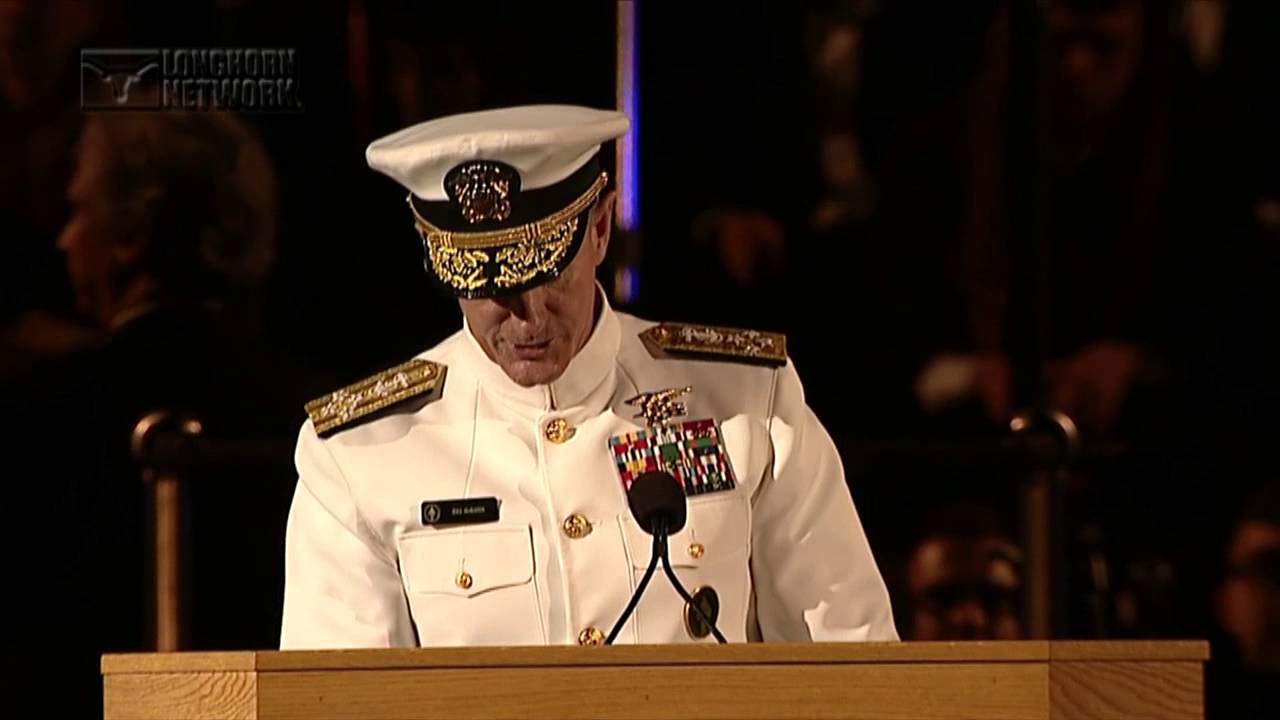
It starts with a bed. Honestly, that sounds a bit ridiculous when you’re talking about a four-star Admiral who oversaw the raid on Osama bin Laden. But in 2014, when William H. McRaven stood before the graduating class at the University of Texas at Austin, he didn't lead with tales of high-stakes espionage or midnight helicopter crashes. He talked about hospital corners. He talked about a task so mundane most college kids probably hadn't done it in four years.
The commencement speech Admiral McRaven delivered that day didn't just go viral; it became a cultural touchstone that basically redefined how we look at personal discipline. You've probably seen the clips. Maybe you've seen the book that followed. But there is a reason this specific talk survived the 24-hour news cycle and the decade of noise that followed. It wasn't just "motivational." It was a tactical manual for surviving a world that, quite frankly, doesn't care about your feelings or your degree.
The Core Philosophy: Making Your Bed as a Survival Tactic
The speech is built on ten principles McRaven learned during SEAL training. The first one—the bed—is the one everyone remembers.
If you make your bed every morning, you will have accomplished the first task of the day. It gives you a small sense of pride, and it will encourage you to do another task and another. And, if by chance you have a miserable day, you will come home to a bed that is made—that you made—and a made bed gives you encouragement that tomorrow will be better.
It’s about the psychology of the "small win." Life is chaotic. You can't control the stock market, your boss's mood, or the traffic on I-35. But you can control the state of your sheets. When McRaven talks about this, he isn't being a neat freak. He’s talking about anchoring yourself. If you can't do the little things right, you'll never do the big things right. It’s a simple truth that hits hard because it’s so accessible. You don't need a SEAL budget to make your bed.
Beyond the Bed: The "Sugar Cookie" and Failure
One of the more visceral parts of the speech involves the "Sugar Cookie." In SEAL training, if you fail a uniform inspection, you have to run into the surf zone, get soaking wet, and then roll around in the sand until you are covered from head to toe. You stay that way all day. Cold, chafed, and gritty.
The point? Sometimes, no matter how well you prepare or how hard you work, you still end up as a sugar cookie.
McRaven’s point is that life is inherently unfair. He doesn't sugarcoat it (pun intended). He tells the graduates that they will fail. They will be treated poorly. They will face obstacles that have nothing to do with their merit. This is a massive departure from the "you can be anything" rhetoric usually found at graduations. It's refreshing because it's true. The goal isn't to avoid being a sugar cookie; it's to keep moving even when you're covered in sand.
Why This Message Resonated Globally
Why did this specific commencement speech Admiral McRaven gave outperform thousands of others?
Context matters.
In 2014, the world was shifting. We were deep into the digital age, where everything felt intangible. McRaven brought back the physical. He brought back the idea of grit. He spoke to a generation that was being told they were "snowflakes" and gave them a roadmap that was actually quite respectful of their potential. He didn't mock them; he challenged them.
The Power of "The Circus"
McRaven describes "The Circus" as the extra hours of physical training for those who failed the day's goals. It was designed to wear you down until you quit. But a funny thing happened. Those who were constantly in The Circus grew stronger. Their fatigue turned into a different kind of endurance.
This is a lesson in resilience that most people get wrong. We think of failure as a detour. McRaven argues that failure is the gym. It’s where the actual strength is built. If you aren't failing, you aren't being pushed, and if you aren't being pushed, you aren't getting stronger.
- Measuring a Person by the Size of Their Heart: He famously mentioned that in SEAL training, height, weight, and background didn't matter as much as the will to succeed.
- Slide Down the Obstacle Headfirst: Taking risks is non-negotiable.
- Don't Back Down from Sharks: Confronting bullies (or metaphorical sharks) is the only way to survive the "deep water" of professional life.
- Start Singing When You're Up to Your Neck in Mud: Hope is a powerful force, and it often starts with one person refusing to give up.
The "Muck" and the Power of One
One of the most moving stories in the speech takes place at "Hell Week." The recruits are waist-deep in freezing mud, shivering, exhausted, and ready to quit. Then, one voice starts singing. Then another. Soon, the whole group is singing.
This isn't just a "Kumbaya" moment. It’s a demonstration of how one person can change the collective morale of a group. In a corporate setting, or a family setting, or a community, being the person who "sings in the mud" is a leadership trait that can't be taught in a textbook. It’s an act of defiance against despair.
McRaven’s delivery is key here. He’s stoic, but you can hear the grit in his voice. He isn't some life coach who read a book on mindfulness; he’s a man who spent decades in the most grueling environments on Earth. That E-E-A-T (Experience, Expertise, Authoritativeness, Trustworthiness) is what makes the message stick. You believe him because he lived it.
The Misconceptions
People often think this speech is just about "discipline." It’s not.
If you look closer, it's actually about humility. Making your bed is a humble act. Accepting that you're a sugar cookie is a humble act. Realizing you need others to help you paddle the boat is a humble act. The "rugged individualist" trope of the Navy SEAL is broken down here. McRaven explicitly says you can't change the world alone. You need teammates. You need people who will help you through the mud.
Real-World Application: Beyond the University
Since that day in Austin, the "Make Your Bed" philosophy has been adopted by CEOs, athletes, and stay-at-home parents alike. It’s basically the "gateway drug" to habit stacking.
James Clear, author of Atomic Habits, touches on similar themes, though McRaven’s approach is more visceral and duty-based. While Clear focuses on the systems of habit, McRaven focuses on the character required to maintain them.
What You Can Do Tomorrow
If you want to actually apply the commencement speech Admiral McRaven delivered to your own life, don't just watch the video and feel inspired for ten minutes. Inspiration is a feeling; discipline is a behavior.
- Start with the 60-second win. Make your bed. Don't check your phone first. Don't grab coffee first. Straighten the sheets. It’s a physical signal to your brain that the day has begun and you are in charge.
- Identify your "Circus." What is the thing you are currently failing at or struggling with? Instead of avoiding it, recognize that the extra "reps" you're doing right now are making you more capable than those who had it easy.
- Find your "Singing" moment. When things go sideways at work or home this week, be the person who injects a bit of hope instead of more cynicism. It’s a choice.
- Accept the Sand. You will work hard and still get passed over for a promotion. You will be kind and someone will be mean to you. That’s the sugar cookie. Shake it off. Keep going.
Admiral McRaven’s 2014 address wasn't just a speech; it was a challenge to stop waiting for the world to be fair and start making it better through small, disciplined actions. It’s about the fact that changing the world doesn't require a cape. Sometimes, it just requires a set of clean sheets and the refusal to quit when the mud gets cold.
Practical Next Steps
- Watch the full 19-minute video on YouTube to catch the nuances of his delivery that short clips miss.
- Read "Make Your Bed: Little Things That Can Change Your Life...And Maybe the World" for expanded stories on the ten principles.
- Audit your morning routine. If the first thing you do is reactive (checking email), switch to a proactive task (like the bed) to reclaim your mental agency.
The wisdom here isn't in the hearing; it's in the doing. Go make your bed.