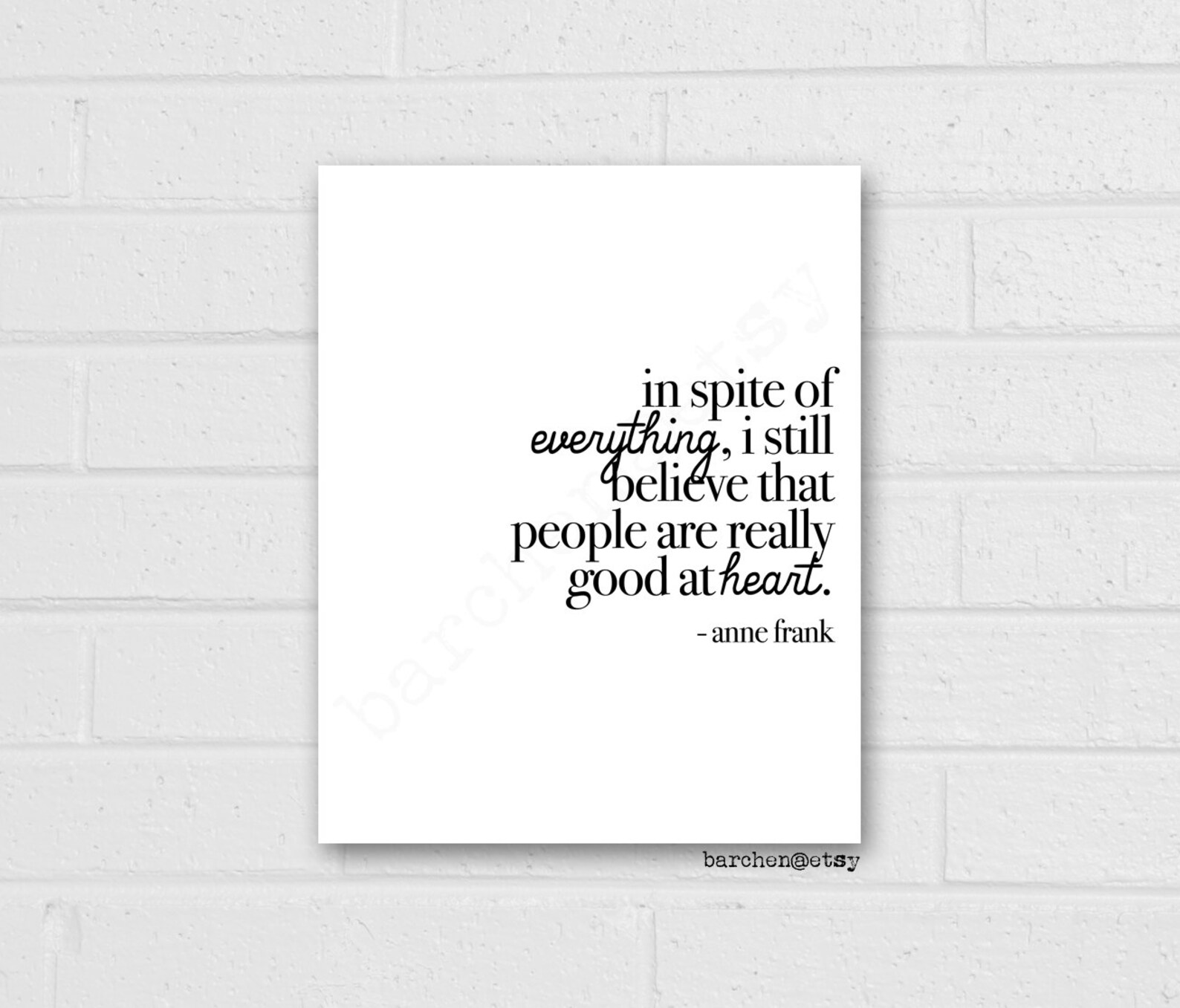
We’ve all seen the quote. It’s on posters in middle school classrooms and plastered across Instagram squares every time there’s a global tragedy. "In spite of everything, I still believe that people are really good at heart." It’s beautiful. It’s hopeful. It’s also, honestly, a little bit haunting when you remember where the girl who wrote it ended up.
People tend to treat Anne Frank like a saint or a symbol rather than a teenager. They use her words to feel better about the world. But if you actually sit down and read the Diary of a Young Girl, you realize that staying optimistic wasn't some easy, natural trait for her. It was a choice. A hard one. She was living in a dark, cramped "Secret Annex" for 761 days, listening to sirens and wondering if the next knock on the door would be the Green Police.
When Anne wrote about being good in spite of everything, she wasn't being naive. She was fighting.
The Context We Usually Ignore
The sentence appears in her diary entry from July 15, 1944. That’s late. Very late. The residents of the Annex had been hiding for two years. Food was scarce. Tensions were high. Imagine living in a few hundred square feet with seven other people, never being able to step outside or speak above a whisper during the day. You’d probably hate everyone. Anne often did. She wrote about her "fits of rage" and her deep frustrations with her mother and the van Pels family.
Yet, she penned those famous words just three weeks before the Gestapo stormed the building.
It’s easy to be a humanist when you’re sipping a latte in a safe neighborhood. It’s an entirely different thing to do it while you’re being hunted. Anne saw the worst of humanity—the betrayal, the hunger, the systemic cruelty of the Nazi regime—and she still refused to let her soul sour. That’s the "everything" she was talking about. It wasn't just a bad day at school; it was the Holocaust.
The Complexity of the July 15 Entry
If you read the full entry from that day, it’s not all sunshine and rainbows. It’s actually pretty dark. She talks about how difficult it is to maintain any kind of idealism when "ideals, dreams, and cherished hopes rise within us, only to be crushed by grim reality." She describes the world being turned into a wilderness and hears the "ever-approaching thunder" of destruction.
She was scared.
But then comes the pivot. She writes that she looks up at the heavens and thinks that "it will all come right." This wasn't a passive belief. It was a psychological survival mechanism. By deciding that people were good at heart, she gave herself a reason to keep living. If everyone was truly evil, why bother hiding? Why bother writing?
Beyond the Famous Quote
Most people don't realize there are different versions of the diary. Anne herself started editing her entries (the "Version B") because she heard a radio broadcast from the Dutch government-in-exile asking for diaries and letters to be preserved after the war. She was a serious writer. She was crafting a narrative.
This matters because it shows that her optimism was part of her professional voice as much as her private one. She wanted to be a journalist. She wanted to be a "famous writer." She knew that her perspective on humanity had value.
- She wrote about the "inner Anne" and the "outer Anne."
- She critiqued her own flaws with brutal honesty.
- She acknowledged that her kindness was a shield against the "cruel world."
Honestly, calling her a "cheerful victim" does her a disservice. She was a complex, often moody, incredibly sharp-witted young woman who understood exactly how much danger she was in. She didn't ignore the darkness; she just chose not to let it win.
Why the "In Spite of Everything" Narrative Persists
After the war, Otto Frank—the only survivor of the eight people in the Annex—was the one who decided to publish the diary. He cut out some of the more biting remarks Anne made about her mother and some of her more explicit descriptions of her developing body. He wanted the book to be a bridge.
The world in 1947 was broken. People needed to believe that the human spirit was unbreakable. Anne’s words provided that. But some critics, like the writer Cynthia Ozick, have argued that the way we use that quote today is almost a "desecration." Ozick famously argued that because Anne was murdered, her optimism was "belied." Basically, the ending of the story makes the quote feel like a lie to some people.
But is it?
If Anne had survived, would she still believe it? We can’t know. We do know that her friend Hanneli Goslar, who saw Anne briefly in the Bergen-Belsen concentration camp before Anne died, described her as "broken" and "weeping." The horrors of the camps were designed to strip away every ounce of humanity. That is the reality we have to balance against the diary.
The Reality of the Secret Annex
To understand the "everything" she was facing, you have to look at the logistics.
They lived on rotting potatoes and kale.
They couldn't flush the toilet during the day.
They lived in constant fear of the "warehouse man" or burglars who might hear them.
Anne spent her formative years, from 13 to 15, in a cage.
When you look at it that way, her belief in human goodness isn't a "nice thought." It’s an act of defiance. It’s a middle finger to the Nazis. They could take her clothes, her home, and eventually her life, but they couldn't force her to hate them. That’s where the power of the diary lies. It’s not in the tragedy; it’s in the resistance of the mind.
Challenging the Myth
Let’s be real for a second. We like the quote because it lets us off the hook. If a girl in the Holocaust can say people are good, then we don't have to feel so bad about the state of the world, right?
Wrong.
Anne’s quote is a challenge, not a comfort. She was saying that the potential for goodness exists, but the "everything" part—the war, the persecution, the silence of the neighbors—proves that humans often choose not to act on that goodness. The "good at heart" part is the capacity. The "everything" is the reality.
Practical Takeaways from Anne’s Perspective
We aren't hiding in an annex, but we all face moments where it feels like the world is going to hell. Anne’s approach to life provides a few genuine "life hacks" for keeping your head straight when things get messy.
Nature as a Reset
Anne wrote extensively about looking at the chestnut tree outside her window. She believed that as long as you could look at the sky and the clouds, you could find a way to be happy. It sounds cliché, but for her, it was literal. If you’re feeling overwhelmed, get outside.
Radical Honesty with Yourself
She didn't just write about how great the world was; she wrote about how much she annoyed herself. She was her own harshest critic. Improving the world starts with acknowledging your own "bad" parts.
The Power of a Creative Outlet
Writing saved Anne's sanity. It gave her a place to put the "everything" so it didn't stay stuck in her head. Whether it’s a diary, a sketchbook, or a voice memo, find a place to dump your thoughts.
Choosing Your Narrative
Anne could have written a diary that was just a list of complaints. Instead, she wrote a book about growth. You get to choose how you frame your own story, even when you don't choose the circumstances.
The Final Legacy
Anne Frank died in early 1945, likely of typhus, just a few weeks before the British liberated Bergen-Belsen. Her physical life ended in a way that was the polar opposite of "good."
But her voice survived.
When we talk about in spite of everything, we are talking about the fact that her words reached millions of people while the names of her captors are largely forgotten or loathed. The "goodness" she believed in didn't save her life, but it saved her humanity. And in the end, that might be what she was actually trying to say.
If you want to truly honor Anne Frank’s legacy, don't just put her quote on a t-shirt. Read the entries where she’s angry. Read the parts where she’s scared. Understand the weight of the "everything" before you claim the "goodness."
Actionable Steps for Further Learning:
- Visit the Anne Frank House website to view the virtual 3D tour of the Secret Annex. This gives you a physical sense of the space that the diary doesn't always convey.
- Read "Version B" of the diary. This is the version Anne edited herself, showing her growth as a writer and her intentionality in crafting her message.
- Research the "Righteous Among the Nations" at Yad Vashem. These were the real-life examples of the "good people" Anne believed in—the ones who risked their lives to hide others.
- Support modern organizations that protect journalists and writers in conflict zones, as Anne’s greatest wish was to continue her work as a writer after the war.