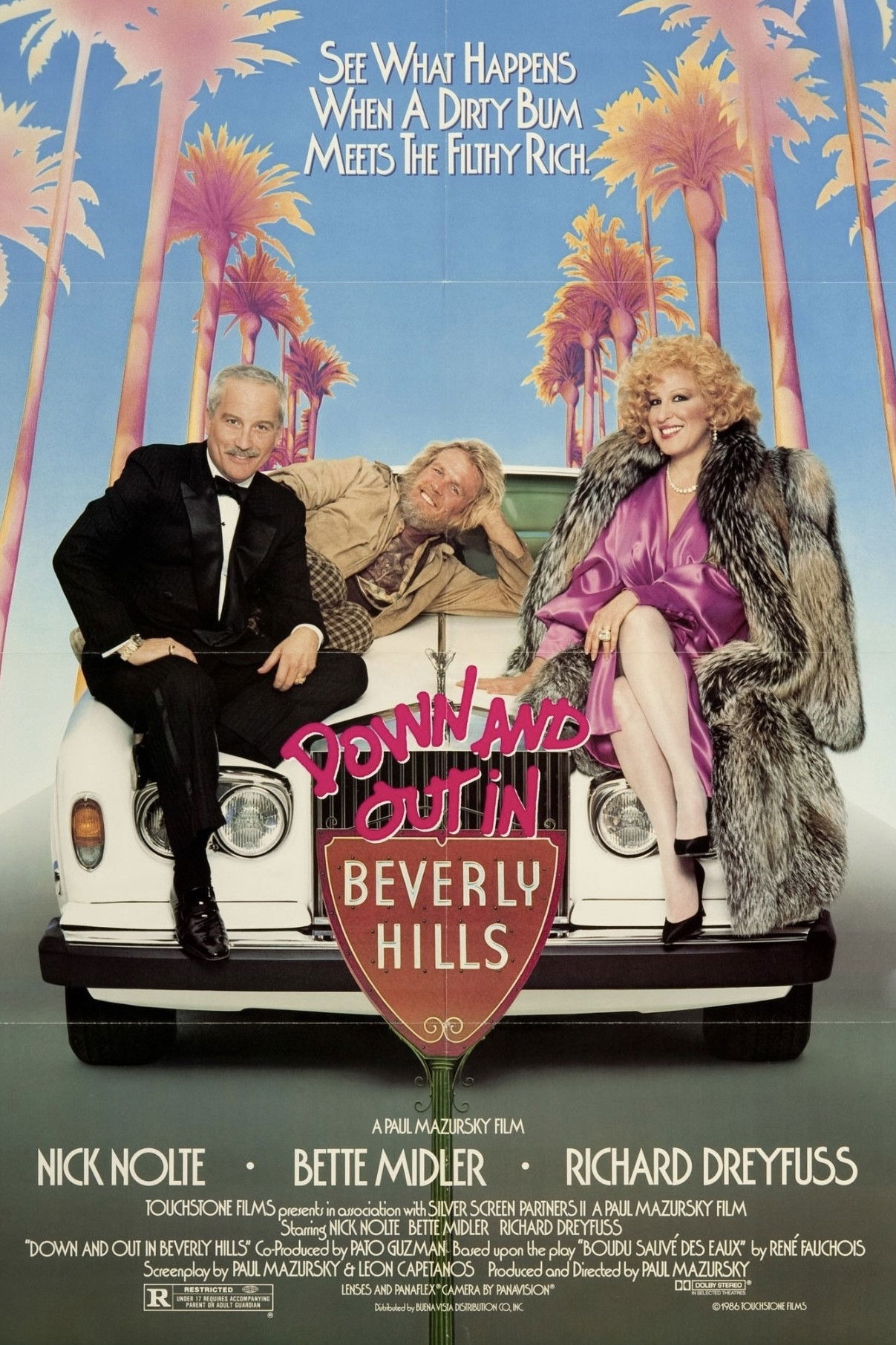
Paul Mazursky didn't just make a comedy in 1986. He basically built a time capsule of Reagan-era excess and then dropped a homeless man right into the middle of the foyer. If you haven't revisited the Down and Out in Beverly Hills movie lately, you're missing out on one of the sharpest satires ever to come out of the studio system. It was the first R-rated film ever released under the Walt Disney Studios’ Touchstone label. That's a fun trivia fact, sure, but it also tells you everything you need to know about the tone. Disney wanted to grow up, and they chose a story about a guy trying to drown himself in a rich man's pool to do it.
Honestly, the setup sounds like a standard sitcom trope today, but back then? It was edgy. Bette Midler and Richard Dreyfuss play the Whitemans, a couple so wealthy they’ve run out of real problems and started inventing new ones. Then enters Nick Nolte as Jerry Baskin. He’s a drifter. He’s dirty. He’s lost his dog. When he tries to end it all in their backyard, he inadvertently becomes the family’s new guru. It's wild how well this movie holds up because, frankly, our obsession with "wellness" and the guilt of the upper class hasn't changed a bit. If anything, it’s gotten weirder.
The Cast That Made the Chaos Work
You can’t talk about this film without talking about the chemistry. Richard Dreyfuss is at his manic best here. He plays Dave Whiteman, a guy who makes a fortune off hangers—literally, coat hangers—and feels incredibly guilty about it. He’s trying to be a "good guy" by "saving" Jerry, but really, he’s just bored. Dreyfuss has this way of vibrating on screen that makes you feel his mid-life crisis in your teeth.
Then there’s Bette Midler as Barbara. She’s peak 80s. She’s doing yoga, she’s seeing gurus, and she’s utterly detached from reality. Midler’s performance is brilliant because she doesn’t play Barbara as a villain. She plays her as someone who is desperately, hilariously unfulfilled despite living in a palace.
And then... there’s Mike.
Mike is the dog. Specifically, a Border Collie named Mike who played Matisse. In many ways, the dog is the most sane character in the Down and Out in Beverly Hills movie. He has his own therapist. Think about that for a second. In 1986, the idea of a dog having a psychiatrist was the height of comedic absurdity. Nowadays, people in West Hollywood probably have acupuncture schedules for their Goldendoodles. Mazursky was way ahead of the curve on that one. Nick Nolte, for his part, brings a physical presence that is both intimidating and pathetic. He’s not a "magical" homeless person who fixes everyone with wisdom; he’s a bit of a con artist, a bit of a philosopher, and a lot of a mess.
Why This Remake Actually Beat the Original
Most people don't realize this movie is actually a remake of a 1932 French film called Boudu sauvé des eaux (Boudu Saved from Drowning) by Jean Renoir. Remakes usually suck. We all know this. But Mazursky did something clever. He took the DNA of the French class struggle and marinated it in 1980s American materialism.
In the original French version, Boudu is a force of nature who disrupts a middle-class household. In the Down and Out in Beverly Hills movie, Jerry Baskin is a mirror. He reflects the insecurities of everyone he meets. The daughter’s eating disorder, the son’s identity crisis, the wife’s sexual frustration—Jerry doesn't necessarily "fix" these things through some profound moral journey. He just provides a catalyst for the family to stop pretending for five minutes.
The cinematography by Phedon Papamichael (who was just starting out then) captures that bright, over-saturated Los Angeles sun that makes everything look expensive and slightly sickly. It’s beautiful but hollow. That’s the point. The Whiteman mansion is a character in itself. It’s huge, it’s white, and it’s filled with stuff nobody needs.
The Politics of the Pool
Let’s get real about the ending. Without spoiling it for the three people who haven't seen it on cable at 2 AM, it’s not a neat "happily ever after." It’s cynical.
Critics at the time, like Roger Ebert, pointed out that the movie doesn't actually solve the problem of homelessness. Well, duh. It’s a satire. If it ended with Jerry getting a job at the hanger factory and Dave giving away all his money, it would have been a lie. Instead, the movie suggests that the rich will always find a way to co-opt the "authentic" experience of the poor to make themselves feel better.
It’s a biting critique of liberalism in the 80s. Dave Whiteman wants to help Jerry, but he also wants Jerry to look and act exactly how Dave thinks a "reformed" person should. He wants a pet project, not a person.
Key Elements That Defined the Film:
- The Score: Andy Summers from The Police did the music. It has that quirky, rhythmic 80s vibe that keeps the pacing tight.
- Little Richard: He plays the neighbor! Seeing Little Richard scream at his gardeners is a cinematic gift we didn't deserve.
- The Dog's POV: The scenes with Matisse the dog are genuinely some of the best animal acting in film history. The dog actually looks depressed.
What Most People Get Wrong About the Movie
A lot of people remember the Down and Out in Beverly Hills movie as just a goofy comedy. They remember the dog or Bette Midler’s outfits. But if you watch it now, it’s actually kind of dark. There’s a scene where Jerry talks about his past—or what we think is his past—and it’s heavy.
The movie plays with the idea of truth. Is Jerry a former genius? Is he a total fraud? Does it even matter? The Whitemans don't care if he's telling the truth; they just care that he’s interesting. In the world of Beverly Hills, being boring is a far greater sin than being a liar.
Is It Still Relevant?
Look at the headlines today. Look at the wealth gap in Los Angeles. Look at the tents lined up just blocks away from multimillion-dollar condos. The Down and Out in Beverly Hills movie is arguably more relevant in 2026 than it was in 1986. The absurdity has just scaled up.
We still have the same characters. We still have the Dave Whitemans who think a "nice gesture" fixes systemic issues. We still have the Barbaras looking for enlightenment in the latest wellness fad. And we definitely still have the Jerry Baskins, people who have fallen through the cracks and are just trying to find a place to exist without being treated like a prop.
How to Watch and What to Look For
If you’re going to sit down and watch it, pay attention to the background. Mazursky was a master of the "lived-in" frame. There’s always something happening—a maid doing something ridiculous, a neighbor being extra, a piece of art that looks like a nightmare.
- Watch for the wardrobe changes: Notice how Jerry’s clothes start to mirror Dave’s as the movie progresses.
- Listen to the dialogue: It’s fast. It’s very "New York in LA."
- The Cameos: Keep an eye out for Paul Mazursky himself. He loved popping into his own films.
Actionable Next Steps for Film Buffs
If you want to truly appreciate the Down and Out in Beverly Hills movie, don't just watch it in a vacuum. Start by watching the original 1932 Boudu sauvé des eaux. It’s a fascinating comparison of how two different cultures (and two different eras) handle the concept of the "intruder" in the home.
Next, check out Mazursky's other work, specifically An Unmarried Woman or Bob & Carol & Ted & Alice. He had a specific knack for capturing the American middle and upper class in moments of transition.
Finally, read Nick Nolte’s memoir, Rebel. He talks about his process for playing Jerry, and it’s as intense as you’d expect from Nolte. He actually spent time living on the streets to get into character, which explains why he looks so genuinely haggard in the opening scenes.
The film isn't just a relic of the 80s. It’s a sharp, funny, and occasionally uncomfortable look at what happens when two worlds collide and neither one knows how to handle it. It’s about the lies we tell ourselves to keep our comfortable lives from falling apart. And it has a really great dog.