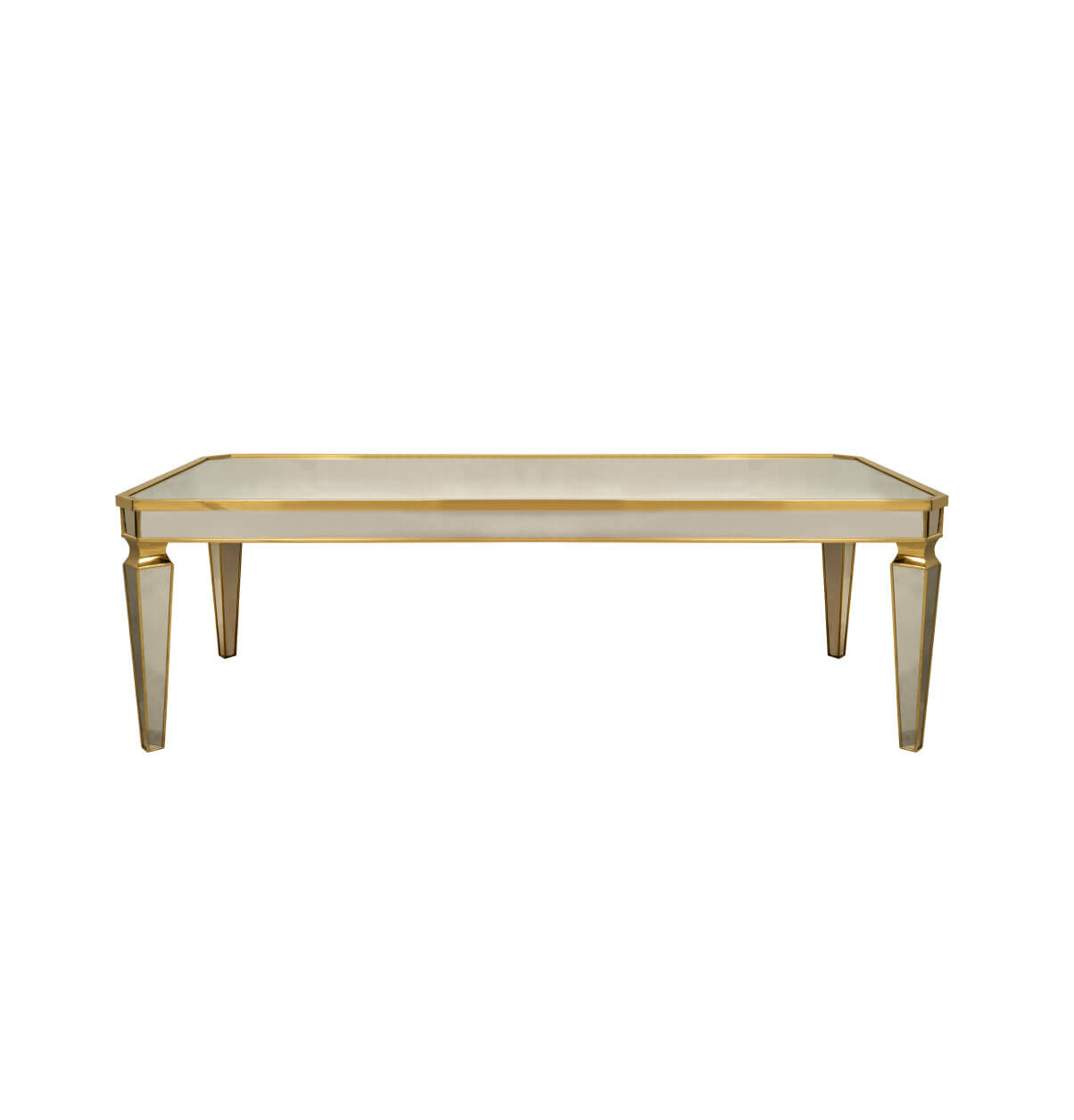
You walk into a high-end restaurant or a staged Pinterest home and it just feels expensive. You can't quite put your finger on why. The lighting is soft, the room feels massive, and there’s a sense of depth that your own home lacks. More often than not, the secret isn't the $10,000 chandelier. It’s the dining room table mirror. Honestly, most people think mirrors belong in the bathroom or the hallway. They’re wrong.
Design is weird.
Sometimes the most practical room in the house—the place where you actually eat and drop your keys—is the hardest to style because it’s so functional. A dining room table mirror fixes the "box" problem. Most dining rooms are just four walls and a table. It's boring. By adding a mirror, you’re basically cutting a window into a solid wall. It’s visual magic.
The Science of Why a Dining Room Table Mirror Actually Works
It isn't just about vanity. It’s physics. When you place a mirror adjacent to or behind a dining table, you are doubling your light sources. If you have a single pendant light or a tray of candles on the table, the mirror bounces that light back into the room. This is especially huge if your dining area is tucked away in a dark corner of an open-concept apartment.
Designers like Kelly Wearstler and Nate Berkus have frequently utilized reflective surfaces to manipulate scale. In a small dining nook, a large-scale mirror can make a four-person table feel like it’s floating in a much larger ballroom. It's an old trick, but it works every single time.
But wait.
There is a massive catch. If you hang it at the wrong height, you’re just forcing your guests to watch themselves chew. That is the quickest way to make a dinner party awkward. Nobody wants to see their own jaw movements in high definition while they're trying to enjoy a steak. You have to find the "sweet spot" where the mirror reflects the tabletop decor and the ambient light, but not the literal faces of every person sitting down.
Picking the Right Shape for Your Space
Don't just grab a random rectangle from a big-box store. The shape of your mirror needs to talk to the shape of your table.
If you have a long, rectangular farmhouse table, a horizontal "landscape" mirror is the move. It mimics the lines of the table and stretches the room. However, if you have a round tulip table, a circular mirror creates a beautiful, soft symmetry. It feels intentional.
Then there’s the "Leaner." If you have a massive, floor-to-ceiling mirror, don't hang it. Lean it against the wall behind the head of the table. It creates this effortless, Parisian-apartment vibe that feels much less stiff than a perfectly centered, bolted-to-the-wall piece.
What Most People Get Wrong About Placement
The biggest mistake? Hanging the mirror too high.
People have this weird instinct to treat mirrors like art galleries, hanging them at eye level for someone who is standing up. But in a dining room, everyone is sitting. If the mirror is too high, it’s reflecting the ceiling fan and the top of the door frame. Boring. You want it to reflect the vibe.
- The 57-inch Rule: Generally, the center of the mirror should be about 57 to 60 inches from the floor. But for a dining room, you might even go lower.
- The Buffet Connection: If you have a sideboard or buffet pushed against the wall, the mirror should live about 4 to 6 inches above the top of that furniture.
- The View: Before you drill a single hole, stand where the mirror will go and look across the room. What is it reflecting? If it’s reflecting the entrance to a messy kitchen or a cluttered hallway, don't put it there. You’re just doubling the mess.
Lighting matters too. If you have a beautiful chandelier, a dining room table mirror should capture the sparkle of the crystals or the glow of the bulbs. It turns one light fixture into two.
The Frame Game: Texture and Material
A mirror without a frame is just a piece of glass. The frame is where the personality happens.
If your dining room is full of wood—wood table, wood chairs, wood floors—you need to break that up. A wooden-framed mirror will just get lost in the "brown-out." Instead, go for a matte black metal frame for an industrial look, or a weathered gold leaf frame for something more traditional.
Antique mirrors are also making a huge comeback. I’m talking about "foxed" glass—that cloudy, speckled look you see in old French cafes. It’s great because it provides the depth and light-reflection of a mirror without the "staring at myself" intensity of clear silvered glass. It’s softer. It’s moodier.
- Industrial: Thin black frames, grid patterns (looks like a window).
- Glam: Beveled edges, no frame, or mirrored frames.
- Organic: Rattan, driftwood, or asymmetrical "puddle" shapes.
- Minimalist: Ultra-thin circular frames in brass or chrome.
Creating a Focal Point Without Being Tacky
Let’s talk about the "Gallery Wall" approach. Sometimes one big mirror is too much. It feels like a gym.
You can instead use a cluster of smaller mirrors. If you arrange them correctly over a dining table, it acts like a piece of abstract art. Use different sizes but keep the frame color consistent so it doesn't look like a flea market exploded on your wall.
Another pro tip: Use a mirror to "bring the outside in." If your dining table sits opposite a window with a view of a garden or even just some trees, the mirror will act as a second window. It’s a literal mood booster. Studies in environmental psychology often point to the fact that seeing greenery—even in a reflection—lowers cortisol levels. So, technically, a well-placed mirror might make your dinner guests less stressed.
Feng Shui and the Dining Room Table Mirror
In Feng Shui, the dining room is a symbol of the family’s wealth and "nourishment." A mirror here is actually considered very lucky. Why? Because it "doubles" the food on the table, which symbolizes an abundance of resources.
Now, whether you believe in energy flow or not, there’s a psychological component to it. A room that feels "abundant" and bright is a room where people want to linger. It encourages longer conversations. It makes the meal feel like an event rather than just a chore.
However, avoid mirrors that are "shattered" or made of many small, disconnected pieces if you’re following these principles. The idea is to reflect a whole, cohesive image of the family, not a fragmented one.
Practical Maintenance (The Part Nobody Likes)
Dining rooms are messy. Steam from hot food, flying pasta sauce, and fingerprints from kids can ruin the look of a mirror in about five minutes.
If you’re going to commit to a mirror in this space, you need a microfiber cloth and a dedicated glass cleaner. Avoid anything with ammonia if you have an antique or silver-leaf frame, as it can eat away at the finish over time.
Also, consider the weight. A high-quality dining room table mirror is heavy. We’re talking 40, 50, sometimes 80 pounds. Do not—I repeat, do not—try to hang this with a simple nail and a prayer. You need to hit a stud or use heavy-duty toggle bolts. If that mirror falls while you're eating soup, that’s seven years of bad luck you definitely don't want.
Making the Final Choice
Choosing a mirror shouldn't be stressful, but it should be calculated. Think about the height of your ceiling. If you have low ceilings, a vertical mirror can help "lift" the room. If you have high ceilings, a wide horizontal mirror can ground the space and make it feel more intimate.
Go for something that feels slightly too big. Most people buy mirrors that are too small for their walls, and it ends up looking like a postage stamp in the middle of a desert. Be bold. A dining room is one of the few places in the house where you can afford to be a little dramatic.
Actionable Steps for Your Dining Room
- Measure your table: The mirror should generally be about 2/3 or 3/4 the width of the table or the buffet it's sitting over.
- Check the "Sit Test": Have someone hold the mirror (or a piece of cardboard the same size) at the height you want. Sit at the table. If you're staring directly into your own eyes, move it up four inches.
- Layer your lighting: Make sure you have a dimmable light source. A mirror reflecting a 100-watt glaring bulb is painful. A mirror reflecting a dimmed chandelier is atmospheric.
- Consider the frame depth: If your dining room is narrow, a thick, chunky frame might stick out too far and feel cramped. Go for a "pill" or "slim" frame in tight quarters.
Buying a mirror is the fastest way to renovate a room without actually touching a paintbrush or hiring a contractor. It changes the architecture of the space instantly. Focus on the reflection, get the height right, and don't be afraid to go big.
To get started, measure the wall space behind your table and subtract 12 inches from each side; that is your maximum ideal width for a mirror that looks balanced. Once you have those dimensions, look for a frame material that contrasts with your table—metal for wood tables, or wood for glass/stone tables—to create a layered, professional look.