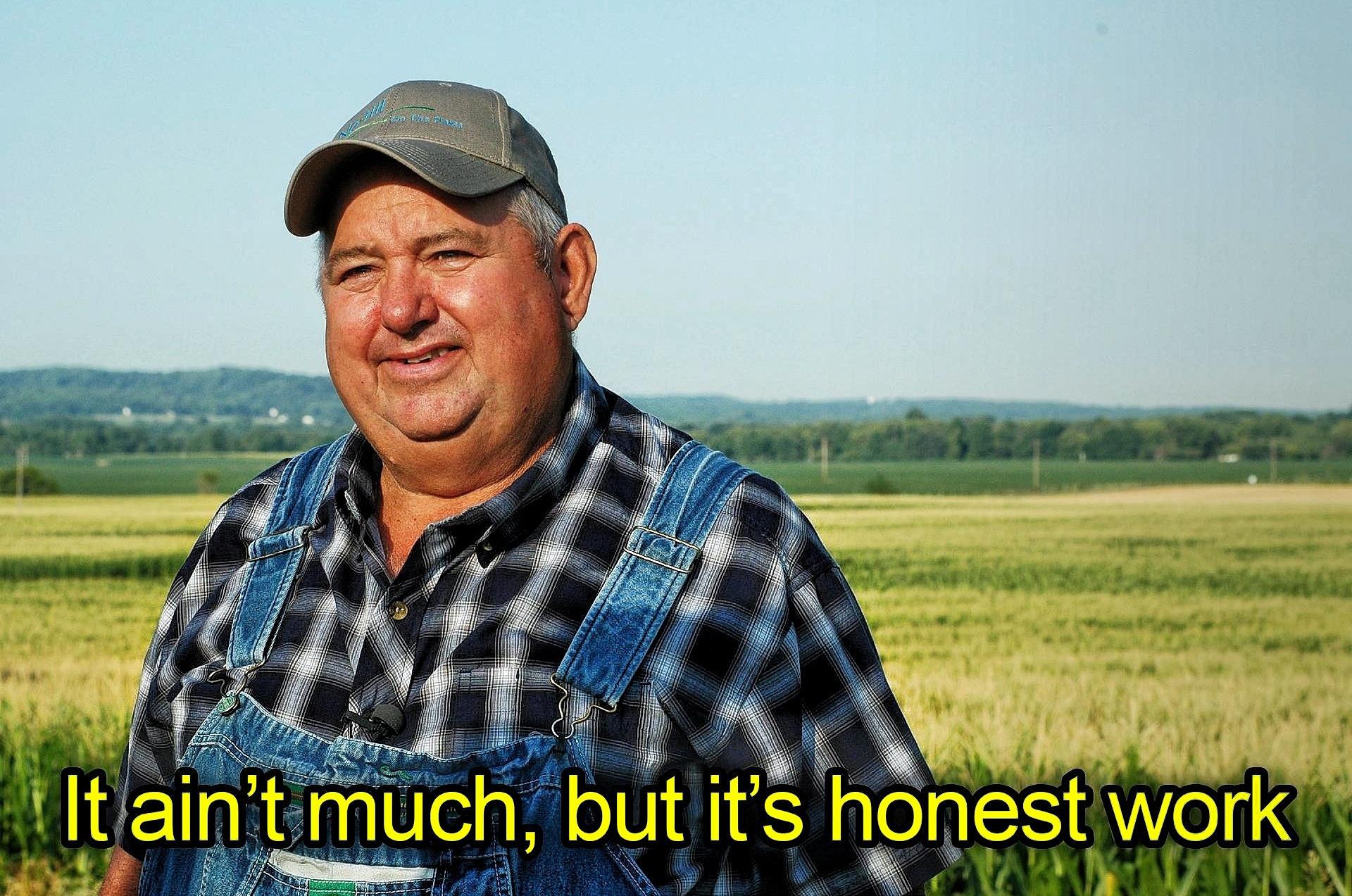
You’ve seen the face. It’s Dave Brandt. He’s wearing overalls, standing in a field, and looking remarkably content with his life. If you’ve spent more than five minutes on Reddit or X (formerly Twitter) in the last decade, you know exactly what I’m talking about. The phrase it's not much but it's honest work has morphed from a simple caption into a universal shorthand for the quiet dignity of just doing your job.
But here’s the thing about internet culture: it moves fast. Memes die. Trends get buried by the next dance craze or AI-generated nonsense. Yet, this specific image of an Ohio farmer has stayed relevant for years. Why? Because it taps into something deeply human that most of the internet usually ignores—the value of the "grind" without the "hustle culture" toxicity.
Honestly, it's kinda refreshing. In an era where everyone is trying to be a "disruptor" or a "six-figure influencer," there's a certain magnetic pull toward a guy who's just happy he finished his chores.
The Real Story of Dave Brandt
The man in the photo wasn't an actor. He wasn't a model posing for a stock photo company. David Brandt was a real-deal farmer from Carroll, Ohio. He was a pioneer in "no-till" farming, which is basically a way of growing crops without disturbing the soil through tillage.
It’s actually pretty technical stuff.
He spent his life teaching other farmers how to use cover crops to improve soil health and reduce the need for chemicals. He was a legend in the agricultural world long before he became a digital icon. The original photo was taken for an article by the U.S. Department of Agriculture (USDA) back in 2014. It was meant to highlight soil health. It wasn't meant to be a joke.
But the internet had other plans. Around 2018, someone on Reddit took that image, added the caption it's not much but it's honest work, and the rest is history. It’s one of those rare moments where the internet actually got it right. They took a man who spent his life doing something difficult and unglamorous and turned him into a symbol for everyone else doing the same.
Why This Meme Refuses to Die
Most memes have a shelf life of about two weeks. This one? It’s been half a decade and it still hits. I think it’s because it works as a humblebrag and a genuine expression of pride at the same time.
You use it when you finally finish a 50-page report that nobody is going to read. You use it when you spend four hours cleaning your kitchen until the floor shines. You use it when you get three kills in a video game while your teammates are getting thirty. It’s the ultimate "I did my part" badge.
- The relatable struggle: We aren't all CEOs. Most of us are just pushing paper or fixing things.
- The lack of pretension: There’s no filter. No ring light. Just a guy in a field.
- The moral high ground: There is a specific kind of pride in doing "honest" work, especially when the world feels full of scams.
Think about the context of 2026. We are surrounded by deepfakes and automated bots. Seeing a real person talking about real labor feels grounded. It’s an anchor.
The Tragedy Behind the Meme
It’s important to talk about what happened recently. In May 2023, Dave Brandt passed away at the age of 76 following complications from a car accident. The internet didn't just post "F" to pay respects; they actually mourned.
It was a strange moment where the digital world collided with reality. People started sharing his actual work. They learned about his contributions to sustainable agriculture. They realized that the "honest work" he was talking about in the meme was actually saving the planet's topsoil.
He knew about the meme, by the way. He reportedly got a kick out of it. He didn't sue anyone. He didn't try to launch a "Honest Work" cryptocurrency. He just kept farming. That, in itself, is the most "honest work" thing he could have done.
How It Became the Voice of a Generation
We’re living through a weird time. The "Great Resignation" happened, then "Quiet Quitting" became a buzzword, and now we're all just trying to figure out if our jobs will exist in five years. In that chaos, it's not much but it's honest work acts as a mantra.
It’s the antithesis of the "hustle" mentality.
The "hustle" tells you that if you aren't making passive income while you sleep, you're failing. It tells you to monetize your hobbies. It tells you that "honest work" is for suckers. But people are burning out on that. They’re realizing that there is a profound mental health benefit to just doing a task well and calling it a day.
Psychological Impact
Psychologists often talk about "flow states" and "tangible outcomes." When you garden, or paint a room, or code a small script that actually works, your brain gets a hit of dopamine that is way more sustainable than the hit you get from a "like" on Instagram.
Dave Brandt’s face represents that specific dopamine hit.
It’s the feeling of looking at a finished pile of wood you just chopped. Is it going to change the world? No. Is it much? Not really. But it’s yours.
Misinterpretations and Modern Usage
Sometimes people use the meme ironically, which is where it gets really funny. Like when a massive corporation settles a multi-billion dollar lawsuit for a fraction of the cost and posts a "we're trying" message. Or when a developer fixes one tiny typo in a sea of broken code.
But the irony only works because the original sentiment is so pure.
If you look at the subreddit r/memes or r/wholesomememes, the Dave Brandt template is usually reserved for the "little wins."
- Gaming: Successfully landing a plane in a simulator after twenty tries.
- Parenting: Getting a toddler to eat one piece of broccoli.
- Fitness: Walking for 15 minutes when you really wanted to sit on the couch.
- Coding: Finally finding the missing semicolon after three hours of debugging.
It’s a celebration of the incremental. We need that. We’re so obsessed with "scale" and "growth" that we forget that most of life is just incremental progress.
The Cultural Legacy of Honest Labor
There’s a long history of praising the "common worker" in art and literature, from Steinbeck to the Works Progress Administration murals of the 1930s. This meme is just the 21st-century version of that.
It’s our version of The Gleaners.
Except instead of oil on canvas, it’s pixels on a smartphone screen. The medium changed, but the message stayed the same: there is dignity in the effort.
Dave Brandt didn't set out to be a philosopher. He set out to grow corn and soybeans without ruining the land. But by being himself, he gave the internet a language to talk about self-worth. He reminded us that you don't have to be a superstar to be "enough."
What We Can Learn from the "Honest Work" Philosophy
If you want to actually apply this to your life, start by lowering the bar for what you consider a "success." We spend so much time looking at the "much" that we ignore the "honest."
Stop waiting for the massive promotion or the viral moment. Focus on the task in front of you. Whether you're a barista, a surgeon, or a student, there's a version of Dave Brandt’s field in your life.
Tending to it matters.
Even if nobody sees it. Even if it doesn't make you rich. Even if it's just "not much."
Actionable Steps to Embrace the Mindset
If you're feeling burnt out or like your work doesn't matter, try these shifts:
Audit your "wins." At the end of the day, write down one thing you did that was "honest work." Not something that made money or got praise, but something you did correctly and thoroughly. It could be as small as finally responding to that nagging email or organizing your junk drawer.
Disconnect the result from the effort. Focus on the "tilling of the soil." In Dave Brandt’s world, you can do everything right and a drought can still ruin the crop. You can’t control the weather. You can only control the work. Learn to find peace in the process rather than the outcome.
Avoid the "optimization" trap. You don't need a productivity app for everything. Sometimes, just doing the work manually—the "honest" way—is better for your brain than trying to automate it. There's a reason people still bake bread by hand even though you can buy a loaf for two dollars. The effort is the point.
Respect the "not much." Stop apologizing for small progress. If you wrote one paragraph of your book today, that’s better than writing zero. It’s not much, but it’s honest work. Own it.
Dave Brandt left a legacy of better soil and a better internet. We can at least try to leave our little corners of the world a bit better than we found them, one small, honest task at a time.