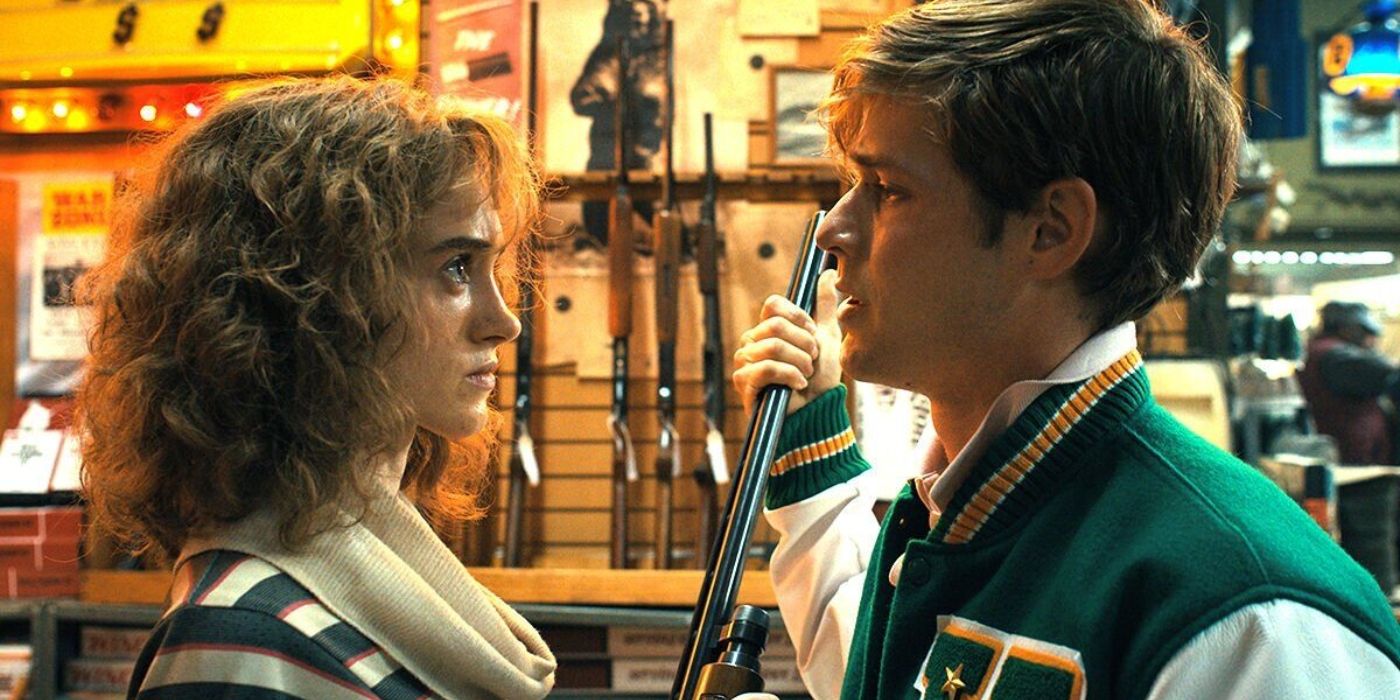
He’s the worst. Honestly, if you spent any time on Twitter or Reddit during the summer of 2022, you saw the vitriol. People hated Jason Carver more than they hated Vecna. Think about that for a second. Vecna is a literal lich who snaps teenagers' bones like dry kindling and gouges out their eyes, yet the basketball captain with the perfect hair was the one everyone wanted to see get ripped in half.
Jason Carver isn't just a side character in Stranger Things Season 4. He's a mirror.
Most people see him as a standard 80s jock trope. You know the type—the guy from The Karate Kid or Back to the Future who exists just to be a foil to the nerdy protagonist. But the Duffer Brothers did something much meaner with Jason. They made him right. Well, "right" in his own head. That’s what makes him terrifying. He isn't a monster from the Upside Down; he’s the guy who lives next door and thinks he’s saving the world while he’s actually destroying it.
The Anatomy of a High School Hero
Jason starts off as the golden boy of Hawkins. He's charismatic. He's a leader. When he gives that speech in the gym about "winning for Benny" and "winning for Barb," he isn't just grandstanding. He actually believes it. He loves his girlfriend, Chrissy Cunningham. That’s the pivot point. When Chrissy dies in Eddie Munson’s trailer, Jason’s entire world-view shatters.
He can't process a supernatural reality. Most of us couldn't.
If you found out your girlfriend was levitated and crushed by an interdimensional demon, your brain would probably look for a more "logical" explanation too. For a kid in 1986 Indiana, that logic was the Satanic Panic. It was a real thing. It ruined real lives. By leaning into the "Hellfire Club is a cult" narrative, Jason becomes the avatar for every misguided moral crusade in history. He doesn't think he's a villain. He thinks he's the protagonist of a completely different show—a gritty true-crime thriller where he's the grieving boyfriend seeking justice.
Mason Dye, the actor who played Jason, did an incredible job of keeping that intensity high. You can see the grief in his eyes before the rage takes over. It’s a nuanced performance that often gets buried under the collective fan-base desire to see him fail.
Why Jason Carver Matters More Than Vecna
Vecna is a fantasy. He represents trauma and depression, sure, but he's ultimately a guy in a rubber suit (or a lot of CGI). You aren't going to meet a Vecna at a PTA meeting or a town hall. You are, however, going to meet a Jason.
His danger lies in his ability to mobilize.
Look at the scene in the town hall. He uses his grief as a weapon. He uses his status as the "hero" of the basketball team to bypass logic and go straight for the town's throat. He turns a grieving community into a mob. That’s a very specific kind of horror that Stranger Things hadn't really explored before. Usually, the "human" villains are just bullies like Billy Hargrove or government suits like Dr. Brenner. Jason is different because he has the power of the public on his side.
The most chilling part? He's technically doing what our heroes do.
Think about it. Eleven and the gang see a threat, they gather their friends, and they go to war to stop it. Jason sees what he perceives as a threat (Eddie and the "cult"), gathers his friends, and goes to war to stop it. The difference is information. Jason is operating with 10% of the facts and 100% of the conviction. That gap is where people get killed.
The Patrick Incident and the Point of No Return
When Jason sees Patrick get "vecna-ed" in the middle of Lover's Lake, it should have been a wake-up call. It should have proven that Eddie wasn't just some guy with a knife. But confirmation bias is a hell of a drug. Instead of realizing there's a supernatural monster, Jason decides that Eddie has literal Satanic powers.
He doubles down.
It's a brilliant bit of writing. It shows that even when presented with evidence that contradicts our world-view, we will often twist that evidence to fit our existing narrative. Jason needed Eddie to be the villain because if Eddie wasn't the villain, then the world was far more chaotic and scary than Jason could handle.
The Tragic Final Act in the Creel House
The final showdown between Lucas Sinclair and Jason Carver is one of the best choreographed fights in the series. It’s messy. It’s desperate. It’s not a "cool" fight. It’s two kids who are both trying to save someone they love, but they are speaking two different languages.
Lucas is trying to explain the end of the world.
Jason is trying to "save" Max from a cult leader.
When Jason steps on Max’s Walkman, he isn't just being a jerk. He’s accidentally sentencing her to death. He thinks he’s stopping the "ritual." It’s the ultimate irony of his character: his attempt to be a hero is exactly what allows the villain to win.
Then comes the end.
Jason Carver’s death is sudden and, frankly, a bit unceremonious. When the gate opens through the Creel House, he’s simply torn in half. No final words. No redemption. Just gone. Some fans felt it was too quick, but it fits the theme. In the face of actual cosmic horror, the "golden boy" doesn't get a heroic sacrifice. He’s just collateral damage. He was a big fish in a small pond who jumped into the ocean and realized too late that there were sharks.
What We Can Learn from the Hawkins Hero
Dealing with the "Jason Carvers" of the world isn't about winning a fistfight. It's about recognizing the signs of a dangerous narrative before it takes hold. If you're analyzing this character for a film study or just trying to understand why he bothered you so much, keep these points in mind:
- Charisma is a Tool: Being likable doesn't make someone right. Jason’s ability to speak well was his most dangerous attribute.
- The Danger of Certainty: Jason never doubted himself. Not once. That lack of doubt is what led to the town's descent into chaos.
- Context Matters: To understand Jason, you have to understand the 1980s. The "Satanic Panic" was fueled by the media and religious leaders, making Jason's reaction a product of his environment, not just a personal failing.
If you want to dive deeper into how Stranger Things uses real-world history to ground its sci-fi elements, look up the "West Memphis Three." It's a real-life case where three teenagers were wrongly convicted of murder because they liked heavy metal and "occult" imagery. It's the direct inspiration for Eddie Munson's arc and Jason's crusade.
Understanding the history makes Jason much scarier. He isn't a cartoon. He's a history lesson wrapped in a varsity jacket.
To really grasp the impact of this character, re-watch Season 4 and try to watch it from Jason's perspective only. Don't look at what the audience knows. Only look at what he sees. You'll find a much more tragic, complex, and ultimately infuriating character than you remembered. It doesn't make him likable, but it makes him one of the best-written "human" antagonists in modern television.