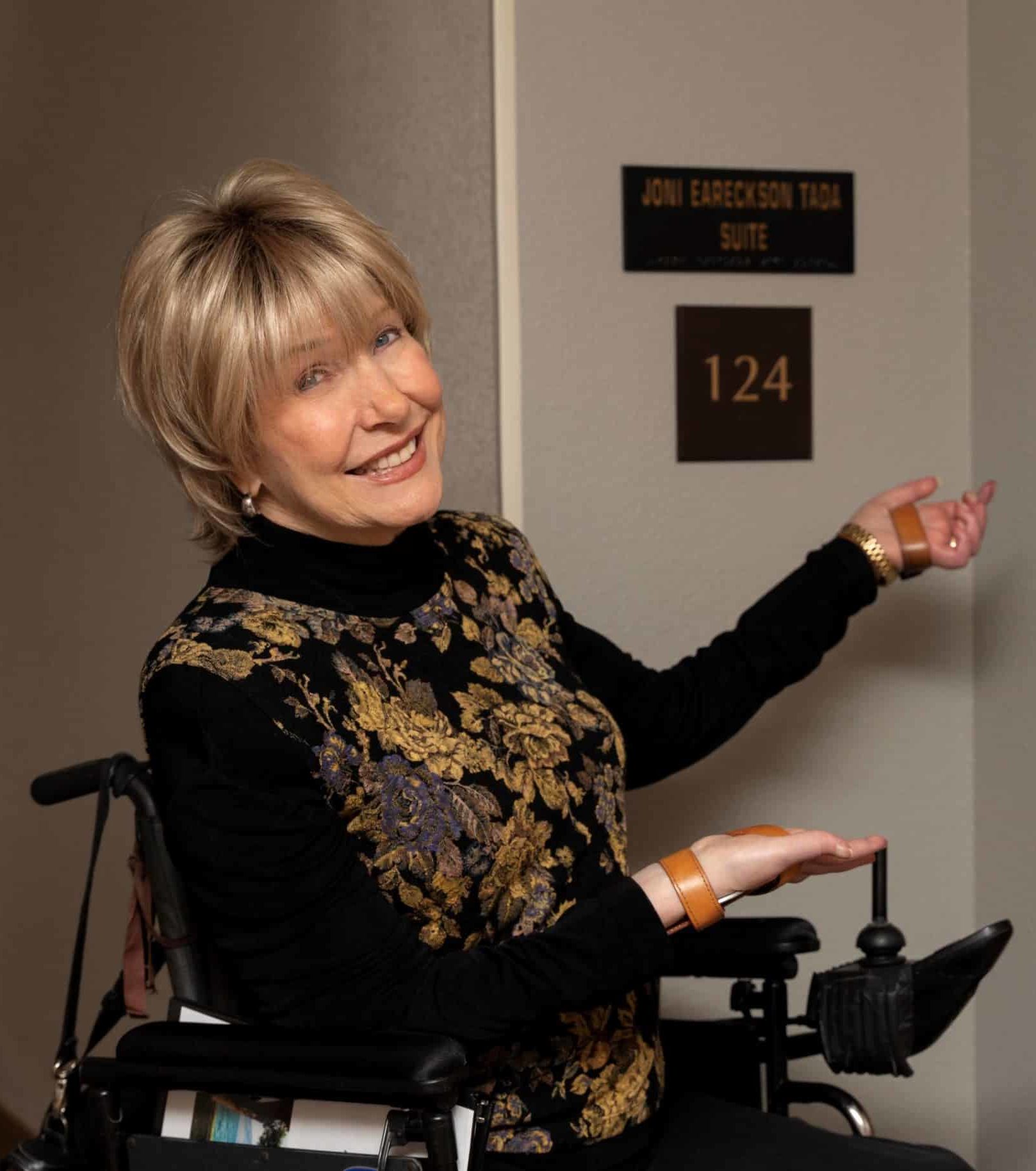
It is a strange thing to watch someone paint with their teeth. Most people, when they first see a video of it, kind of lean in with this mix of pity and morbid curiosity, but that usually evaporates in about thirty seconds. Once you see the actual brushwork, the pity dies. You realize you aren’t looking at a "disability craft" or some therapeutic hobby meant to pass the time in a wheelchair. You are looking at fine art.
Paintings by Joni Eareckson Tada have been around for over half a century now, which is wild to think about. She dived into shallow water in the Chesapeake Bay in 1967, snapped her spinal cord, and became a quadriplegic at seventeen. Most teenagers in that position would—and do—lose their minds. Joni did for a while. But then she picked up a pensil with her teeth. Then a brush.
The Mechanics of Mouth Painting
You’ve probably wondered how it actually works. It’s not just "holding a brush." To get the kind of detail she achieves, especially in her early charcoal pieces or her later, more vibrant landscapes, requires a level of neck muscle control that is honestly exhausting to even describe. She clenches the brush between her molars. To get a fine line, she has to move her entire head with the precision of a surgeon. If she sneezes or her neck spasms, the piece could be ruined.
She uses a bridge—a wooden stick used by artists to steady the hand—but for her, it’s about steadying the trajectory of her head.
The early works were mostly black and white. Think back to the late 60s and early 70s. She was using pens and ink because they were easier to control than the fluid, unpredictable nature of oils or watercolors. Those early drawings, like her famous "Tree of Life" or the detailed renderings of horses, have this high-contrast, almost etched quality. They feel tight. Controlled. Maybe even a little bit tense, reflecting a woman who was still fighting to find her place in a world that suddenly felt very small.
Evolution from Ink to Color
As she got older, the style shifted. It’s a bit of a metaphor for her life, I guess. The world got more colorful.
If you look at paintings by Joni Eareckson Tada from the 80s and 90s, you see a massive jump into oils and watercolors. The "Joni’s World" collection, which many people recognize from her greeting cards and books, is much softer. She started leaning into impressionism. We’re talking soft meadows, floral arrangements that look like they’re glowing from the inside, and a lot of biblical imagery that doesn't feel forced.
It’s actually pretty hard to find her original canvases for sale. Most of what the public sees are prints handled through her organization, Joni and Friends. Because she’s spent decades as a high-profile advocate for people with disabilities, her art became the visual soul of her ministry.
Why the Detail Matters
Critics sometimes dismiss mouth painting as "folk art," but that’s a lazy take. If you look at her 1980s piece The Journey Home, the way she handles light hitting the trees is objectively sophisticated. She isn't just "getting it on the page." She’s manipulating values and temperatures in a way that suggests she’s thinking three steps ahead of the brush.
She often works on large canvases. Imagine the sheer physical stamina required to paint a three-foot-wide landscape when your range of motion is limited to the arc of your neck. It’s grueling. She has spoken about the physical pain of long sessions, the way her jaw aches, and how she has to rely on assistants to mix the pigments to the exact consistency she demands. She’s the director; her teeth are the conductor.
The Market and Collectibility
People often get confused about where to find these pieces. You won't usually find a "Joni Eareckson Tada" at a Christie’s auction next to a Rothko, but within the world of Christian art and disability advocacy, her work is the gold standard.
- Limited Edition Prints: These are the most common. They often come with a certificate of authenticity and are frequently used for fundraising.
- Originals: These are mostly held in private collections or at the Joni and Friends International Disability Center in California.
- Illustrated Books: Joni has illustrated several children's books, like The Christmas Story, where the art has to be simplified for the medium but still retains that signature "Joni" glow.
What most people get wrong is thinking she stopped painting because she got busy with her radio show or her global advocacy. She didn't. She’s had bouts with cancer and chronic pain that sidelined her, but she keeps coming back to the easel. It’s her "breathing room."
The Psychological Impact of the Art
There’s a specific "look" to paintings by Joni Eareckson Tada. It’s hard to pin down, but it’s basically a refusal to be dark. Given her history—the diving accident, the decades in a chair, the battle with stage III breast cancer—you’d expect her art to be gritty. Dark. Maybe a bit existential.
But it’s the opposite.
Her work is almost aggressively hopeful. She leans into the "Old Master" style of lighting—chiaroscuro—where light emerges from deep shadows. It’s a theological statement as much as an aesthetic one. She’s showing you that the light is winning.
Common Misconceptions About Her Technique
People think she uses a special computer or a robotic arm these days. Nope. While she uses voice-activated tech for her writing and emails, the art is still manual. Well, "mouth-ual."
- The Brush Setup: She uses standard brushes but often has the handles extended or wrapped in a grip-friendly material so she can hold them comfortably without destroying her teeth.
- The Perspective: Because she is sitting in a wheelchair, her perspective is always slightly lower than a standing artist. This gives her landscapes a grounded, "from the earth" feeling.
- The Assistant’s Role: An assistant is vital. They move the easel up, down, or tilt it. They thin the paint. But they never touch the brush to the canvas. That line is never crossed.
Where to See the Work Today
If you’re actually looking to buy or view the work, your best bet isn't a random art gallery in New York. You have to go to the source. The Joni and Friends website has a dedicated gallery section. They’ve digitized a lot of it.
Honestly, the best way to appreciate it is to look at a high-res scan of her charcoal work from the 70s and then compare it to a watercolor from 2010. The transition from the "tightness" of pen and ink to the "freedom" of watercolor is the story of someone who stopped fighting their circumstances and started using them as a canvas.
Actionable Insights for Art Lovers and Collectors
If you're interested in the intersection of disability and fine art, or if you're looking to collect, keep these points in mind:
- Check the Signature: On her drawings, you’ll often see "P.T.L." (Praise The Lord) next to her name. It’s her trademark.
- Look for the "Joni" Label: Many secondary market prints are sold on eBay or at estate sales. Ensure they are officially licensed by her ministry to guarantee they aren't low-quality scans.
- Study the Mouth-Painting Movement: Joni isn't the only one. Exploring the Association of Mouth and Foot Painting Artists of the World (VDMFK) can give you context on where her skill level sits compared to others in the field.
- Support the Cause: Buying her art is almost always a double-win; it usually funds the distribution of wheelchairs to developing nations.
Paintings by Joni Eareckson Tada aren't just pictures. They are evidence of a person who refused to be silent when her body stopped working. Whether you're religious or not, the technical proficiency of a woman painting a perfect rose with her molars is something that demands respect. It’s a reminder that the brain is the primary artist; the hand—or the mouth—is just the tool.
To truly understand the depth of this work, one should look at the original sketches for her book Joni, which remains a seminal piece of 20th-century disability literature. The raw honesty in those lines is something no AI or able-bodied artist can quite replicate because it was born out of a very specific kind of fire.