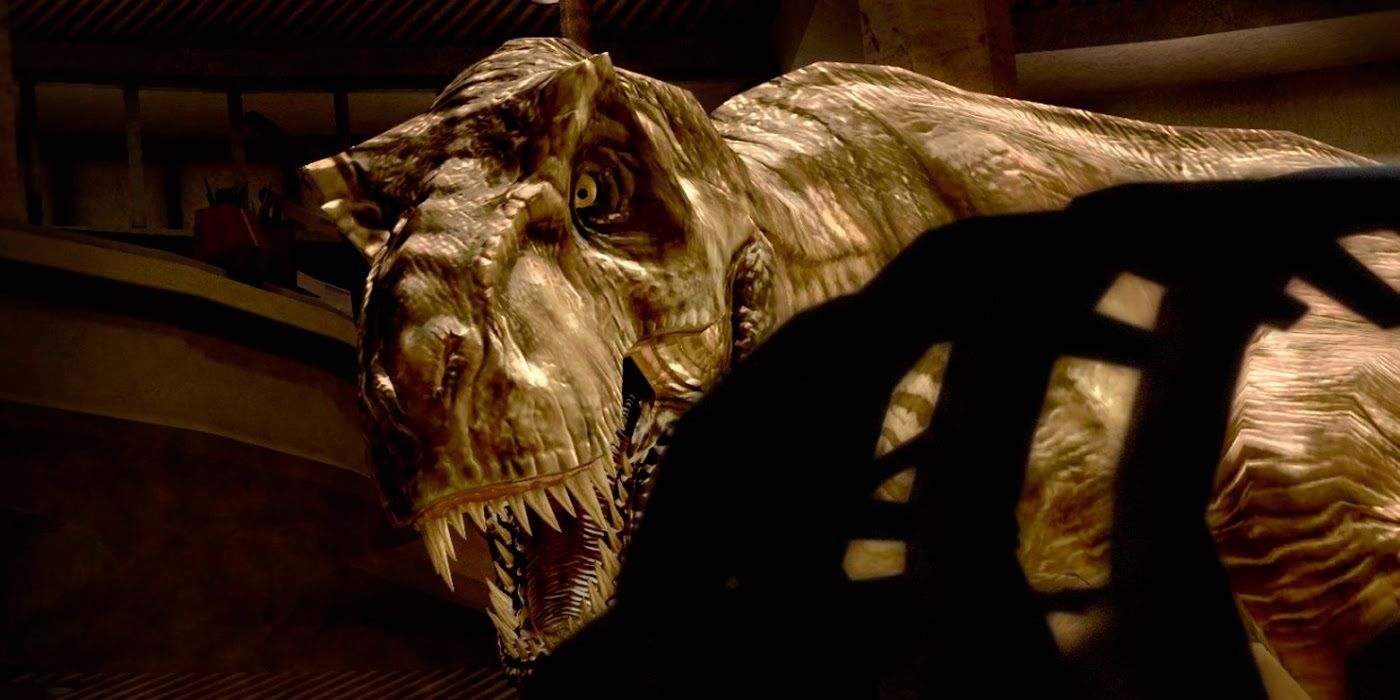
Honestly, if you grew up in the nineties, that first roar in the rain wasn't just a sound effect. It was a core memory. Fast forward through a couple of decades of CGI evolution and questionable plot twists, and we finally got to see the "Grandma" of the series one last time. People call her Rexy. She’s the literal backbone of the series. Seeing Rexy in Jurassic World Dominion felt like a weirdly emotional reunion for fans who have stuck with the property since 1993, even if the movie itself had a lot of moving parts to juggle.
She’s old now. You can see it in her skin. The scars from the raptor fight in the first film are still there, etched into her hide like a history book. It’s kinda wild to think that a digital (and sometimes animatronic) dinosaur has more character development than half the human cast in modern blockbusters.
The Long Journey to the BioSyn Valley
When we find Rexy at the start of the final trilogy's conclusion, she’s basically a fugitive. After the Lockwood Estate disaster in Fallen Kingdom, she spent her time roaming the Pacific Northwest. There’s that famous drive-in theater scene—which was actually a huge part of the marketing—where she just wreaks havoc while people are trying to watch a movie. It’s classic Spielbergian tension, even if Colin Trevorrow was the one behind the lens this time.
But the real meat of the story happens when she gets captured and shipped off to the BioSyn sanctuary in Italy. This wasn't just a plot device to get all the dinosaurs in one place. It was about setting up the ultimate "grudge match" that fans had been arguing about since 2001.
You remember Jurassic Park III, right? The Spinosaurus vs. T-Rex fight? People were furious. It lasted about thirty seconds and our girl lost. Rexy in Jurassic World Dominion was, in many ways, the writers' attempt to give the Tyrannosaurus her crown back, even if they had to introduce a new "Final Boss" to do it: the Giganotosaurus.
The Giganotosaurus Rivalry: More Than Just Teeth
The Giga was marketed as "The Joker" of the dinosaur world. A bit of an exaggeration? Probably. But in the context of the film, it represented a biological rival that the T-Rex couldn't beat on her own. This is where the movie gets a bit divisive. Some people loved the tag-team wrestling match at the end, while others thought it was a bit too "superhero movie."
Basically, Rexy gets her butt kicked for a good portion of the final act. She’s older, she’s slower, and the Giga is just a massive powerhouse. It’s only when the Therizinosaurus—the one with the giant Edward Scissorhands claws—steps in that the tide turns. It’s a messy, brutal, three-way brawl in the middle of a burning research facility.
Is it realistic? Not really. Paleontologists like Steve Brusatte, who consulted on the film, have pointed out that these animals lived millions of years and thousands of miles apart. But in the world of Dominion, it served a thematic purpose. It was about the old world finding a way to survive in a new, corporate-controlled environment.
Why the Animatronics Actually Mattered This Time
One thing Trevorrow and his team did right was leaning back into practical effects. John Nolan’s creature shop built a massive, full-scale animatronic for Rexy. You can feel the weight of it. When the camera lingers on her eye, you aren't just looking at pixels; you're looking at a physical object that’s actually there with the actors.
This makes a huge difference for the performance. Bryce Dallas Howard and Chris Pratt have both mentioned in interviews how much easier it is to act against a giant, breathing machine than a tennis ball on a stick. It brings out a sense of scale that CGI often loses.
- The animatronic weighed several tons.
- It required a team of puppeteers to move the nostrils, eyes, and jaw.
- The skin texture was hand-painted to match the 1993 original, including the specific scarring from "The Big One" (the lead raptor from the first film).
There's a specific shot where Rexy steps through the circular BioSyn logo, perfectly framing her head in the classic Jurassic Park silhouette. It’s a total fan-service moment, but man, it works. It reminds you that despite all the clones and locusts and corporate espionage, the heart of this franchise is a 40-foot carnivore with a legacy.
The "Protos" Flashback Controversy
We have to talk about the prologue. If you saw the movie in theaters, you might have been confused because the coolest part of Rexy’s story was actually cut from the theatrical release. There’s a flashback to 65 million years ago showing the "original" T-Rex being killed by a Giganotosaurus. A mosquito then bites that T-Rex, which—theoretically—is the source of the DNA used to create Rexy in the 90s.
This adds a whole "blood feud" layer to the fight in Dominion. Rexy isn't just fighting a big predator; she's settling a debt 65 million years in the making. Why they cut this from the theatrical version is anyone's guess, but if you're watching the Extended Edition, it makes the finale much more satisfying.
Rexy’s Role in the Larger Jurassic Ecosystem
In the end, Rexy doesn't go back to a cage. She stays in the BioSyn valley, which has been turned into a global sanctuary. The film ends with her encountering two other Tyrannosaurs—presumably the ones from the second movie, The Lost World. It’s a "happily ever after" for a creature that has been poked, prodded, and shot at for three decades.
Rexy in Jurassic World Dominion represents the end of an era. With rumors of a new Jurassic City or Jurassic World 4 always swirling, it’s unclear if we’ll see her again. Honestly? I hope we don't. She’s earned her retirement.
What You Should Do Next
If you're a fan looking to dive deeper into the lore of the BioSyn incident or the specific design choices for the dinosaurs in this film, here are a few actual steps to take:
- Watch the Extended Version: Seriously. The theatrical cut removes the prologue and several character beats that make the T-Rex's arc actually make sense. The extra 14 minutes are vital.
- Check out the "Jurassic World: Chaos Theory" series: While it focuses on the "Nublar Six" kids, it provides a lot of context for what happened to the dinosaurs globally between the movies.
- Read Steve Brusatte’s "The Rise and Fall of the Dinosaurs": He was the consultant for Dominion. If you want to know how the real Giganotosaurus or T-Rex lived, his book is the gold standard.
- Visit the prop exhibits: If you’re ever near Universal Studios, they often have the original molds and animatronic parts on display. Seeing the scale of the Rexy head in person is a reminder of how much work goes into these films.
The legacy of the T-Rex in this franchise is one of survival. From the rain-soaked roads of Isla Nublar to the snowy forests of the Sierra Nevadas, she’s stayed the queen. Dominion might have been a crowded movie, but it gave its biggest star a final bow that respected where she came from.