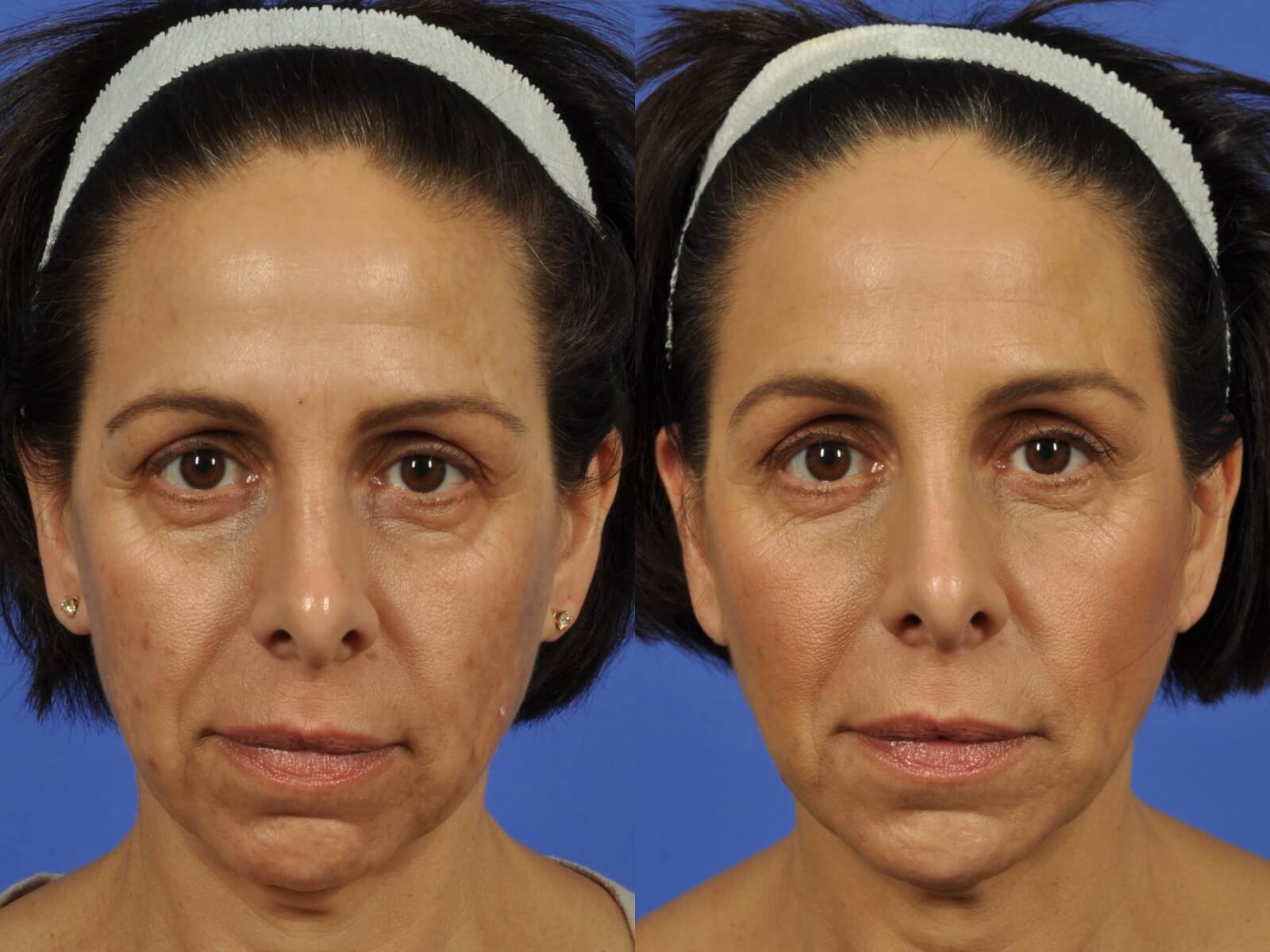
You’ve probably seen them while scrolling Instagram at 2 a.m. One photo shows a person looking like they haven't slept since the Obama administration—deep, dark hollows and purple shadows that make them look permanently exhausted. The "after" photo? Suddenly, they look like they just finished a three-week yoga retreat in Bali. Smooth. Bright. Refreshed. These tear trough filler before after photos are the bread and butter of cosmetic injectors, but honestly, a lot of what you're seeing is complete nonsense.
Lighting is a liar.
If you tilt your head ten degrees toward a ring light, those shadows vanish. If the "before" photo is taken in harsh overhead office lighting and the "after" is shot with a professional softbox, the filler isn't doing the heavy lifting—the photons are. But that doesn't mean the procedure is a scam. When done right, it's actually one of the most transformative non-surgical treatments available. You just have to know what you’re looking at and, more importantly, whether your own face is actually a candidate for it.
The Anatomy of a Tired Eye
The "tear trough" is that deep crease that runs from the inner corner of your eye down toward your cheek. As we get older, several things happen simultaneously. First, the fat pads in our cheeks start to descend. Gravity is rude like that. Second, the skin under the eye—which is already the thinnest on the entire body—gets even thinner. Finally, the orbital bone itself actually recedes slightly over time.
This creates a literal hole.
When light hits that hole, it casts a shadow. That shadow is what you perceive as a "dark circle." Now, here is the kicker: filler only fixes shadows caused by hollowness. If your dark circles are caused by hyperpigmentation (actual brown pigment in the skin) or visible blood vessels (blue/purple tint), filler won't do a damn thing. In fact, it might make it look worse.
Why some people look "puffy" instead of "rested"
Have you ever seen someone who looks like they have little sausages under their eyes? That’s often a result of poor patient selection or the wrong product. The under-eye area is incredibly unforgiving. Unlike the cheeks or chin, where you want a thick, structural gel, the tear trough requires something thin and "hydrophilic-neutral."
If an injector uses a product that loves to drink up water—like certain high-G-prime hyaluronic acids—the area will swell. You’ll wake up looking like you’ve been crying for three days straight. This is why looking at tear trough filler before after photos requires a skeptical eye. You want to see the "after" shot at least two weeks post-injection, not immediately after when the swelling is providing a temporary (and fake) sense of fullness.
Real Experts and the "Tyndall Effect"
Dr. Gavin Chan, a well-known cosmetic physician who has spent years debunking filler myths, often points out that filler in the tear trough can last way longer than the "6 to 12 months" advertised on the box. In some cases, MRI scans have shown filler still sitting under the eye five or ten years later.
This leads to the "Tyndall Effect."
This is a physical phenomenon where light scatters as it passes through a clear substance (the filler) sitting too close to the surface of the skin. It creates a weird, bluish bruise-like tint that never goes away with concealer. If you see an "after" photo where the area looks slightly blue or ghostly, that’s a botched job, even if the hollow is gone.
The Mid-Cheek Connection
You can't talk about the eyes without talking about the cheeks. Most high-end injectors won't even touch your tear troughs until they’ve addressed the "mid-face." Think of it like a bridge. If the pillars of the bridge (your cheekbones) have crumbled, you can’t just keep patching the road (the tear trough). Often, by adding a little volume to the upper cheek, the tear trough naturally smooths out without needing a single drop of product directly under the eye.
How to Read Tear Trough Filler Before After Photos Like a Pro
When you are hunting for a provider, don't just look at the "wow" factor. Look for the technical details.
- Check the chin angle. Is the patient tucking their chin in the before and lifting it in the after? If the chin is higher in the after photo, the shadows will naturally disappear because of the light source.
- Look at the lower lash line. Real results often show a slight improvement in the transition between the eye and the cheek. If the area looks "flat" like a piece of paper, it’s probably overfilled.
- The "Smile Test." Filler might look great when the face is still. But what happens when the person laughs? If the filler bunches up into a weird lump, it wasn't placed deeply enough under the muscle (the orbicularis oculi).
The Scary Stuff: Risks Nobody Mentions
Let's get serious for a second. The under-eye area is a high-risk zone. There are vital arteries here that connect to the blood supply for the retina. If an untrained injector accidentally hits a vessel and injects filler into it, it can cause "vascular occlusion," which in the worst-case scenario leads to permanent blindness.
It’s rare. Like, incredibly rare. But it’s not zero.
This is why you don't go to a "filler party" at a hair salon for this. You want someone who knows facial anatomy better than they know their own kids. Most top-tier pros now use a cannula—a blunt-tipped needle—instead of a sharp one. A cannula is less likely to pierce a blood vessel and usually results in much less bruising. If you see tear trough filler before after photos where the patient has zero bruising immediately after, they probably used a cannula.
When Filler Isn't the Answer
Sometimes, the "before" photo shows something that filler can't fix: festoons or malar bags. These are little pockets of fluid or fat that sit on the cheekbone. If you put hyaluronic acid (which attracts water) near a festoon, you are basically pouring gasoline on a fire.
In those cases, the "after" photo you actually want to see involves a lower blepharoplasty. That’s a surgical procedure where a doctor removes or repositions the actual fat pads. It’s more expensive, yeah, but it’s permanent and won’t leave you looking like a Cabbage Patch Kid.
Pricing and Reality
Expect to pay anywhere from $600 to $1,500 per syringe depending on where you live. Most people only need one syringe split between both eyes. If a clinic is offering a "buy one get one free" deal on tear trough filler, run. Fast. This is medical art, not a grocery store promotion.
Actionable Steps for Your Consult
If you're ready to move past looking at photos and actually want to do it, here is how you handle the consultation so you don't get swindled.
First, do the "Mirror Test." Stand in a room with overhead lighting. If the circles are there, they are shadows. Now, take a hand mirror and tilt your face up toward the light. If the circles disappear, filler will help. If they stay dark even when the light hits them directly, it’s pigment, and you need a laser or a chemical peel, not an injection.
Second, ask about the "Dissolve Plan." Ask your injector: "How many times have you had to use Hyaluronidase (the eraser for filler) this month?" A good injector isn't afraid to dissolve their own work—or someone else’s—if it doesn't look right. If they act like their work is perfect and never needs adjusting, find someone else.
Third, demand to see "Late-Stage" photos. Ask to see tear trough filler before after photos from six months post-treatment. Anyone can make a face look good for a photo five minutes after the needle comes out. The real test is how that product integrates with your tissues over half a year of blinking, smiling, and sleeping.
Finally, manage your expectations. Filler is a "softening" agent. It's not a Photoshop "content-aware fill" tool. You will still have some texture under your eyes. You will still have a face that moves. The goal is to look like you've had a really great nap, not like you've been replaced by a wax figure.
Check for board certification (look for American Board of Cosmetic Surgery or similar reputable bodies), read the negative reviews—not just the five-star ones—and always prioritize safety over a cheap price tag. Your eyes are literally the most delicate part of your face; treat them that way.