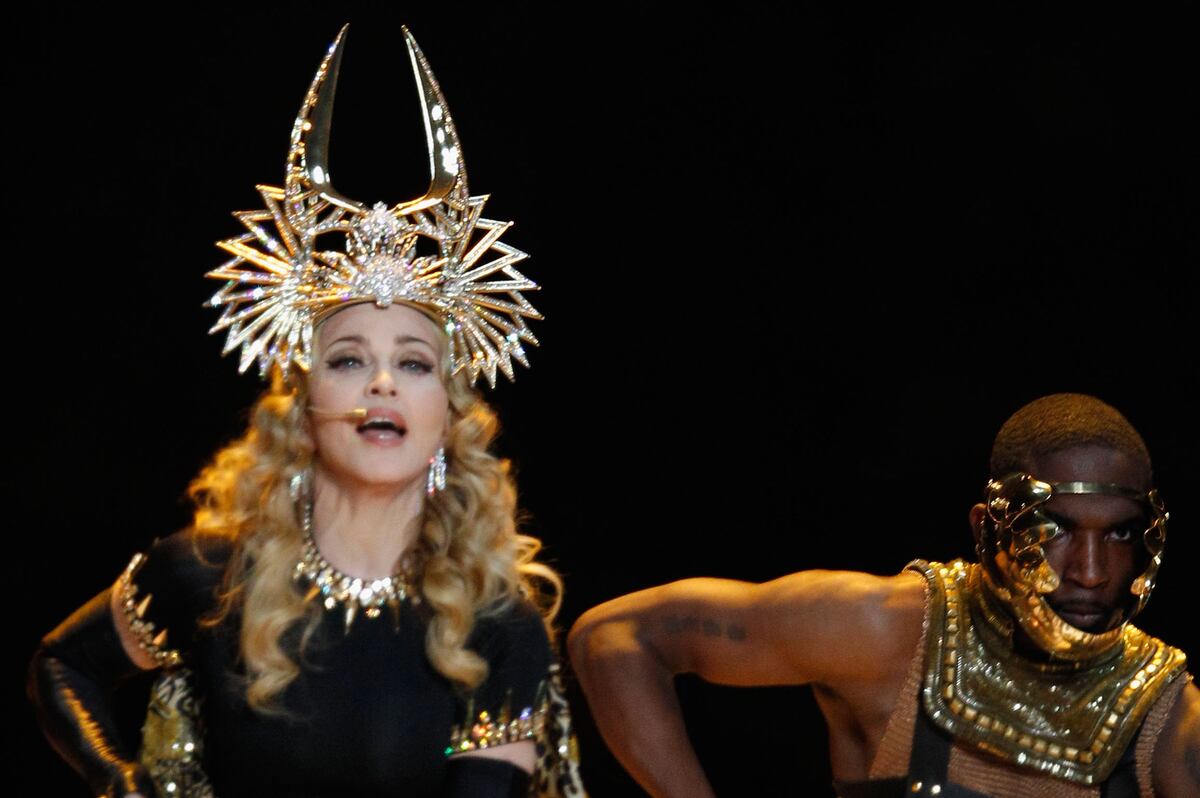
It was February 5, 2012. Indianapolis was freezing. Inside Lucas Oil Stadium, everyone was waiting for the Material Girl. Madonna hadn't been on a stage this big in years. People were skeptical. Could a 53-year-old pop icon still command a room full of football fans and casual viewers? Honestly, she didn't just command it; she basically rewrote the blueprint for what a "modern" halftime show looks like. Before this, we had a string of "safe" classic rock acts—The Who, Tom Petty, Bruce Springsteen. Great musicians, sure. But they weren't spectacles. The 2012 Super Bowl halftime show changed the math. It moved us away from the post-Janet Jackson "wardrobe malfunction" era of playing it safe and shoved us headfirst into the era of the viral, multi-guest mega-production.
The show started with an entrance that would make Cleopatra blush. Hundreds of gladiators pulling a massive gold chariot. It was heavy. It was loud. It was campy as hell. When Madonna stepped out in those thigh-high boots, it felt like a statement. She wasn't there to just sing "Vogue." She was there to remind everyone that she was the architect of the modern pop star.
The Guest List That Broke the Internet (Almost)
Madonna didn't go it alone. That’s kinda the secret sauce of the 2012 Super Bowl halftime show. She brought out LMFAO, Nicki Minaj, M.I.A., and CeeLo Green. Think about that lineup for a second. It was a chaotic mix of Top 40 dominance and indie-rebel energy.
The collaboration with LMFAO was basically a fever dream of shuffling and neon. But then things got real when M.I.A. and Nicki Minaj joined for "Give Me All Your Luvin'." This is where the night took a turn that the NFL definitely didn't plan for in their rehearsal notes. M.I.A. gave the camera the middle finger. Just a quick flash. A split second of rebellion in the middle of a billion-dollar broadcast. The NFL and NBC went into a tailspin. They tried to blur it, but they were too slow. It resulted in a multi-year legal battle that felt way more serious than a finger should ever be. M.I.A. later argued she was "invoking a goddess," but the league saw it as a breach of contract. It’s funny looking back—compared to what goes viral now, it was nothing. But in 2012? It was a scandal.
Why the Production Value Mattered
We have to talk about the floor. The stage was actually a giant LED screen provided by a company called Tait Towers. This wasn't standard back then. Usually, you just had some lights and maybe some pyrotechnics. But the 2012 Super Bowl halftime show used the ground itself as a canvas. When Madonna sang "Like a Prayer" with CeeLo Green and a full gospel choir, the floor looked like it was cracking open to reveal a world of light. It was immersive. It made the stadium feel small and the performance feel massive.
The choreography was handled by Jamie King, who has worked with everyone from Prince to Britney Spears. He utilized slacklining—remember that trend?—with a performer named Andy Lewis. Watching a guy bounce on a thin piece of webbing while Madonna danced a few feet away was terrifying and brilliant. It added a layer of "anything could happen" to a broadcast that is usually scripted to death.
The Setlist Strategy
Madonna was smart. She didn't just play the new stuff. She knew the audience.
- Vogue: The opener. Pure fashion. Pure 80s nostalgia.
- Music / Party Rock Anthem: The bridge. Connecting her 2000s hits with the current "shuffling" craze.
- Give Me All Your Luvin’: The promotion. She had a new album, MDNA, coming out.
- Open Your Heart / Express Yourself: The medley.
- Like a Prayer: The closer. Total emotional payoff.
This structure is now the industry standard. Look at Katy Perry or Lady Gaga’s shows years later. They all follow the Madonna 2012 map: start with a legacy hit, bring out the "it" artists of the moment, and finish with a spiritual or anthemic sing-along.
The Impact on the "Pop Era" of Halftimes
Before Madonna, the NFL was scared. They were still reeling from the 2004 incident with Justin Timberlake and Janet Jackson. Their solution for nearly a decade was to hire older men with guitars. Paul McCartney, The Rolling Stones, Prince (who was incredible, obviously). But they were missing the youth demographic. They were missing the "Discover" feed of 2012, even if it didn't exist in the same way yet.
The 2012 Super Bowl halftime show proved that you could have a high-concept pop show that appealed to everyone. It pulled in 114 million viewers. That was actually higher than the viewership for the game itself (the Giants vs. the Patriots). Let that sink in. More people tuned in to see Madonna dance with a slackliner than to see Tom Brady try to win another ring. That changed the leverage. Suddenly, the halftime show wasn't just a bathroom break. It was the main event for a huge portion of the planet.
Challenges and Technical Hurdles
It wasn't all smooth sailing. Madonna actually hurt her hamstring during rehearsals. You can see it if you watch closely—she's a bit more cautious on the stairs than usual. But she's a pro. She masked it. There was also the issue of the "shouter" or the "glitch" in the audio during the first few seconds of "Vogue." Live TV is a nightmare for sound engineers. They were mixing a choir, a rock band, electronic backing tracks, and multiple live mics in a cavernous stadium.
The fact that it sounded as good as it did is a miracle of modern engineering. They used a massive Sennheiser wireless system that had to fight through the interference of thousands of cell phones in the stands. Nowadays, we take for granted that the sound will be crisp. In 2012, it was a tech gamble every single time the lights went down.
The Cultural Shift
We also saw the beginning of "guest star fatigue" start here. While Nicki and M.I.A. worked, some critics felt it was too crowded. Do we really need LMFAO? Probably not. But the NFL loves a "something for everyone" approach. Madonna understood that she was a vessel for the brand as much as she was an artist.
What We Can Learn From 2012
If you're looking at this from a marketing or production standpoint, the 2012 Super Bowl halftime show is a masterclass in brand reinvention. Madonna wasn't the "current" girl on the radio in 2012—Adele and Rihanna were. But Madonna used the platform to prove she was still the boss.
She also showed that controversy, even if unplanned (the M.I.A. finger), keeps a performance alive in the press for weeks. The NFL hated it, but the "buzz" was undeniable. It made the halftime show "must-see TV" again. You couldn't look away because you didn't know what might happen.
Actionable Insights for Fans and Creators
If you're a student of pop culture or someone who works in events, there are a few things to take away from this specific performance.
- Visuals over everything: In a stadium that big, your face doesn't matter as much as the shape of the stage. Use the floor. Use the height.
- Strategic Collaboration: Don't just pick guests because they're famous. Pick them because they represent a demographic you don't already have. Madonna had the 40-somethings; she needed the kids who liked LMFAO.
- The Medley is King: Nobody wants to hear the full 5-minute version of a song at halftime. They want the hooks. Get in, hit the chorus, and get out.
- Control the Narrative: Even with the M.I.A. hiccup, Madonna’s team was quick to pivot back to the success of the performance.
The 2012 Super Bowl halftime show remains a high-water mark for production. It was the moment the NFL stopped being a football league that had music, and started being a global entertainment platform that happened to play football in the middle of it. If you haven't watched it in a while, go back and look at the "Like a Prayer" finale. Even with the lower resolution of 2012 cameras, the scale is still breathtaking. It's a reminder that pop music, when done with enough budget and enough ego, is a legitimate art form.
To really understand the current state of the Super Bowl, you have to start with Madonna in Indianapolis. It was the spark that lit the fire for the massive, high-tech, star-studded spectacles we expect every February now. Without her, we might still be watching classic rock bands play their greatest hits while the audience grabs a snack. Instead, we're glued to the screen, waiting for the next "finger" or the next "left shark." Madonna started that.