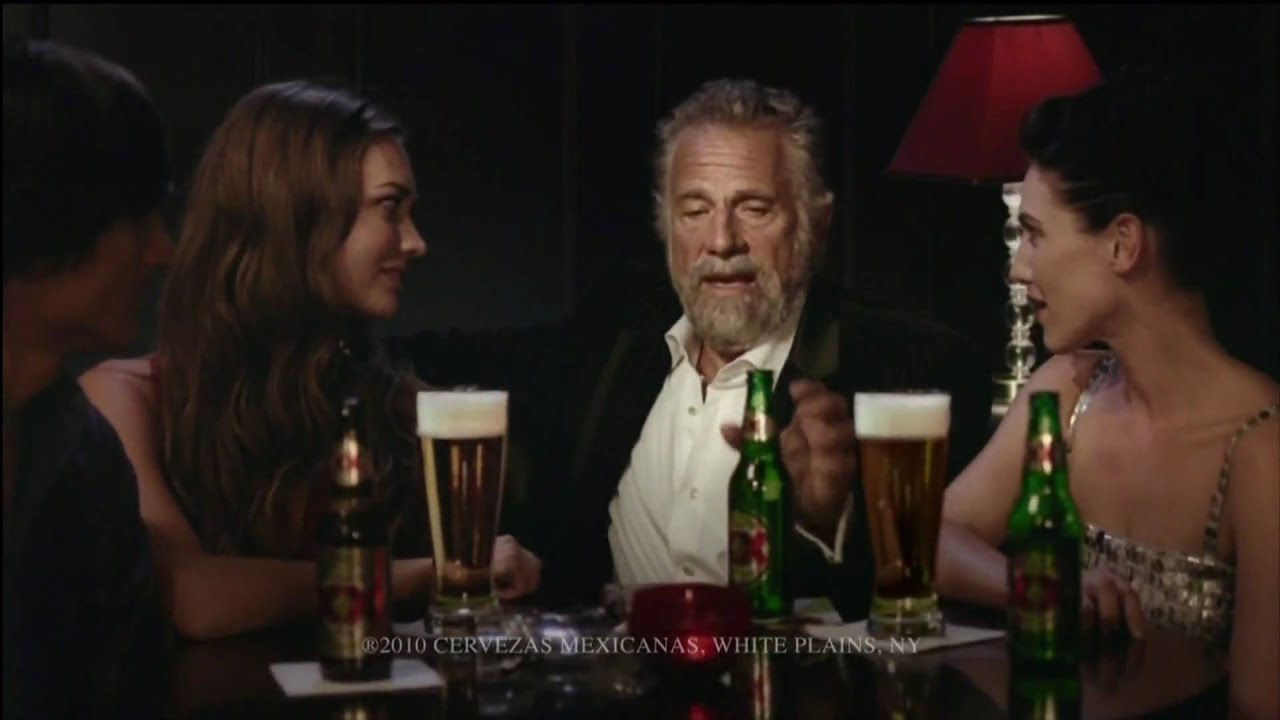
He was the only man to ever have an emotional conversation with a psychic... and the psychic learned something.
That’s how it started. In 2006, a brand that was basically an afterthought in the Heineken USA portfolio decided to stop acting like a beer company and start acting like a storyteller. The Dos Equis beer commercial didn't just sell lager; it sold a persona so absurdly confident that it became a global shorthand for "cool." Honestly, before Jonathan Goldsmith stepped into those tailored suits, Dos Equis was just another green-bottle import sitting in the shadow of Corona. Then came "The Most Interesting Man in the World."
It changed everything.
The campaign, dreamed up by the legendary Euro RSCG (now Havas Worldwide), was a massive gamble on irony. Most beer ads at the time were stuck in a loop of "hot people at a beach party" or "guys watching football in a bar." Dos Equis did the opposite. They gave us an older, sophisticated, silver-haired protagonist who wrestled sharks, played Jai Alai, and freed grizzly bears from traps. It worked because it was funny, sure, but it also tapped into a very specific masculine aspiration that wasn't about being a "bro."
The Man Behind the Legend: Jonathan Goldsmith
People often forget that Jonathan Goldsmith wasn't some A-list star found on a Hollywood lot. He was a veteran character actor who had spent decades playing villains in Westerns and guest-starring on Star Trek. When he walked into the audition, the brief asked for a character like Hemingway—someone with lived-in gravitas. Goldsmith, who was reportedly living on a sailboat at the time, channeled his friend Fernando Lamas and improvised the iconic line: "I don't always drink beer, but when I do, I prefer Dos Equis."
He was perfect.
The brilliance of his performance was the deadpan delivery. He never winked at the camera. He never let the audience in on the joke. Whether he was winning a game of chess against a computer that wasn't plugged in or hand-feeding a hawk, he played it straight. This gave the Dos Equis beer commercial a level of "re-watchability" that was unheard of in the mid-2000s. You weren't just watching an ad; you were waiting for the next "fact" about his life.
Why the "Most Interesting Man" Strategy Actually Worked
From a business perspective, the numbers were staggering. Between 2006 and 2011, Dos Equis saw its sales triple in certain markets. While the rest of the imported beer category was struggling to stay flat, Dos Equis was seeing double-digit growth year after year.
Why? Because they understood "Social Currency."
Long before TikTok challenges and viral memes were the primary goal of every marketing department, the Dos Equis beer commercial was built to be quoted. "Stay thirsty, my friends" became a cultural catchphrase. It wasn't just about the beer; it was about the identity associated with the beer. If you drank Dos Equis, you were signaling that you were in on the joke. You were sophisticated, adventurous, and maybe a little bit dangerous.
It was a masterclass in positioning.
The campaign also solved a major problem for the brand: how do you sell a Mexican beer to people who aren't at a Mexican restaurant? By making the brand about the man rather than the origin, Dos Equis moved into the "lifestyle" category. It became the beer for the guy who travels, the guy who reads, and the guy who knows how to fix a vintage motorcycle.
The Tricky Transition to Augustin Legrand
Nothing lasts forever, though. In 2016, the brand decided to "refresh" the campaign. They sent Jonathan Goldsmith on a one-way mission to Mars (literally, in the ad) and brought in a younger, more active version of the character played by French actor Augustin Legrand.
It was a polarizing move.
Legrand's version of the Most Interesting Man was more of a "doer." He was seen scuba diving, sprinting through ruins, and being physically intense. The problem? He lacked the mystical, effortless charm of Goldsmith. The original character was interesting because he didn't have to try. The new guy looked like he was trying very hard.
Marketing experts like Mark Ritson have often pointed out that when you have a "fluent device"—a recognizable character or symbol that drives brand recognition—you should be very careful about changing it. Dos Equis eventually moved away from the "Most Interesting Man" format entirely around 2018, pivoting toward more traditional sports-focused marketing and their "Get a Dos" campaign.
The Anatomy of the Perfect Ad Script
If you look back at the original scripts, they followed a very rigid, yet creative, three-part structure.
- The Hyperbolic Feat: A montage of grainy, vintage-style footage showing the Man doing something impossible (e.g., "He can speak French... in Russian").
- The Product Statement: The "I don't always drink beer..." line, which served as a soft-sell.
- The Call to Action: "Stay thirsty, my friends."
This structure allowed the writers to be infinitely creative while keeping the brand message consistent. It’s a formula that many have tried to copy—think of the Old Spice "The Man Your Man Could Smell Like" campaign—but few have executed with the same longevity.
What We Can Learn From the Dos Equis Legacy
The Dos Equis beer commercial taught the industry that humor and "cool" aren't mutually exclusive. It showed that you could talk down to your audience—in a playful way—and they would love you for it. The Man wasn't a "relatable" guy. He was an "aspirational" guy.
In a world where brands are constantly trying to be "just like you," there is still a massive opportunity for brands that want to be "better than you."
The legacy of these ads isn't just in the sales spikes or the awards. It's in the way we talk about branding. When people say they want to make something "the Most Interesting Man of [Industry]," everyone knows exactly what that means. It means high-concept, character-driven storytelling that doesn't take itself too seriously but takes its brand image very seriously indeed.
If you’re looking to apply these lessons to your own brand or just want to appreciate the craft, here is the move.
Start by looking at your "fluent devices." Do you have a recurring character, a specific color palette, or a tagline that people actually remember? If not, you're just making noise. The Dos Equis beer commercial succeeded because it picked a lane and stayed in it for a decade. It didn't chase trends. It created one.
Next, audit your brand's "voice." Is it too safe? Dos Equis succeeded because it was willing to be weird. Telling people your spokesperson is "the only man to ever ace a Rorschach test" is weird. But it's memorable. In the attention economy, being memorable is more valuable than being "correct."
Finally, look at the transition. When Dos Equis changed their lead actor, they lost the "soul" of the campaign. This happens in business all the time when a founder leaves or a brand tries to "rebrand" for a younger audience without understanding what the older audience loved. Consistency is the most underrated virtue in marketing.
Stay thirsty for better content.
Actionable Insights for Brand Storytellers:
- Identify Your Hemingway: Find a spokesperson or brand persona that embodies the values of your product rather than just its features.
- Embrace the Hyperbole: Don't be afraid to use exaggeration to make a point. If your product is "reliable," don't just say it—show it surviving a volcano.
- The Power of the Catchphrase: Create a closing line that feels like a piece of advice or a blessing rather than a sales pitch. "Stay thirsty" is an invitation to a lifestyle.
- Know When to Hold 'Em: If a campaign is working, don't change it just because you are bored of it. Your audience likely isn't.